
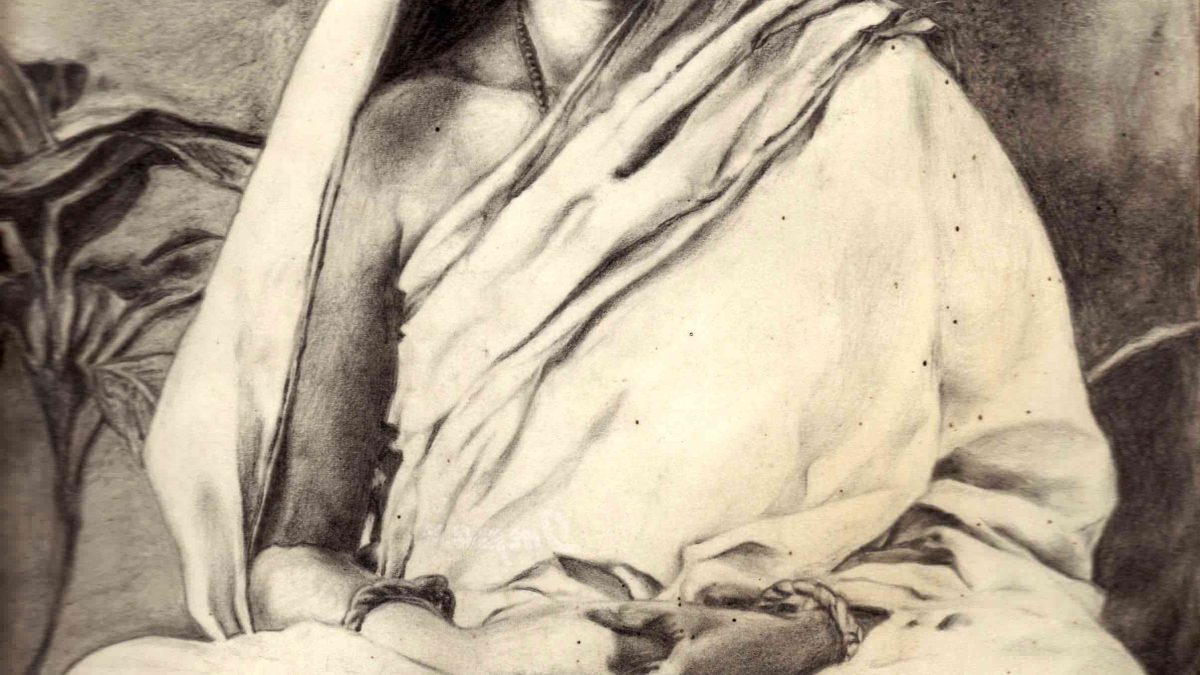
Sarada Devi (22 December 1853 – 21 July 1920), born Saradamani Mukhopadhyay and revered as the Holy Mother, Sri Ma, was the wife and spiritual companion of Ramakrishna Paramahamsa. An unlettered village woman, she became after his death the centre of the movement that grew up in his name, advising its monks, initiating disciples and giving it a character of practical kindness. For followers of the Ramakrishna tradition she is an embodiment of the motherhood of God.
Quick Facts
| Birth name | Saradamani Mukhopadhyay |
| Born | 22 December 1853, Jayrambati, Bankura district, Bengal |
| Died | 21 July 1920 (aged 66), Calcutta |
| Known as | Holy Mother (Sri Ma) |
| Spouse | Ramakrishna Paramahamsa |
| Associated with | Ramakrishna Math and Mission; Udbodhan House, Calcutta |
| Legacy | Sri Sarada Math and Ramakrishna Sarada Mission |
Early Life
She was born at Jayrambati, a small village in Bankura, the eldest child of a poor Brahmin farmer and priest. She had no schooling and from an early age helped in the fields, fed the cattle and looked after her younger brothers. During a famine she helped her parents feed the starving who came to their door. At five she was betrothed, as was the custom, to Gadadhar Chattopadhyay of the neighbouring village of Kamarpukur, then twenty-three and already known for his religious absorption. He returned to Dakshineswar and she remained with her parents.
Dakshineswar
Hearing rumours as she grew up that her husband had gone mad, she set out in 1872, at eighteen, to see for herself, walking most of the sixty miles. She found him sane and gentle. He taught her everything from spiritual practice to how to trim a lamp and judge people’s characters, and one night that year he performed a ceremony in which he worshipped her as the Divine Mother. Their relationship remained celibate.
For more than a decade she lived in a tiny room at the base of the music tower in the temple garden, rising hours before dawn, cooking for her husband and the growing stream of his visitors, and spending the day behind a bamboo screen. Few of his disciples saw her face. He said that she was the embodiment of the same power he worshipped in the temple, and he entrusted his work to her.
The Holy Mother
After his death in 1886 she went on pilgrimage and then lived at Kamarpukur in such poverty that she sometimes had only rice and greens. The disciples learned of it and brought her to Calcutta. From then on she divided her time between Jayrambati and the city, where in 1909 the monks built a house for her, known as the Mother’s House, which also held the office of the order’s Bengali journal.
The young monks, including Swami Vivekananda, sought her blessing before any major step; he would not sail for America in 1893 until he had it. She settled their disputes, approved the mission’s turn to social service and reminded them that feeding the hungry came before building temples. She gave spiritual initiation to a great many people, monks and householders, and continued to cook, sweep and nurse the sick members of a large and quarrelsome household of relatives.
Teaching
She wrote nothing. Her teaching was her conduct and a few plain sayings. She made no distinction of caste or creed: when others objected that a Muslim labourer of bad reputation was eating at her house, she replied that he was as much her son as one of the leading monks. She welcomed Western women disciples such as Sister Nivedita and supported the school for girls that Nivedita founded. Shortly before her death she told a grieving devotee: if you want peace, do not find fault with others; learn to make the whole world your own; no one is a stranger.
Death and Legacy
She died in Calcutta on 21 July 1920 and was cremated at Belur Math, where a temple marks the spot. In 1954, the centenary of her birth, a monastic order for women, Sri Sarada Math, was founded in her name. Her village home at Jayrambati is a place of pilgrimage.
Frequently Asked Questions
When and where was Sarada Devi born?
Sarada Devi was born on 22 December 1853 in Jayrambati, Bankura district, Bengal.
When did Sarada Devi die?
Died: 21 July 1920 (aged 66), Calcutta.
Featured image: Sarada Devi, pencil sketch after a well-known photograph. Photo by Saptarshi Ghosh, in the public domain, via Wikimedia Commons.



