
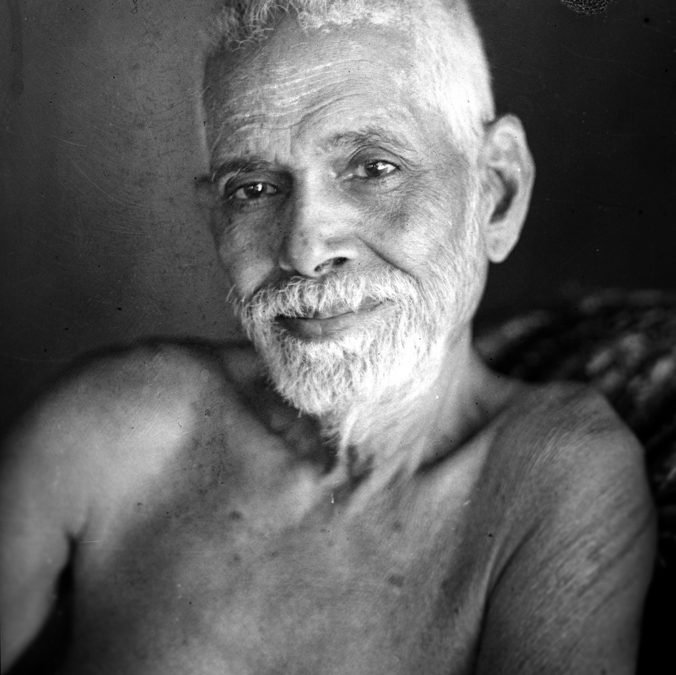
Ramana Maharshi (30 December 1879 – 14 April 1950), born Venkataraman Iyer, was an Indian sage who lived for fifty-four years at Tiruvannamalai in Tamil Nadu, at the foot of the hill Arunachala. At sixteen he underwent an experience that he described as the death of the sense of a separate self, and he left home for the hill and never went away from it. He taught, largely through silence and brief answers, the practice of self-enquiry summed up in the question “Who am I?”. He is among the most widely revered Indian spiritual figures of modern times.
Quick Facts
| Birth name | Venkataraman Iyer |
| Born | 30 December 1879, Tiruchuli, near Madurai, Tamil Nadu |
| Died | 14 April 1950 (aged 70), Tiruvannamalai, Tamil Nadu |
| Known as | Bhagavan Sri Ramana Maharshi |
| Occupation | Sage, spiritual teacher |
| Teaching | Self-enquiry (atma-vichara) |
| Associated with | Arunachala; Sri Ramanasramam, Tiruvannamalai |
| Works | Nan Yar? (Who am I?), Upadesa Saram, Ulladu Narpadu |
Early Life
He was born at Tiruchuli, a village south of Madurai, the second son of Sundaram Iyer, a pleader in the local court. He was an ordinary schoolboy, strong, fond of games and a notably heavy sleeper. His father died in 1892, and the boys were sent to live with an uncle in Madurai, where Venkataraman attended a mission school.
The Experience at Sixteen
In July 1896, sitting alone in an upstairs room of his uncle’s house, he was seized by a sudden and violent fear that he was about to die. Instead of calling for help he lay down, held his breath and limbs rigid like a corpse, and asked himself what it was that dies. The body would be carried to the burning ground; but was he the body? He said afterwards that he knew at that moment, as a direct fact and not as a thought, that the “I” was something that death could not touch, and that the fear vanished for good.
He lost interest in lessons, friends and food. Six weeks later, on 29 August, he took a few rupees, left a note saying that he had gone in search of his Father and that no one need look for him, and boarded a train. On 1 September 1896 he reached Tiruvannamalai, went straight to the great temple of Arunachaleswara, threw away his remaining money and his sacred thread and had his head shaved.
Arunachala
For the first years he sat in various parts of the temple, including an underground vault where insects ate into his legs unnoticed, absorbed and silent, kept alive by people who put food in his mouth. In 1899 he moved up the hill to the Virupaksha cave, where he stayed for seventeen years, and then to a higher hermitage. His family found him in 1898; he would not return. His mother came to live with him in 1916 and his younger brother followed. When she died in 1922 she was buried at the foot of the hill, and the settlement that grew around her shrine became Sri Ramanasramam.
In 1907 the Sanskrit scholar Ganapati Muni, having received from him an answer that resolved his doubts, declared that he should be known as Bhagavan Sri Ramana Maharshi.
Teaching
He said that his real teaching was silence. For those who needed words he taught self-enquiry: to turn attention to the feeling “I” and trace it to its source, asking “Who am I?” whenever a thought arises, until the individual “I” subsides and what remains is the Self, which is pure awareness. For those who found this hard he recommended surrender to God, which he held came to the same thing. He belonged to no order, initiated no one formally, and did not travel or lecture.
His earliest written answers, given on a slate to a questioner about 1902, were published as Nan Yar? (“Who am I?”). He composed a small number of Tamil poems and treatises, among them Upadesa Saram, Ulladu Narpadu (“Forty Verses on Reality”) and hymns to Arunachala.
The Ashram
He lived in a single hall open to visitors at all hours, rose before dawn to cut vegetables in the kitchen, and insisted that he be given nothing that was not given to all. Animals were treated as residents; a cow, a dog, a crow and a deer have graves in the ashram. The English journalist Paul Brunton’s book A Search in Secret India (1934) brought seekers from Europe and America.
Death and Legacy
A cancerous growth appeared on his left arm in 1949 and returned after several operations. To devotees who wept he said, “They say I am going away; where could I go? I am here.” He died on the evening of 14 April 1950. The ashram at Tiruvannamalai continues to receive visitors from across the world, and his teaching has become the main source of the modern revival of the philosophy of non-duality.
Featured image: Ramana Maharshi, photographed by G. G. Welling in 1948. Photo by G. G. Welling, in the public domain, via Wikimedia Commons.



