
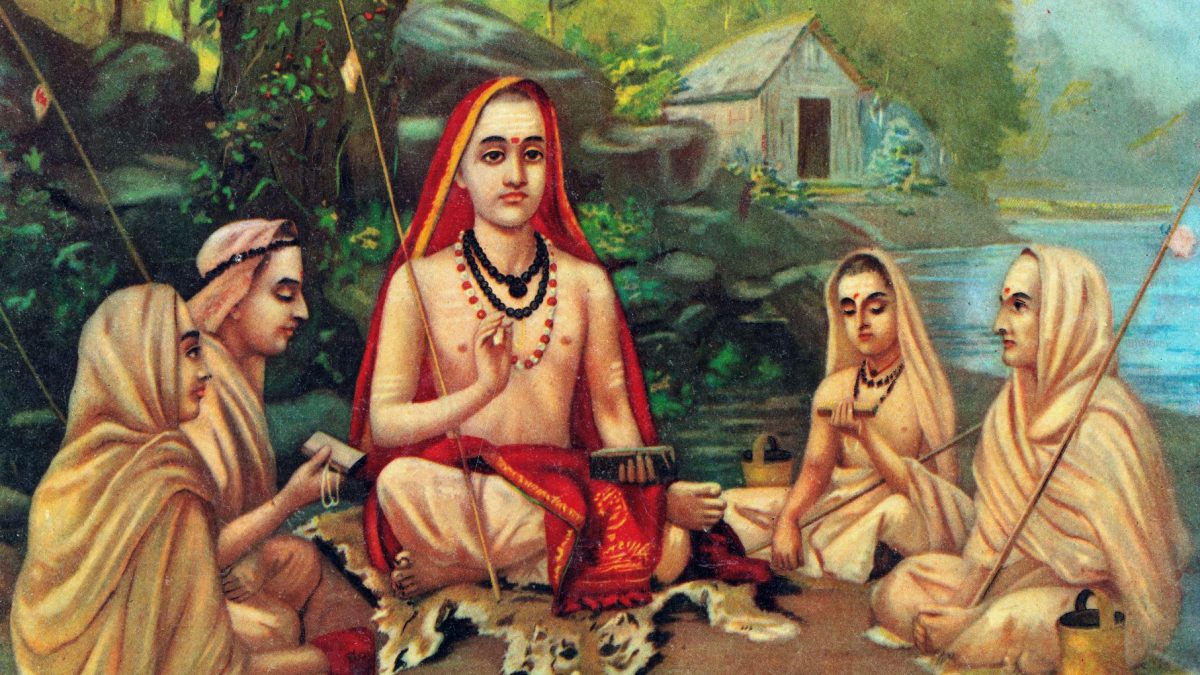
Adi Shankara, also called Shankaracharya (traditionally 788–820 CE), was an Indian philosopher and theologian who gave the doctrine of Advaita Vedanta, non-dualism, its classic form. Born at Kaladi in present-day Kerala, he is said to have travelled the length of India in a short life of thirty-two years, debating scholars of rival schools, writing commentaries on the central Hindu scriptures and founding monasteries at the four corners of the country. His dates are traditional, and much of what is told about his life comes from biographies written centuries after his death.
Quick Facts
| Name | Adi Shankara (Shankaracharya) |
| Born | Traditionally 788 CE, Kaladi, Kerala |
| Died | Traditionally 820 CE (aged 32), Kedarnath |
| Occupation | Philosopher, theologian, monk |
| School | Advaita Vedanta |
| Teacher | Govinda Bhagavatpada |
| Notable works | Commentaries on the Brahma Sutras, principal Upanishads and Bhagavad Gita; Upadeshasahasri |
| Known for | Four mathas at Sringeri, Dwarka, Puri and Jyotirmath |
Early Life
According to the traditional accounts he was born into a Nambudiri Brahmin family at Kaladi, on the bank of the Periyar river. His father, Shivaguru, died when he was a small child, and he was brought up by his mother, Aryamba. He is said to have mastered the Vedas by the age of eight and to have longed to become a monk. A well-known story tells that a crocodile seized his leg while he was bathing in the river, and that he called to his mother to let him renounce the world in his last moments; when she agreed, the crocodile let him go.
He left home and travelled north to the Narmada, where he became the disciple of Govinda Bhagavatpada, himself a pupil of Gaudapada, the author of an early Advaita text.
Philosophy
Shankara taught that Brahman, pure consciousness without attributes, is the only reality, and that the individual self, Atman, is not different from it. The world of many things and separate selves is neither fully real nor wholly unreal; it is an appearance, like a rope mistaken for a snake in poor light, sustained by ignorance. Liberation is not something to be produced by ritual or reached in another world. It is the removal of that ignorance through knowledge, and the scriptures, a teacher and disciplined reflection are the means.
He distinguished two levels of truth, the everyday and the ultimate, which allowed him to accept worship and ethical action as preparation of the mind while denying them final authority.
Works
His standing rests on his commentaries on what are called the three foundations of Vedanta: the Brahma Sutras, the principal Upanishads and the Bhagavad Gita. The Upadeshasahasri, “A Thousand Teachings”, is generally accepted as his own independent treatise. A great many other works carry his name, including the Vivekachudamani and devotional hymns such as “Bhaja Govindam” and the Saundarya Lahari; scholars doubt that all of them are his.
Travels and Institutions
Tradition describes a tour of the whole country in which he defeated in debate the champions of ritualism, Buddhism and other schools. The most famous contest was with Mandana Mishra, a great scholar of ritual, with Mishra’s wife as judge. He is credited with establishing four monasteries, at Sringeri in the south, Dwarka in the west, Puri in the east and Jyotirmath in the north, each under one of his chief disciples, and with organising Hindu monks into ten orders. He is also said to have returned to Kaladi to perform his mother’s funeral rites, against the rule for monks, as he had promised her. He is believed to have died at Kedarnath in the Himalayas.
Legacy
Advaita became the most influential school of Hindu philosophy, and later thinkers such as Ramanuja and Madhva defined their positions against it. The heads of the monasteries he founded still bear the title Shankaracharya. In the modern period Swami Vivekananda and Sarvepalli Radhakrishnan presented his thought to the world as the heart of Hinduism. Kaladi is a place of pilgrimage, and Kerala’s Sanskrit university there is named after him.
Frequently Asked Questions
When and where was Adi Shankara born?
Birth details: Traditionally 788 CE, Kaladi, Kerala.
When did Adi Shankara die?
Died: Traditionally 820 CE (aged 32), Kedarnath.
What is Adi Shankara known for?
Known for: Four mathas at Sringeri, Dwarka, Puri and Jyotirmath.
Featured image: Adi Shankara with his disciples, painting by Raja Ravi Varma, about 1904. Photo by Raja Ravi Varma, in the public domain, via Wikimedia Commons.



