
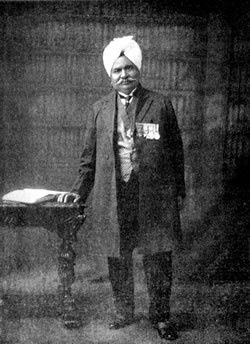
Sir Ganga Ram (13 April 1851 – 10 July 1927) was an Indian civil engineer, agriculturist and philanthropist of the undivided Punjab. As a government engineer he designed many of the finest public buildings of Lahore and is called the father of the modern city. In retirement he reclaimed tens of thousands of acres of wasteland by irrigation, made a fortune, and gave almost all of it away. Hospitals founded in his name serve Lahore and Delhi to this day.
Quick Facts
| Full name | Ganga Ram Agarwal |
| Born | 13 April 1851, Mangtanwala, Punjab (now in Pakistan) |
| Died | 10 July 1927, London (aged 76) |
| Education | Government College, Lahore; Thomason College of Civil Engineering, Roorkee (1873) |
| Occupation | Civil engineer, agriculturist, philanthropist |
| Known for | The public buildings of Lahore; lift irrigation; the Sir Ganga Ram Hospital |
| Honours | Rai Bahadur; Companion of the Order of the Indian Empire; knighted 1922 |
Early Life
He was born in a village in the Sheikhupura district, where his father, who had migrated from the United Provinces, was a junior police official. The family moved to Amritsar. He studied at Government College in Lahore and won a scholarship to the Thomason College at Roorkee, the leading engineering school in India, where he passed out in 1873 with a gold medal.
Engineer
He joined the public works department and worked on the arrangements for the imperial assembly at Delhi and on railway and water works. After further training in England he was posted to Lahore as executive engineer and held the post for about twelve years.
The buildings he designed or constructed there, in a blend of Mughal and European styles and in the red brick of the province, still define the city’s Mall:
- the General Post Office and the Lahore Museum
- Aitchison College and the Mayo School of Arts
- later, Model Town, a planned garden suburb, and the hospital and colleges he endowed
He retired in 1903 and served for some years as superintending engineer of the state of Patiala, where he rebuilt the capital.
Farmer
He then turned to the land. He took on lease from the government some fifty thousand acres of barren, high-lying ground in the Montgomery district that the canals could not reach, and raised water to it with pumps driven by a hydroelectric plant of his own design. Within three years the desert was under crops. He repeated the feat on other tracts, and built a power station at Renala Khurd on a canal fall.
On his estate he laid out a model village, Gangapur, and connected it to the nearest railway station by a tramway whose cars were pulled by horses. A version of it still runs.
Philanthropist
He lived simply and regarded his wealth as a trust. In 1923 he placed most of it in a charitable trust.
- **The Sir Ganga Ram Hospital, Lahore (1921):** free treatment for the poor
- **A home for Hindu widows,** whose remarriage he promoted, and a school and college for girls
- **A commerce college, an institute for the disabled and a home for the aged**
- **A business bureau and library** to help educated young men find work
The Governor of Punjab, Sir Malcolm Hailey, said of him that he won like a hero and gave like a saint.
Death
He died in London on 10 July 1927. Part of his ashes was immersed in the Ganga and part brought back to Lahore, where a memorial stands by the Ravi.
After Partition
His family moved to India in 1947 and founded the Sir Ganga Ram Hospital in New Delhi, opened in 1954, now among the capital’s best-known private hospitals. In Lahore the hospital he built continues, and with it a medical college.
The writer Saadat Hasan Manto told a story of the riots of 1947 in which a mob attacks the statue of Ganga Ram, and a man hurt in the scuffle is carried off for treatment to the Sir Ganga Ram Hospital. Pakistan has restored his memorial and counts him among the makers of Lahore.
Among Indian engineers of his era, the best known is M. Visvesvaraya.
Featured image: Sir Ganga Ram in the 1920s. Photo by an unknown photographer, in the public domain, via Wikimedia Commons.



