
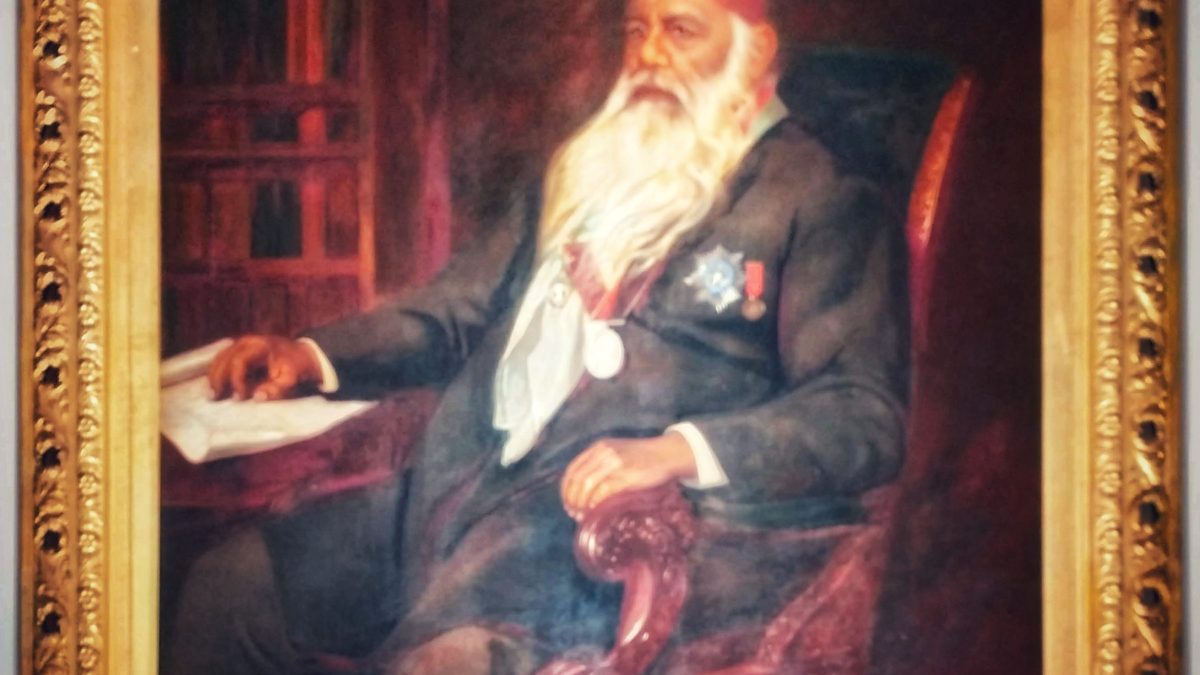
Sir Syed Ahmad Khan (17 October 1817 – 27 March 1898) was an Indian Muslim reformer, educationist, jurist and writer. Convinced after the revolt of 1857 that Indian Muslims could recover only through modern education, he founded the Muhammadan Anglo-Oriental College at Aligarh in 1875. It became Aligarh Muslim University in 1920, and the wider effort he led, known as the Aligarh Movement, changed the intellectual life of Muslims in South Asia. His political views, especially his opposition to the Congress, remain debated.
Quick Facts
| Full name | Syed Ahmad Khan |
| Born | 17 October 1817, Delhi, India |
| Died | 27 March 1898 (aged 80), Aligarh, Uttar Pradesh |
| Occupation | Reformer, educationist, judge, author |
| Known for | Aligarh Movement; founder of the Muhammadan Anglo-Oriental College |
| Notable works | Asar-us-Sanadid; The Causes of the Indian Revolt; Tahzib-ul-Akhlaq |
| Honours | Knighthood (KCSI, 1888) |
Early Life
He was born in Delhi into a family that had long held positions at the Mughal court, and was educated in the traditional manner in the Quran, Persian, Arabic, mathematics and medicine. After his father’s death he took a clerical post under the East India Company in 1838, qualified as a subordinate judge and served in the courts of several towns of what is now Uttar Pradesh. In 1847 he published Asar-us-Sanadid, a pioneering survey of the monuments and notable people of Delhi.
1857 and After
During the revolt of 1857 he was posted at Bijnor, where he protected the European residents. The rebellion and its suppression destroyed the world he had grown up in; members of his own family were killed in Delhi. In The Causes of the Indian Revolt (1859) he argued, at some risk, that the uprising had been caused by British policies and above all by the exclusion of Indians from the councils of government, so that the rulers never learned what their subjects thought.
Educational Work
He opened schools at Moradabad and Ghazipur and in 1864 founded the Scientific Society to translate English works on history, science and political economy into Urdu. It soon moved with him to Aligarh. In 1869–70 he visited England, studied Oxford and Cambridge and returned determined to build a residential college of that kind. His journal Tahzib-ul-Akhlaq, begun in 1870, urged social reform and a rational reading of religion, and brought fierce attacks from conservative scholars, some of whom declared him an unbeliever.
A school opened at Aligarh on 24 May 1875, and the Viceroy laid the foundation stone of the college in January 1877. The Muhammadan Anglo-Oriental College taught Western arts and sciences in English alongside Islamic studies, admitted Hindu students and employed Hindu and British teachers. He raised its funds by every means, including lotteries and stage performances. In 1886 he founded the Muhammadan Educational Conference to spread the movement across India.
Politics
He served on the Viceroy’s Legislative Council from 1878 to 1883 and was knighted in 1888. He had earlier described Hindus and Muslims as the two eyes of the bride that was India. From 1887, however, he advised Muslims to keep away from the Indian National Congress, arguing that elections and competitive examinations in a country so divided would leave the less educated Muslim minority permanently outvoted. Later nationalists and the advocates of Pakistan both drew on his words, and historians still dispute his intentions. He also championed Urdu when the claims of Hindi were pressed.
Death and Legacy
He died at Aligarh on 27 March 1898 and is buried beside the university mosque. The college he founded produced much of the Muslim professional and political leadership of the next century, and his birthday is celebrated as Sir Syed Day by its former students around the world.
Frequently Asked Questions
When and where was Sir Syed Ahmad Khan born?
Sir Syed Ahmad Khan was born on 17 October 1817 in Delhi, India.
When did Sir Syed Ahmad Khan die?
Died: 27 March 1898 (aged 80), Aligarh, Uttar Pradesh.
What is Sir Syed Ahmad Khan known for?
Known for: Aligarh Movement; founder of the Muhammadan Anglo-Oriental College.
What honours has Sir Syed Ahmad Khan received?
Knighthood (KCSI, 1888).
Featured image: Painted portrait of Sir Syed Ahmad Khan. Photo by Sufe, licensed under CC BY-SA 4.0, via Wikimedia Commons.



