
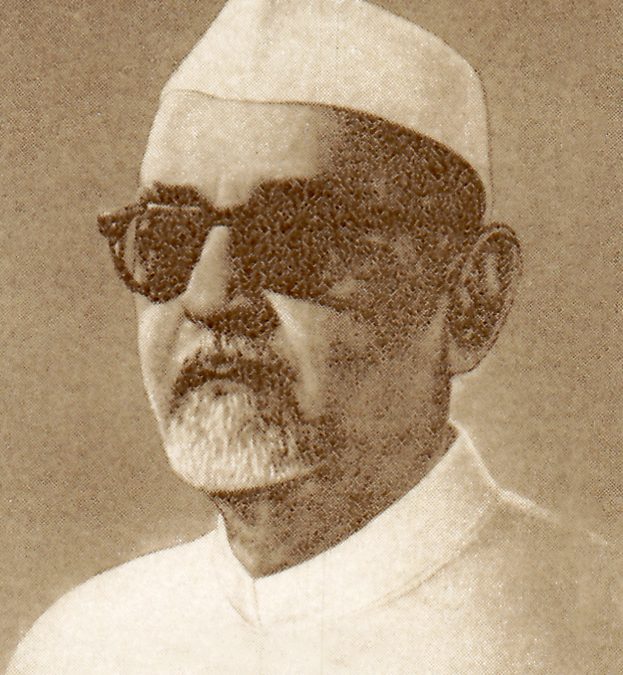
Dr Zakir Husain (8 February 1897 – 3 May 1969) was an Indian educationist and statesman who was the third President of India, from May 1967 until his death, and the first Muslim to hold the office. As a student of twenty-three he helped found the nationalist university Jamia Millia Islamia, and he led it through twenty-two years of poverty. He was awarded the Bharat Ratna in 1963.
Quick Facts
| Full name | Zakir Husain Khan |
| Born | 8 February 1897, Hyderabad |
| Died | 3 May 1969, New Delhi (aged 72) |
| Education | Islamia High School, Etawah; Muhammadan Anglo-Oriental College, Aligarh; University of Berlin (Ph.D. in economics, 1926) |
| Occupation | Educationist, economist, statesman |
| Offices | Vice-Chancellor, Jamia Millia Islamia (1926–1948); Vice-Chancellor, Aligarh Muslim University (1948–1956); Governor of Bihar (1957–1962); Vice-President (1962–1967); President of India (1967–1969) |
| Awards | Padma Vibhushan (1954), Bharat Ratna (1963) |
| Spouse | Shahjahan Begum |
Early Life
He was born in Hyderabad, where his father, a Pathan of the Afridi tribe from Kaimganj in the Farrukhabad district of the United Provinces, practised law. His father died when he was ten and his mother four years later, in a plague epidemic. He was schooled at Etawah under a headmaster of strong religious and moral influence, and went on to the college at Aligarh.
Jamia
In October 1920 Mahatma Gandhi came to Aligarh and asked students to leave institutions that depended on the British government. Zakir Husain, then a postgraduate student and junior teacher, was among a group who walked out. With the support of nationalist Muslim leaders they founded a new institution, the Jamia Millia Islamia, the national Muslim university, which began in tents.
He left for Germany in 1922 and took a doctorate in economics at Berlin. While there he had an edition of the poetry of Ghalib printed and learnt much about German educational ideas.
By 1925 the Jamia, which had moved to Delhi, was close to collapse. He and two friends in Berlin sent word that they would come and serve it for life. He took charge in 1926. He and a band of teachers pledged to work for twenty years on a salary of no more than a hundred and fifty rupees a month, often unpaid. He kept the institution alive, built its campus at Okhla, and made it a place where education was joined to manual work, community service and the arts.
Basic Education
In 1937 Gandhi proposed a scheme of schooling through a productive craft, in the mother tongue. The committee that worked it out, under Zakir Husain, produced what is called the Wardha scheme of basic education, and he headed the national body set up to promote it.
Aligarh
After Partition the Aligarh Muslim University, which had been a stronghold of the movement for Pakistan, was demoralised and under suspicion. At the government’s request he became its Vice-Chancellor in 1948 and in eight years restored its standing as a national university.
Public Office
He was nominated to the Rajya Sabha in 1952, was Governor of Bihar from 1957 to 1962, and was elected Vice-President in 1962.
In 1967 the Congress nominated him for President. The opposition put up a former Chief Justice, and some argued that a Muslim could not win. He won comfortably and took office on 13 May 1967. In his first speech he said that the whole of India was his home and its people his family.
The Man
He was a scholar of range and a man of great courtesy. He translated Plato’s Republic into Urdu, wrote on economics and education, and wrote stories for children, of which Abbu Khan ki Bakri, about a goat that chooses freedom, is the best loved. He collected fossils and cactus plants, painted, and created a celebrated rose garden.
Death
He died of a heart attack at Rashtrapati Bhavan on 3 May 1969, the first President to die in office. He is buried on the campus of the Jamia Millia Islamia, which became a central university in 1988.
Legacy
His death set off the contest for the presidency between V. V. Giri and Neelam Sanjiva Reddy that split the Congress. His colleague in the national movement, Maulana Azad, shared his conviction that the Muslims of India belonged in a united, secular country.
Featured image: Zakir Husain, from a 1998 postage stamp of India. Photo by India Post, Government of India, licensed under Government Open Data License – India, via Wikimedia Commons.



