
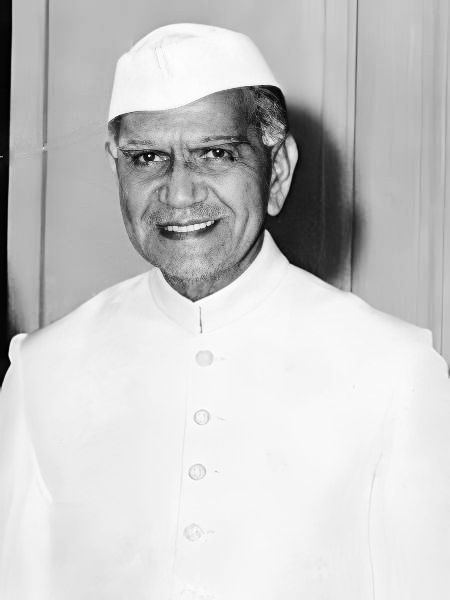
Fakhruddin Ali Ahmed (13 May 1905 – 11 February 1977) was an Indian lawyer and politician who was the fifth President of India, from August 1974 until his death in office. A Congressman from Assam and a Union minister for many years, he is remembered above all as the President who signed the proclamation of the Emergency on the night of 25 June 1975.
Quick Facts
| Full name | Fakhruddin Ali Ahmed |
| Born | 13 May 1905, Delhi |
| Died | 11 February 1977, New Delhi (aged 71) |
| State | Assam |
| Education | St Stephen’s College, Delhi; St Catharine’s College, Cambridge; Inner Temple, London |
| Party | Indian National Congress |
| Offices | President of India (1974–1977); Union Cabinet minister (1966–1974); minister in Assam |
| Spouse | Begum Abida Ahmed |
| Children | 3 |
Early Life
He was born in the old city of Delhi. His father, Colonel Zalnur Ali Ahmed, was an Assamese from Golaghat, an army doctor and one of the first people from the North-East to take a medical degree; his mother was a daughter of the Nawab of Loharu. He was educated in Gonda and Delhi, went to St Stephen’s College, and in 1923 to England, where he took a degree in history at Cambridge and was called to the bar from the Inner Temple.
In England he met Jawaharlal Nehru, who became his friend and political guide.
The Freedom Movement
He began practising law in the Lahore High Court in 1928 and joined the Congress in 1931. He moved his practice to Assam, his father’s province, and was elected to its legislature in 1935. In the first Congress ministry of Assam, under Gopinath Bordoloi in 1938, he was Minister of Finance and Revenue and introduced a tax on agricultural income, aimed at the British-owned tea estates, which caused a stir.
He was jailed for a year in the individual satyagraha of 1940 and for three and a half years after the Quit India movement of 1942.
Career
Assam
After independence he was a member of the Rajya Sabha and Advocate-General of Assam, and from 1957 to 1966 a minister in the state government.
The Centre
Indira Gandhi brought him into the Union Cabinet in 1966. He held the portfolios of irrigation and power, education, industrial development and, from 1970 to 1974, food and agriculture. In the Congress split of 1969 he stood firmly with her.
President
She chose him as the party’s candidate for President in 1974, and he was elected in August, the second Muslim to hold the office after Zakir Husain.
The Emergency
On the night of 25 June 1975 the Prime Minister brought him a proclamation declaring a state of Emergency on the ground of internal disturbance. The Cabinet had not met to consider it. He signed. In the months that followed he signed the ordinances by which the government ruled, at times, it was said, within minutes of receiving them.
A cartoon by Abu Abraham, published in December 1975, showed him in his bathtub handing a signed paper out to a waiting hand and saying that if there were any more ordinances they should be asked to wait. It became the lasting image of his presidency. See the Emergency of 1975–77.
His defenders have said that under the Constitution a President must act on the advice of the government and that he had little choice. His critics reply that he could at least have asked for the Cabinet’s decision.
Death
He died of a heart attack at Rashtrapati Bhavan on 11 February 1977, while the election campaign that would end the Emergency was in progress. He was the second Indian President to die in office. He is buried beside the mosque near Parliament House.
Personal Life
He married Abida in 1945; she was later twice elected to the Lok Sabha. They had two sons and a daughter. He was a keen sportsman, a hockey and football player in his youth and a golfer, and was president of the national football and cricket bodies of Assam and of the All India Lawn Tennis Federation. A medical college at Barpeta in Assam is named after him.
Featured image: Fakhruddin Ali Ahmed as President of India. Photo by the President’s Secretariat, licensed under Government Open Data License – India, via Wikimedia Commons.



