Sir Mokshagundam Visvesvaraya (15 September 1861 – 12 April 1962), often called Sir MV, was an Indian civil engineer, administrator and statesman. He designed irrigation and flood-control works across the country, built the Krishna Raja Sagara dam, and as Dewan of Mysore founded the institutions that made it a model state. He received the Bharat Ratna in 1955, and his birthday is observed in India as Engineers’ Day.
Quick Facts
| Full name | Mokshagundam Visvesvaraya |
| Born | 15 September 1861, Muddenahalli, Kingdom of Mysore (now in Chikkaballapur district, Karnataka) |
| Died | 12 April 1962, Bangalore (aged 100) |
| Field | Civil engineering, public administration |
| Education | Central College, Bangalore (B.A., 1881); College of Science, Poona (engineering, 1883) |
| Known for | Krishna Raja Sagara dam; automatic sluice gates; block system of irrigation |
| Positions | Chief Engineer of Mysore (1909–1912); Dewan of Mysore (1912–1918) |
| Honours | Knight Commander of the Order of the Indian Empire (1915), Bharat Ratna (1955) |
Early Life and Education
He was born at Muddenahalli, a village near Chikkaballapur, into a Telugu-speaking Brahmin family whose ancestors had come from Mokshagundam in present-day Andhra Pradesh. His father, a Sanskrit scholar, died when the boy was about twelve, and he grew up poor, earning his keep in Bangalore by tutoring.
He graduated from Central College, Bangalore, in 1881. With a scholarship from the Mysore government he studied civil engineering at the College of Science in Poona, standing first in 1883.
Career
Bombay Presidency
He joined the Bombay Public Works Department as an assistant engineer and served for about twenty-five years.
- **Sukkur:** He designed a system to supply filtered water from the Indus to the town of Sukkur in Sindh.
- **Automatic gates:** In 1903 he designed and patented automatic sluice gates, first fitted at the Khadakwasla reservoir near Poona, which rose and fell with the water level and so stored more water safely.
- **Block system:** He devised a way of rotating irrigation water among farmers so that it was shared fairly and not wasted.
- **Aden:** He was sent to plan the water supply and drainage of the port of Aden.
He retired early in 1908.
Hyderabad
After the Musi river flooded Hyderabad in 1908 with great loss of life, the Nizam’s government engaged him. He proposed the two reservoirs above the city and a drainage scheme that have protected it since.
Mysore
He became Chief Engineer of Mysore in 1909 and its Dewan, or chief minister, in 1912 under Maharaja Krishnaraja Wadiyar IV. His slogan was “Industrialise or perish”. In six years he founded or planned:
- The Krishna Raja Sagara dam across the Kaveri, one of the largest in India when built
- The Bank of Mysore (1913)
- Mysore University (1916)
- The government engineering college at Bangalore (1917), which now bears his name
- The Mysore iron and steel works at Bhadravati
- The Mysore soap and sandalwood oil factories
- The Kannada Sahitya Parishat (1915)
He resigned in 1918.
Later years
For four decades more he served on committees across India and wrote Reconstructing India (1920) and Planned Economy for India (1934), one of the first Indian arguments for economic planning. He advised on the bridge over the Ganga at Mokameh when he was past ninety.
Character
He was known for strict discipline, punctuality and neat dress. It is said that he kept two sets of candles, one paid for by the government for official work and one of his own for private use.
Legacy
He died in Bangalore in 1962, aged 100. Engineers’ Day is observed on 15 September. A museum, a technological university and many institutions in Karnataka are named after him.
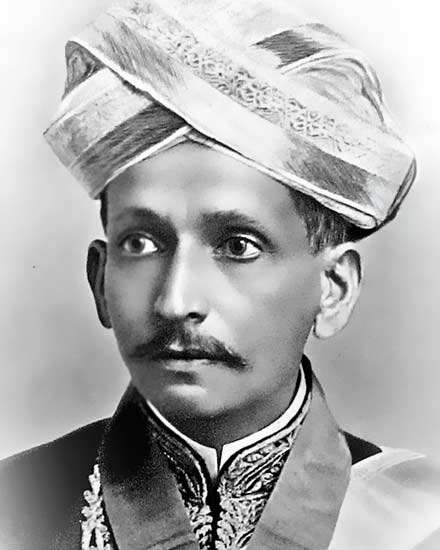
Featured image: M. Visvesvaraya in his thirties, about 1890. Photo by an unknown photographer, in the public domain, via Wikimedia Commons.