
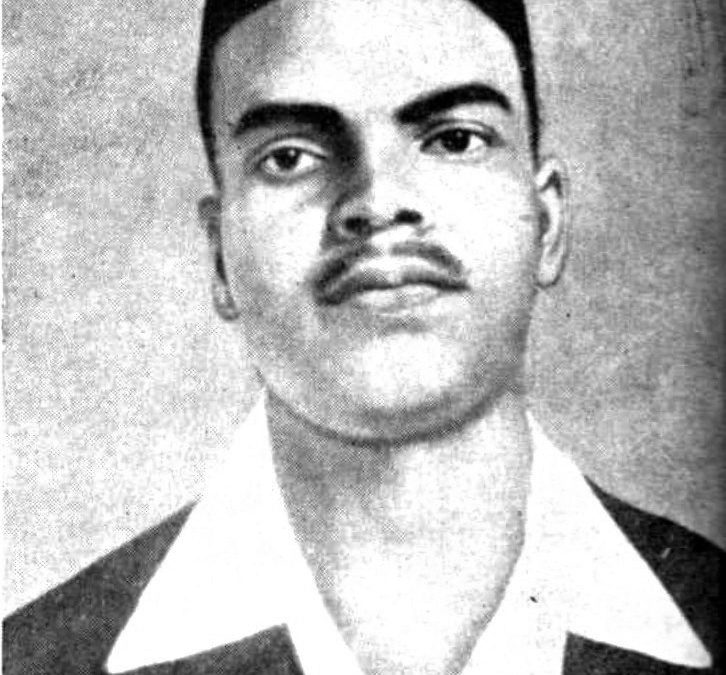
Shivaram Hari Rajguru (24 August 1908 – 23 March 1931) was an Indian revolutionary from Maharashtra, a member of the Hindustan Socialist Republican Association. On 17 December 1928 he fired the first shot at the police officer J. P. Saunders in Lahore, in revenge for the death of Lala Lajpat Rai. He was hanged on 23 March 1931 with Bhagat Singh and Sukhdev Thapar. He was twenty-two.
Quick Facts
| Full name | Shivaram Hari Rajguru |
| Born | 24 August 1908, Khed (now Rajgurunagar), Pune district, Maharashtra |
| Died | 23 March 1931, Lahore Central Jail (aged 22) |
| Organisation | Hindustan Socialist Republican Association |
| Party name | Raghunath |
| Known for | The shooting of J. P. Saunders (1928); the Lahore Conspiracy Case |
| Associates | Bhagat Singh, Sukhdev Thapar, Chandrashekhar Azad |
Early Life
He was born at Khed, a small town on the Bhima river north of Pune, into a Marathi Brahmin family of modest means. The family name is said to come from an ancestor who was preceptor to a Maratha king. His father died when he was six, and he grew up under the authority of an elder brother.
He did badly in English at school, and after a humiliating quarrel with his brother about it, he left home at about fifteen with a few annas in his pocket. He made his way, largely on foot, to Nashik and then to Varanasi.
Varanasi
At Varanasi he studied Sanskrit and logic, lived on the charity of religious houses, and worked for a time as a drill instructor in a school. He was devoted to physical culture and had trained at a famous gymnasium at Amravati; he was a wrestler and, above all, an exceptional shot.
The city was a meeting place of revolutionaries. He came to know members of the underground party led by Chandrashekhar Azad and joined it. In the group he was known as Raghunath, and as a cheerful, restless young man, eager to be chosen for dangerous work and inclined to boast that he could endure more pain than anyone.
Saunders
After the death of Lala Lajpat Rai in November 1928, the association decided to kill the Lahore police superintendent, J. A. Scott, who had ordered the lathi charge in which he was injured.
On the afternoon of 17 December 1928 Rajguru and Bhagat Singh waited outside the police headquarters. A lookout signalled when an officer came out. It was not Scott but his assistant, J. P. Saunders. Rajguru fired once and brought him down; Bhagat Singh fired several more shots. Azad, covering their escape, shot dead an Indian head constable who gave chase.
Two days later the wanted men left Lahore by train. Bhagat Singh, his hair cut and wearing a hat, travelled first class as a young official with the wife of a comrade posing as his own and her small son; Rajguru went with them as the family’s servant, carrying the luggage.
Underground
He spent the next months in hiding in the United Provinces and Maharashtra, moving between Varanasi, Kanpur, Nagpur and Pune. The party thought him too impulsive to be told all its plans. After the arrests of Bhagat Singh and Sukhdev in April 1929 he tried to organise further actions in western India.
He was arrested in Pune on 30 September 1929, with a revolver, and taken to Lahore.
Trial and Execution
He was tried with the others in the Lahore Conspiracy Case, joined their hunger strikes, and was sentenced to death on 7 October 1930. An appeal to the Privy Council was dismissed.
He was hanged in Lahore Central Jail on the evening of 23 March 1931, and cremated with Bhagat Singh and Sukhdev Thapar at Hussainiwala on the Sutlej.
Legacy
- His birthplace was renamed Rajgurunagar, and the house where he was born is preserved as a memorial.
- A postage stamp was issued in his honour in 2013.
- A college in Delhi and many roads and institutions in Maharashtra bear his name.
He was the only one of the three from outside Punjab, and his presence in the group is a reminder that the revolutionary movement of the 1920s drew young men from across the country. The date of their execution is observed as Martyrs’ Day.
Featured image: Shivaram Rajguru. Photo by an unknown photographer, in the public domain, via Wikimedia Commons.



