
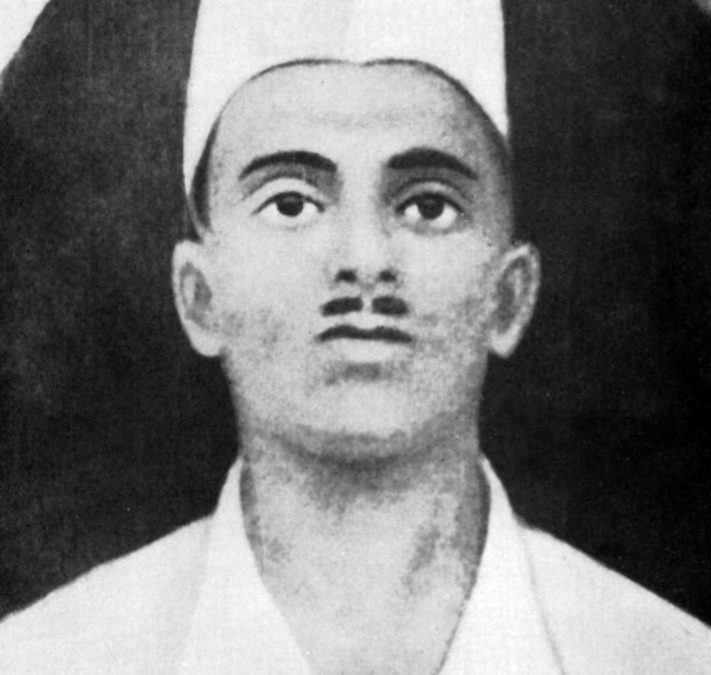
Sukhdev Thapar (15 May 1907 – 23 March 1931) was an Indian revolutionary, the chief organiser in Punjab of the Hindustan Socialist Republican Association. A close friend of Bhagat Singh from their college days, he helped plan the group’s actions, including the shooting of a British police officer in 1928. He was hanged in Lahore Central Jail on 23 March 1931, with Bhagat Singh and Shivaram Rajguru. He was twenty-three. The day is observed in India as Martyrs’ Day.
Quick Facts
| Full name | Sukhdev Thapar |
| Born | 15 May 1907, Ludhiana, Punjab |
| Died | 23 March 1931, Lahore Central Jail (aged 23) |
| Education | National College, Lahore |
| Organisations | Naujawan Bharat Sabha; Hindustan Socialist Republican Association |
| Known for | The Lahore Conspiracy Case |
| Associates | Bhagat Singh, Shivaram Rajguru, Chandrashekhar Azad, Bhagwati Charan Vohra |
Early Life
He was born in Ludhiana into a Punjabi Khatri family. His father died when he was about three, and he was brought up at Lyallpur by his uncle, Lala Achintram, a follower of the Arya Samaj and a Congress worker who went to jail in the national movement. As a schoolboy he refused to salute visiting British officers and was caned for it.
National College
He entered the National College in Lahore, founded by Lala Lajpat Rai for students who had left government institutions. There he met Bhagat Singh, Bhagwati Charan Vohra and Yashpal. The friends read the history of revolutions in Russia, Ireland and Italy, and argued about socialism in the college library.
In 1926 they founded the Naujawan Bharat Sabha, a youth organisation that held public meetings against communalism and for independence, and served as a recruiting ground.
The HSRA
He joined the underground Hindustan Republican Association and was present at the meeting in Delhi in September 1928 at which it added the word “Socialist” to its name. He was put in charge of the organisation in Punjab. He was the one who found recruits and safe houses, raised money and held the group together; his comrades described him as its best organiser, exacting, sharp-tongued and loyal.
Saunders
In October 1928 Lala Lajpat Rai was struck in a police lathi charge on a demonstration in Lahore and died some weeks later. The group resolved to kill the police superintendent who had ordered the charge. Sukhdev took a leading part in the planning. On 17 December 1928 Shivaram Rajguru and Bhagat Singh shot an assistant superintendent, J. P. Saunders, whom they mistook for their target.
It was Sukhdev, by the accounts of the group’s survivors, who insisted that Bhagat Singh was the right man to throw the bombs in the Central Assembly in Delhi in April 1929 and to use the trial that would follow as a platform, though it meant sending his closest friend to almost certain death.
Arrest and Trial
On 15 April 1929 the police raided the group’s bomb factory in Lahore and arrested Sukhdev and others. The case that followed, in which more than twenty were charged with conspiracy and with the murder of Saunders, was formally titled “Crown versus Sukhdev and others”.
The prisoners went on a long hunger strike for the rights of political prisoners; one of them, Jatindranath Das, died. They refused to cooperate with the court, shouted slogans, and were tried in their absence by a special tribunal set up by ordinance, with no right of appeal. On 7 October 1930 Sukhdev, Bhagat Singh and Rajguru were sentenced to death.
The Letter to Gandhi
In March 1931, as Mahatma Gandhi was concluding a truce with the Viceroy, Sukhdev wrote him an open letter. He asked whether the revolutionaries, too, were not entitled to consideration, and defended their aims. Gandhi replied in print after the execution.
Execution
The three were hanged at about half past seven in the evening of 23 March 1931, a day earlier than announced. They are said to have gone to the gallows singing. The bodies were taken out through a hole in the back wall of the jail and cremated secretly on the bank of the Sutlej at Hussainiwala, where a national memorial now stands.
Legacy
His family home in Ludhiana is a protected monument, and a college of the University of Delhi is named after him. He is the least known of the three martyrs of 23 March, perhaps because he worked in the background; without him, his comrades said, the organisation in Punjab would not have existed. Among the group’s other leaders was Chandrashekhar Azad.
Featured image: Sukhdev Thapar. Photo by an unknown photographer, in the public domain, via Wikimedia Commons.



