
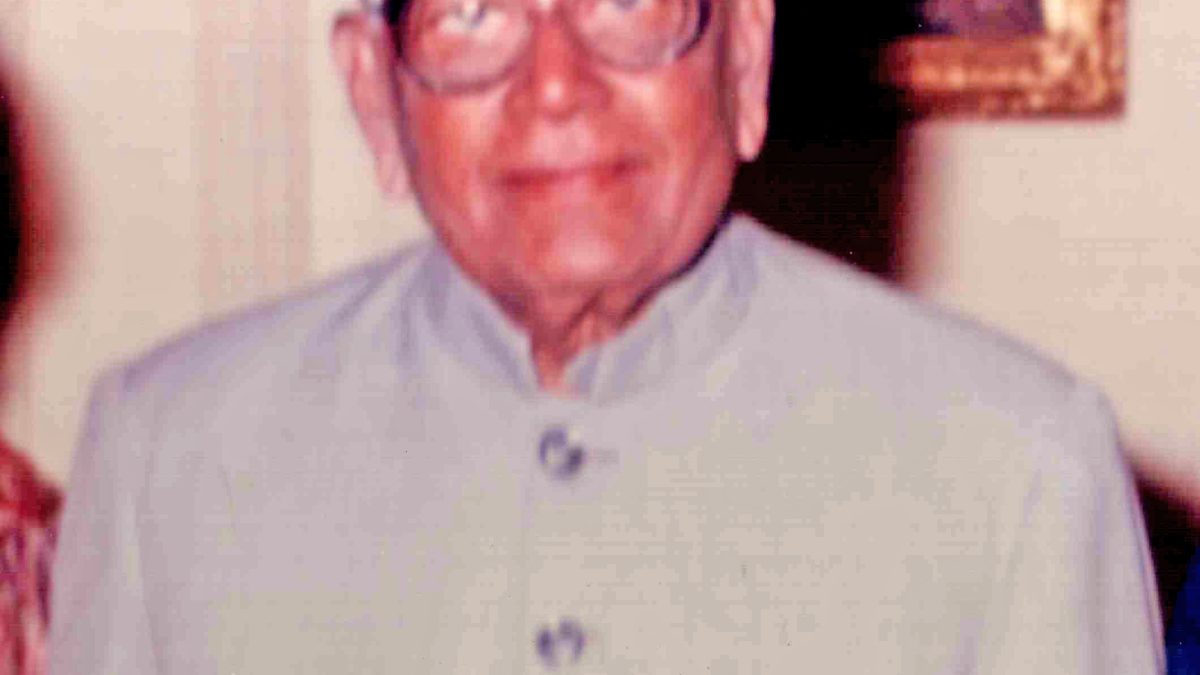
Ramaswamy Venkataraman (4 December 1910 – 27 January 2009) was an Indian lawyer, freedom fighter and statesman who was the eighth President of India, from 1987 to 1992. As a minister in Madras state for ten years he laid the foundations of Tamil Nadu’s industrial growth. He was later Union Minister for Finance and for Defence and Vice President. As President he worked with four prime ministers and had to decide, three times, who should form the government when no party had a majority.
Quick Facts
| Full name | Ramaswamy Venkataraman |
| Born | 4 December 1910, Rajamadam, Thanjavur district, Tamil Nadu |
| Died | 27 January 2009 (aged 98), New Delhi |
| Offices | President of India (25 July 1987 – 25 July 1992); Vice President of India (1984–1987); Union Finance Minister (1980–1982); Union Defence Minister (1982–1984) |
| Party | Indian National Congress |
| Education | Loyola College, Madras (M.A. Economics); Law College, Madras |
| Spouse | Janaki Venkataraman |
| Children | 3 daughters |
Early Life
Venkataraman was born in the village of Rajamadam, near Pattukkottai. He took a master’s degree in economics from the University of Madras and a law degree, and enrolled as an advocate of the Madras High Court in 1935. He joined the Congress as a young man and became a trade union lawyer and organiser, working among plantation, railway, port and estate workers.
He was detained for two years for taking part in the Quit India Movement of 1942. In 1946 he was one of the lawyers sent by the Government of India to Malaya and Singapore to defend Indians accused of collaborating with the Japanese occupation. He founded the Labour Law Journal in 1949.
Madras Minister
He was a member of the Provisional Parliament and of the first Lok Sabha. In 1957 the Chief Minister of Madras, K. Kamaraj, persuaded him to give up his seat in Delhi and join the state cabinet. For the next ten years he held the portfolios of industries, labour, power, transport and commercial taxes.
In that decade Madras, until then a largely agricultural state, acquired an industrial base. Industrial estates were set up at Guindy, Ambattur and other places with sheds, power and finance for small entrepreneurs; large public-sector plants were won for the state, among them the heavy vehicles and boiler factories; and private manufacturers of vehicles, tyres and engineering goods were encouraged to settle around Madras. He is often called the father of the state’s industrialisation.
Union Minister
He was a member of the Planning Commission from 1967 to 1971, dealing with industry, labour, power and transport. Elected to the Lok Sabha from Madras South in 1977 and 1980, he became Finance Minister in Indira Gandhi‘s government in January 1980 and negotiated a large loan from the International Monetary Fund during the balance-of-payments difficulties of 1981. As Defence Minister from 1982 he approved the Integrated Guided Missile Development Programme and brought A. P. J. Abdul Kalam from the space organisation to lead it.
Vice President and President
He was elected Vice President in August 1984 and President in July 1987, defeating the jurist V. R. Krishna Iyer.
His term covered the most unsettled period Indian politics had then known. After the election of 1989 he invited Rajiv Gandhi, as leader of the largest party, who declined, and then V. P. Singh. When that government fell in 1990 he swore in Chandra Shekhar with Congress support from outside. After the election of 1991, held in the shadow of Rajiv Gandhi’s assassination, he appointed P. V. Narasimha Rao. He described himself as a “copybook President” who followed the rule book and kept the office out of controversy, and he set out the principle of inviting the leader of the largest party first. His memoir of these years is My Presidential Years.
Other Roles and Legacy
He represented India at the United Nations General Assembly many times and was a member and later president of the United Nations Administrative Tribunal. He was devoted to the Shankaracharya of Kanchi. He died in New Delhi on 27 January 2009, at ninety-eight, the longest-lived of India’s presidents to that date. In Tamil Nadu he is remembered above all for the factories that grew out of his decade as industries minister.
Featured image: R. Venkataraman in December 2006. Photo by Jaisingh Rathore, licensed under CC BY 2.5, via Wikimedia Commons.



