
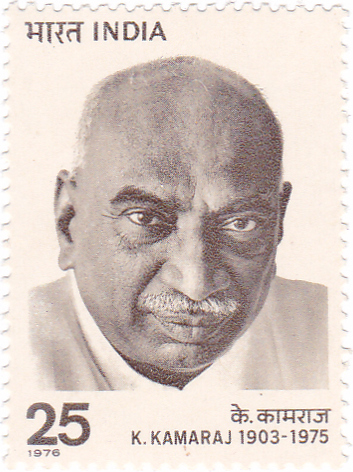
Kumaraswami Kamaraj (15 July 1903 – 2 October 1975) was an Indian freedom fighter and statesman who was Chief Minister of Madras State, now Tamil Nadu, from 1954 to 1963, and president of the Indian National Congress from 1964 to 1967. A man with a few years of schooling, he brought free education and a free midday meal to the children of his state. In Delhi he was the kingmaker who settled the succession after Nehru and again after Shastri. He was awarded the Bharat Ratna after his death.
Quick Facts
| Full name | Kumaraswami Kamaraj |
| Born | 15 July 1903, Virudhunagar, Tamil Nadu |
| Died | 2 October 1975, Madras (aged 72) |
| Party | Indian National Congress; Congress (Organisation) after 1969 |
| Offices | Chief Minister of Madras (1954–1963); President of the Congress (1964–1967) |
| Known for | Free schooling and the midday meal scheme; the Kamaraj Plan |
| Awards | Bharat Ratna (1976, posthumous) |
| Titles | Perunthalaivar; Kingmaker |
Early Life
He was born at Virudhunagar, a market town in the south of the Tamil country, into a family of the Nadar community. His father, a coconut trader, died when he was six. He left school at about eleven and worked in an uncle’s cloth shop.
The massacre at Jallianwala Bagh in 1919 drew him to the Congress. He became a full-time worker at eighteen, took part in the salt satyagraha at Vedaranyam in 1930, and was jailed several times, spending more than eight years in British prisons in all. He never married.
Party Leader
He was the pupil of the Congress leader S. Satyamurti. He became president of the Tamil Nadu Congress Committee in 1940 and held the post for fourteen years, building an organisation that reached into every district.
Chief Minister
He became Chief Minister on 13 April 1954, succeeding C. Rajagopalachari, whose scheme of part-time schooling tied to a family’s hereditary occupation had raised a storm. Kamaraj scrapped it. He kept a small cabinet and took in his rivals.
Education
- Schools that had been closed were reopened and thousands of new ones built, with the aim of a primary school within walking distance of every village
- Schooling was made free, first to the primary stage and then up to the end of secondary school
- In 1956 he introduced a free midday meal in schools, having found that poor children stayed away because they were hungry; free uniforms followed
The proportion of children in school rose from well under half to the great majority in less than a decade.
Industry and irrigation
Dams and canals were built on the state’s rivers, and villages electrified. Large public enterprises came to the state in his time: the lignite mines at Neyveli, the heavy electrical plant at Tiruchirappalli, the railway coach factory at Perambur and others.
The Kamaraj Plan
In 1963, concerned that the Congress was losing touch with the people, he proposed that senior ministers resign their posts and return to party work. Jawaharlal Nehru accepted. Six Union ministers and six chief ministers resigned, Kamaraj first among them. He was elected president of the Congress shortly afterwards.
Kingmaker
When Nehru died in May 1964, Kamaraj guided the party to a consensus on Lal Bahadur Shastri. When Shastri died in January 1966, he secured the election of Indira Gandhi over Morarji Desai. He spoke only Tamil and little English, and is said to have refused the office himself on the ground that a Prime Minister of India must know Hindi or English.
Defeat
In the election of 1967 the Dravida Munnetra Kazhagam swept the Congress out of power in Madras. Kamaraj lost his own seat at Virudhunagar to a student leader. The Congress has not governed the state since.
When the party split in 1969 he stayed with the old organisation against Indira Gandhi and led it in Tamil Nadu until his death.
Death
He died in his sleep in Madras on 2 October 1975, Gandhi’s birthday. He left behind a few clothes, some books and about a hundred rupees. He was awarded the Bharat Ratna in 1976.
Legacy
His midday meal scheme was enlarged by later governments of Tamil Nadu and became the model for the national programme. His birthday is observed in the state as Education Development Day, and the domestic terminal of the Chennai airport and a university at Madurai bear his name.
Featured image: K. Kamaraj, from a 1976 postage stamp of India. Photo by India Post, Government of India, licensed under Government Open Data License – India, via Wikimedia Commons.



