
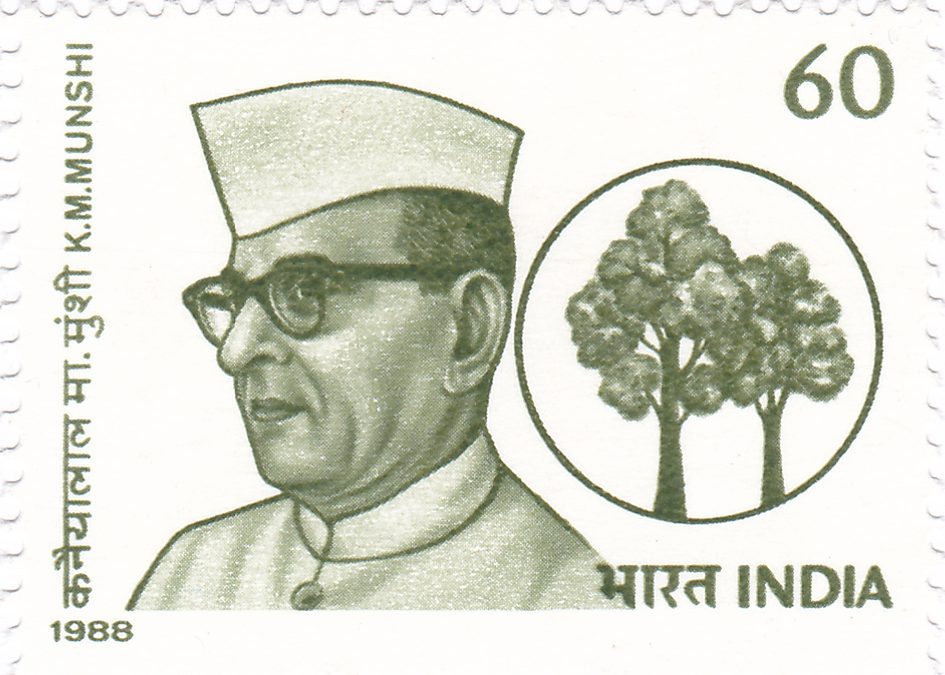
Kanaiyalal Maneklal Munshi (30 December 1887 – 8 February 1971) was an Indian lawyer, freedom fighter, statesman, educationist and one of the foremost novelists in Gujarati. He founded the Bharatiya Vidya Bhavan in 1938, was a member of the committee that drafted the Constitution, represented India in Hyderabad at the time of its integration, directed the rebuilding of the temple of Somnath and, as a Union minister, began the annual tree-planting festival of Van Mahotsav.
Quick Facts
| Full name | Kanaiyalal Maneklal Munshi |
| Pen name | Ghanshyam Vyas |
| Born | 30 December 1887, Bharuch, Gujarat |
| Died | 8 February 1971, Bombay (aged 83) |
| Education | Baroda College (B.A.); University of Bombay (LL.B.) |
| Occupation | Lawyer, politician, writer, educationist |
| Founded | Bharatiya Vidya Bhavan (1938) |
| Offices | Home Minister of Bombay (1937–1939); Union Minister for Food and Agriculture (1950–1952); Governor of Uttar Pradesh (1952–1957) |
| Notable works | Patan-ni Prabhuta, Gujarat-no Nath, Rajadhiraj, Prithvivallabh, Jai Somnath, Krishnavatara |
| Spouse | Atilakshmi (d. 1924); Lilavati Munshi (m. 1926) |
Early Life
He was born at Bharuch, on the Narmada, into a Bhargava Brahmin family of officials. At Baroda College one of his teachers was Aurobindo Ghose, who fired him with nationalist ideas. He took a law degree in Bombay and, after early struggles, became one of the leading advocates of the Bombay High Court.
The Freedom Movement
He joined the Home Rule League, was elected to the Bombay legislature, and resigned from it in 1928 in support of the peasants’ no-tax campaign at Bardoli led by Vallabhbhai Patel, to whom he remained close for life. He joined Mahatma Gandhi‘s salt satyagraha in 1930 and was jailed several times.
As Home Minister in the first Congress government of Bombay, from 1937 to 1939, he put down communal rioting in the city with a firm hand. He left the Congress in 1941, believing that violence in defence against attack was justified, and campaigned against the partition of the country. He returned in 1946.
Bharatiya Vidya Bhavan
On 7 November 1938 he founded the Bharatiya Vidya Bhavan in Bombay to revive the study of Sanskrit and of Indian culture and to restate its values for the modern age. It has grown into an educational trust with well over a hundred centres and several hundred schools, colleges and institutes of management, in India and abroad, and a publishing programme that has produced a history of the Indian people in eleven volumes.
The Constitution
He was a member of the Constituent Assembly and of its drafting committee under B. R. Ambedkar, and of several of its other committees. He had a large hand in the chapter on fundamental rights, argued for a uniform civil code and for Hindi in the Devanagari script as the official language, and helped to work out the compromise on the language question.
Hyderabad
In January 1948 he was sent to Hyderabad as the Government of India’s Agent-General, at a time when the Nizam was holding out against accession and armed irregulars controlled the streets. He remained, virtually under siege, until the Indian Army entered the state in September. See Sardar Patel.
Somnath
The ancient temple of Somnath on the coast of Gujarat lay in ruins. Patel pledged in 1947 that it would be rebuilt. After Patel’s death Munshi, as chairman of the trust, carried the work through, against the misgivings of Jawaharlal Nehru, who feared it would compromise the secular character of the state. The President, Rajendra Prasad, installed the image in May 1951.
Minister and Governor
As Minister for Food and Agriculture from 1950 to 1952 he started Van Mahotsav, the festival of trees held each July, and wrote of a “gospel of the dirty hand”, the care of soil, water and forest. He was Governor of Uttar Pradesh from 1952 to 1957.
Disagreeing with the government’s socialist policies, he left the Congress in 1959 and joined C. Rajagopalachari‘s Swatantra Party.
Writer
He began publishing fiction under a pen name while a young lawyer. His trilogy on the Chalukya kingdom of medieval Gujarat, Patan-ni Prabhuta, Gujarat-no Nath and Rajadhiraj, with Prithvivallabh and Jai Somnath, gave Gujaratis a romantic vision of their past and a new pride in the name of Gujarat. His last great work was Krishnavatara, a retelling of the life of Krishna in several volumes, left unfinished. He also wrote plays, memoirs and histories in Gujarati and English.
Personal Life
His first wife, Atilakshmi, died in 1924. In 1926 he married Lilavati Sheth, a writer who became a legislator and member of Parliament. He died in Bombay on 8 February 1971.
Featured image: K. M. Munshi, from a 1988 postage stamp of India. Photo by India Post, Government of India, licensed under Government Open Data License – India, via Wikimedia Commons.



