
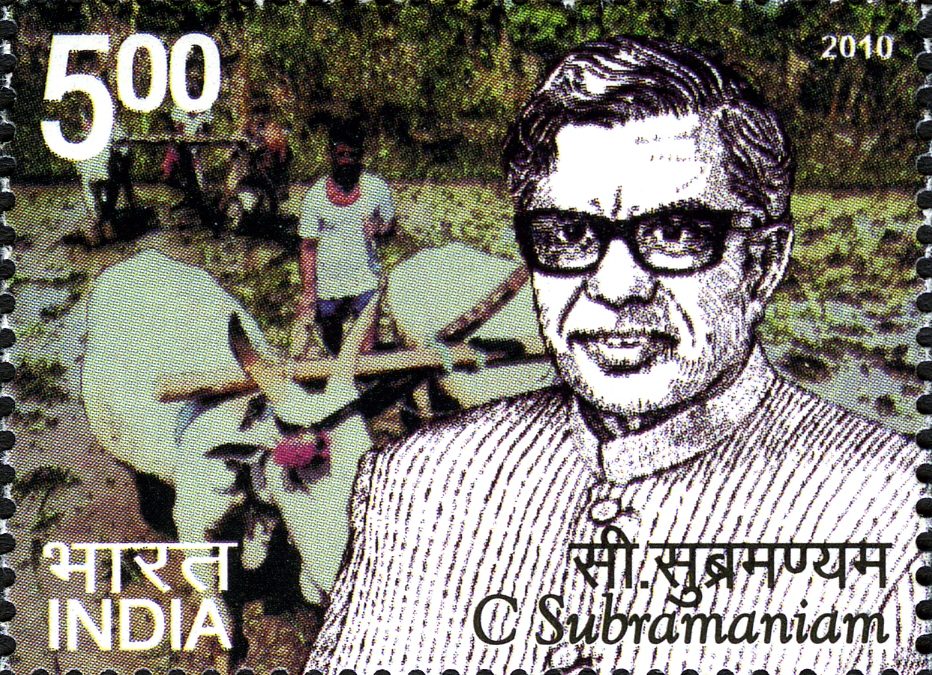
Chidambaram Subramaniam (30 January 1910 – 7 November 2000) was an Indian statesman who, as Union Minister for Food and Agriculture from 1964 to 1967, took the decisions that began the Green Revolution. Against strong opposition he backed the scientists who wanted to introduce high-yielding varieties of wheat, and within a few years India ceased to depend on imported grain. He later held the finance and defence portfolios and was awarded the Bharat Ratna in 1998.
Quick Facts
| Full name | Chidambaram Subramaniam |
| Born | 30 January 1910, Senguttaipalayam, Coimbatore district, Tamil Nadu |
| Died | 7 November 2000, Chennai (aged 90) |
| Education | Presidency College, Madras (B.Sc. in physics); Madras Law College |
| Party | Indian National Congress |
| Offices | Union Minister for Steel, Food and Agriculture, Planning, Industry, Finance and Defence; Governor of Maharashtra (1990–1993) |
| Known for | The political architect of the Green Revolution |
| Awards | Bharat Ratna (1998) |
Early Life
He was born into a farming family in a village near Pollachi. He studied physics at Presidency College in Madras and then law. He joined the civil disobedience movement as a student, was jailed during the Quit India movement of 1942, and practised law at Coimbatore.
Madras
He was a member of the Constituent Assembly. From 1952 to 1962 he was a minister in Madras State, under C. Rajagopalachari and then K. Kamaraj, holding finance, education and law. He was closely involved in the expansion of free schooling in the state.
The Centre
He was elected to the Lok Sabha in 1962 and became Minister for Steel and Heavy Industries.
Food and Agriculture
Lal Bahadur Shastri gave him the food and agriculture portfolio in June 1964. No one wanted it. Production had stagnated, the population was growing fast, and the country lived on shipments of American wheat. Two failed monsoons, in 1965 and 1966, brought parts of India close to famine.
Indian scientists, led by M. S. Swaminathan, had tested dwarf wheats developed in Mexico by Norman Borlaug and found that, with fertiliser and assured water, they yielded two or three times as much as Indian varieties. Subramaniam decided to stake the country’s policy on them.
- **Seed:** in 1966 India imported eighteen thousand tonnes of Mexican wheat seed, the largest seed shipment made anywhere up to that time
- **Prices:** he set up the Agricultural Prices Commission and the Food Corporation of India in 1965, so that farmers would be guaranteed a paying price and the state would buy their grain
- **Inputs:** fertiliser, credit and extension were concentrated in the districts with irrigation
- **Research:** the agricultural research council was reorganised and scientists were given authority and better pay
The Planning Commission, the finance ministry, many economists and much of his own party objected: the plan was costly, favoured better-off farmers and regions, and depended on foreign seed. To make his point he had the lawn of his official house in Delhi ploughed up and sown with the new wheat.
The wheat harvest of 1968 was about a third larger than any before. Schools in Punjab were closed to store the grain. By the early 1970s India was self-sufficient in cereals.
Later Offices
He lost his seat in 1967, returned to Parliament, and sided with Indira Gandhi in the Congress split of 1969. He was Minister of Planning, of Industrial Development and, from 1974 to 1977, of Finance. He left her party in 1978 and was Defence Minister in the short-lived government of Charan Singh in 1979.
He was Governor of Maharashtra from 1990 until 1993, when he resigned after a private remark of his criticising the Prime Minister’s way of working was reported in the press.
Institutions
He founded or inspired a management institute at Tiruchirappalli, a foundation for agricultural research near Chennai and other bodies, and was president of the Bharatiya Vidya Bhavan.
Recognition
- Bharat Ratna (1998)
- U Thant Peace Award and other international honours
Norman Borlaug wrote that the vision and influence of Subramaniam in bringing about agricultural change, and in the political decisions needed to make the new approach effective, should never be underemphasised.
Death
He died in Chennai on 7 November 2000. The agricultural transformation was matched in dairying by the work of Verghese Kurien.
Featured image: C. Subramaniam, from a 2010 postage stamp of India. Photo by India Post, Government of India, licensed under Government Open Data License – India, via Wikimedia Commons.



