Mankombu Sambasivan Swaminathan (7 August 1925 – 28 September 2023) was an Indian agricultural scientist and plant geneticist, known as the father of India’s Green Revolution. In the 1960s he led the introduction of high-yielding varieties of wheat and rice that took India from dependence on food imports to self-sufficiency within a few years. He was the first winner of the World Food Prize and was awarded the Bharat Ratna posthumously in 2024.
Quick Facts
| Full name | Mankombu Sambasivan Swaminathan |
| Born | 7 August 1925, Kumbakonam, Madras Presidency (now Tamil Nadu), India |
| Died | 28 September 2023, Chennai (aged 98) |
| Field | Agricultural science, plant genetics |
| Education | Maharaja’s College, Trivandrum; Agricultural College, Coimbatore; IARI, Delhi; University of Cambridge (Ph.D. 1952) |
| Spouse | Mina Swaminathan (m. 1955; d. 2022) |
| Children | 3 (Soumya, Madhura and Nitya) |
| Honours | Ramon Magsaysay Award (1971), World Food Prize (1987), Padma Vibhushan (1989), Bharat Ratna (2024) |
Early Life
Swaminathan was the son of a surgeon who followed Mahatma Gandhi; his father died when he was eleven. He planned to study medicine, but the Bengal famine of 1943, in which millions starved, turned him towards agriculture. After studying in Coimbatore and Delhi he qualified for the Indian Police Service, which he declined in favour of a fellowship in the Netherlands. He took his doctorate at Cambridge on the genetics of the potato and did further research at the University of Wisconsin.
Career
He joined the Indian Agricultural Research Institute in 1954. In 1963 he arranged for the American scientist Norman Borlaug to visit India and send seeds of the short, sturdy Mexican wheats he had bred. Swaminathan’s team adapted them to Indian conditions and tastes, and with the support of the minister C. Subramaniam and Prime Ministers Lal Bahadur Shastri and Indira Gandhi thousands of demonstration plots were sown. India’s wheat harvest rose from about 12 million tonnes in 1964 to 17 million in 1968 and kept rising.
He was director general of the Indian Council of Agricultural Research (1972–1979), Principal Secretary for Agriculture and a member of the Planning Commission. From 1982 to 1988 he headed the International Rice Research Institute in the Philippines.
With the World Food Prize money he set up the M. S. Swaminathan Research Foundation in Chennai in 1988 to work on sustainable farming, coastal ecology and rural livelihoods. He warned early that the Green Revolution’s heavy use of water and chemicals could harm the land and called for an “evergreen revolution”. As chairman of the National Commission on Farmers (2004–2006) he recommended that support prices be set at least 50 per cent above the cost of production, a formula farmers’ movements still demand. He was a nominated member of the Rajya Sabha from 2007 to 2013.
Personal Life
His wife, Mina, was an educationist. Their daughter Soumya Swaminathan was chief scientist of the World Health Organization. He died at his home in Chennai on 28 September 2023.
Frequently Asked Questions
When and where was M. S. Swaminathan born?
M. S. Swaminathan was born on 7 August 1925 in Kumbakonam, Madras Presidency (now Tamil Nadu), India.
When did M. S. Swaminathan die?
Died: 28 September 2023, Chennai (aged 98).
What honours has M. S. Swaminathan received?
Ramon Magsaysay Award (1971), World Food Prize (1987), Padma Vibhushan (1989), Bharat Ratna (2024).
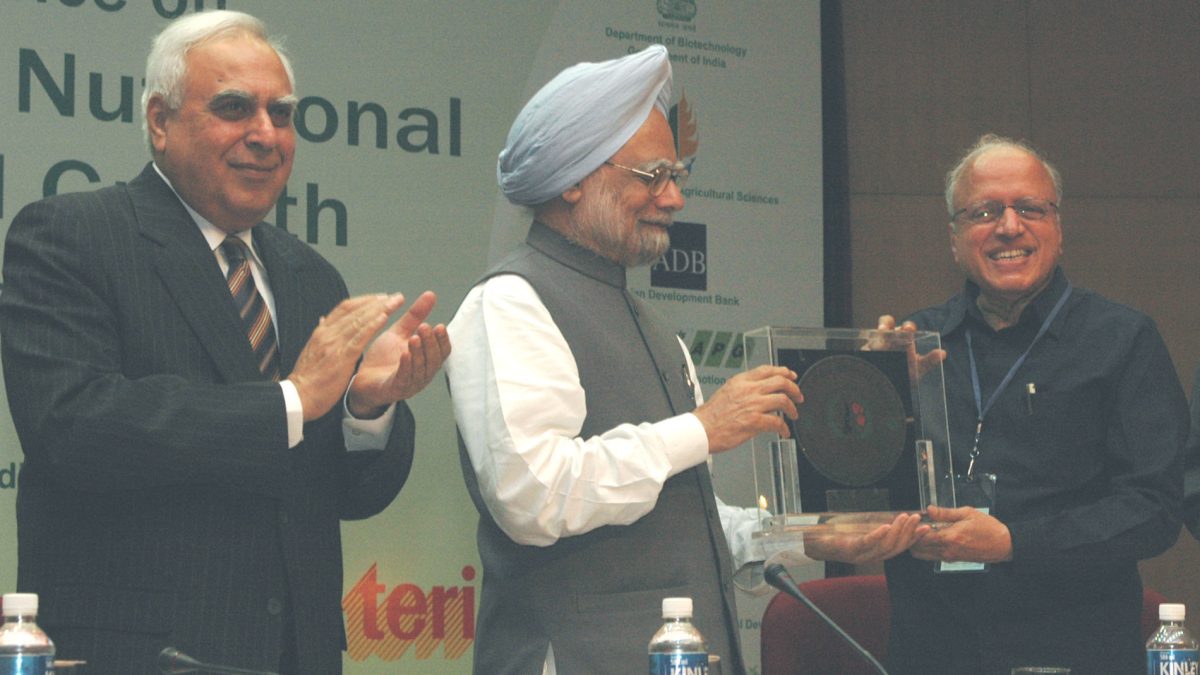
Featured image: M. S. Swaminathan (right) receives the B. P. Pal Centenary Award from Prime Minister Manmohan Singh, New Delhi, 2006. Photo by Prime Minister’s Office, licensed under Government Open Data License – India, via Wikimedia Commons.