Verghese Kurien (26 November 1921 – 9 September 2012) was an Indian engineer and social entrepreneur known as the father of the White Revolution. From a small town in Gujarat he built Amul, a dairy owned by its farmers, and then led Operation Flood, the programme that made India the largest producer of milk in the world.
Quick Facts
| Full name | Verghese Kurien |
| Born | 26 November 1921, Kozhikode (Calicut), Madras Presidency |
| Died | 9 September 2012, Nadiad, Gujarat (aged 90) |
| Field | Dairy engineering, cooperative management |
| Education | Loyola College, Madras (B.Sc.); College of Engineering, Guindy (B.E.); Michigan State University (M.S.) |
| Known for | Amul; Operation Flood; the White Revolution |
| Positions | Founder-Chairman, National Dairy Development Board; Chairman, Gujarat Cooperative Milk Marketing Federation |
| Honours | Ramon Magsaysay Award (1963), World Food Prize (1989), Padma Vibhushan (1999) |
| Spouse | Molly Kurien |
| Children | 1 |
Early Life and Education
He was born at Kozhikode in Kerala into a Syrian Christian family; his father was a civil surgeon in government service. He graduated in physics from Loyola College, Madras, in 1940 and in mechanical engineering from the College of Engineering at Guindy in 1943, and worked for a time at the Tata steel works in Jamshedpur.
A government scholarship sent him to Michigan State University, where he took a master’s degree in mechanical engineering in 1948. The scholarship was meant for dairy engineering, a subject in which, by his own account, he took little interest.
Career
Anand
The scholarship carried a bond. In May 1949 the government posted him to a run-down creamery at Anand in the Kaira district of Gujarat. He disliked the place and meant to leave as soon as he could.
At Anand, farmers led by Tribhuvandas Patel had formed a cooperative in 1946, with the encouragement of Sardar Vallabhbhai Patel, to escape the traders who controlled the milk trade. Tribhuvandas asked the young engineer to help with their machinery, and then to stay. He stayed for the rest of his life.
Amul
Kurien gave the cooperative modern plants and professional management while leaving ownership with the farmers. In 1955 his colleague H. M. Dalaya found a way to make milk powder from buffalo milk, which experts abroad had thought impossible, and the union could then absorb surplus milk in the flush season. The brand name Amul was adopted in 1957. Its butter, cheese and baby food pushed multinational brands aside, helped by an advertising campaign that has run since 1966.
Operation Flood
In 1964 Prime Minister Lal Bahadur Shastri visited Anand, spent a night in a village and asked Kurien to repeat the pattern across India. The National Dairy Development Board was set up at Anand in 1965 with Kurien as chairman, a post he held for 33 years.
Operation Flood, launched in 1970, linked village cooperatives to city markets through a national milk grid. It was financed at first by selling milk powder and butter oil donated by Europe. By the time it ended in 1996, India’s milk output had risen several times over, and in 1998 India overtook the United States as the largest producer.
He also founded the Institute of Rural Management at Anand in 1979.
In Popular Culture
Shyam Benegal’s film Manthan (1976), based on the cooperative movement, was paid for by five lakh Gujarat farmers who gave two rupees each. His memoir is titled I Too Had a Dream.
Personal Life
He married Molly, and they had a daughter, Nirmala. He was a famously outspoken man who quarrelled with bureaucrats and ministers. It was well known that he did not drink milk. He died at Nadiad in 2012.
Legacy
His birthday, 26 November, is observed as National Milk Day.
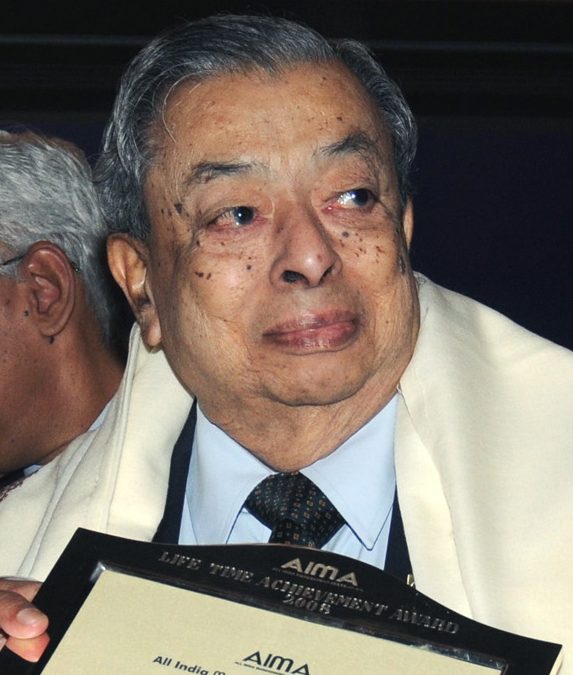
Featured image: Verghese Kurien receiving a lifetime achievement award in New Delhi, February 2009. Photo by Ministry of Railways, licensed under Government Open Data License – India, via Wikimedia Commons.