
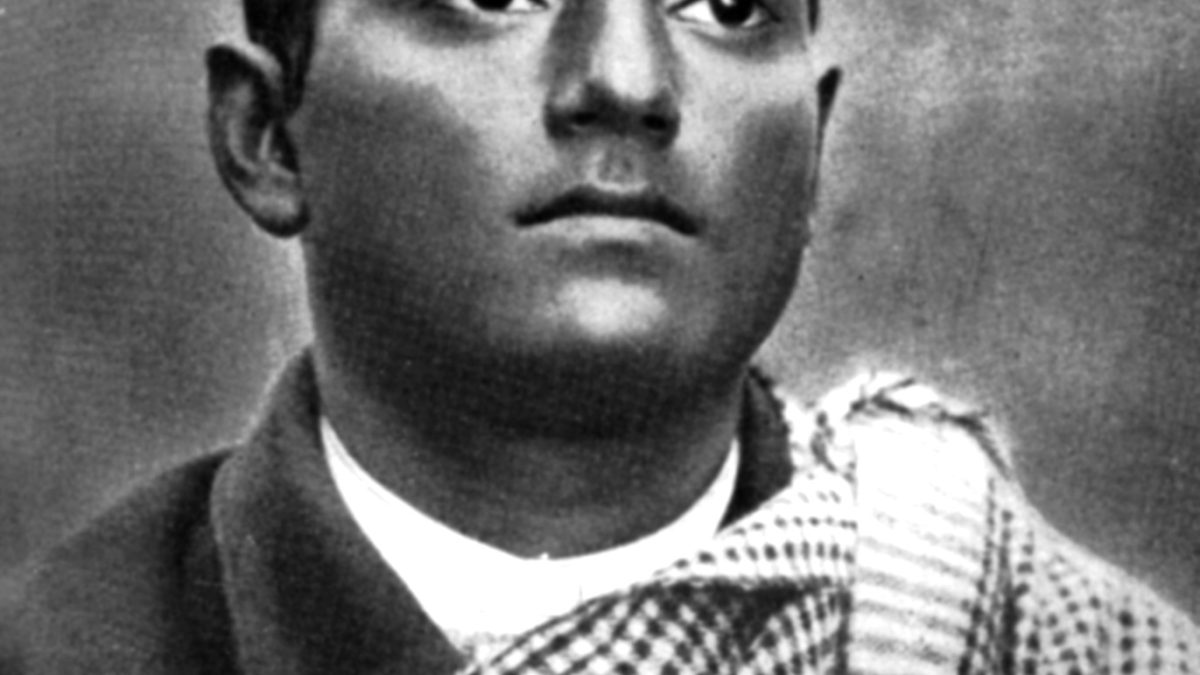
Jatindranath Mukherjee (7 December 1879 – 10 September 1915), known as Bagha Jatin, was an Indian revolutionary and the principal leader of the Jugantar group of Bengal. During the First World War he directed a plan to bring German arms into India for an armed rising. He died of wounds received in a battle with police on the banks of the Buribalam river near Balasore in Odisha. His reported words, “We shall die so that the nation may awake”, became a motto for the generation of revolutionaries who followed.
Quick Facts
| Full name | Jatindranath Mukherjee |
| Born | 7 December 1879, Kayagram, Kushtia (then Bengal Presidency, now Bangladesh) |
| Died | 10 September 1915 (aged 35), Balasore, Odisha |
| Known as | Bagha Jatin (“Tiger Jatin”) |
| Organisation | Jugantar |
| Known for | Indo-German conspiracy; Battle of Balasore |
| Spouse | Indubala Banerjee |
Early Life
Jatin was born in his mother’s village in the Kushtia region. His father died when he was five, and he was brought up by his mother, Sharatshashi, a poet with strong views on self-respect, and by his uncles. He was a powerful swimmer, rider and wrestler. After school at Krishnanagar he joined college in Calcutta in 1895, where he came under the influence of Swami Vivekananda, and learned shorthand and typing to earn a living.
In 1906, near his village, he fought a tiger that had been attacking people and killed it with a short dagger, suffering severe wounds. The surgeon who treated him publicised the feat, and he was known afterwards as Bagha Jatin.
Revolutionary Career
He worked as a stenographer, eventually for a senior official of the Bengal government, a post that gave him cover to travel. From about 1903 he organised secret societies in the districts, linked to the Anushilan Samiti and to the group around the journal Jugantar. He preferred small, independent cells that did not know one another, so that arrests could not destroy the network. Arrested in 1910 in the Howrah conspiracy case, he spent a year in jail and was acquitted when the charge of waging war could not be proved. He lost his government job and became a contractor.
When war broke out in 1914, Indian revolutionaries abroad obtained promises of German arms and money. Jatin was accepted as commander of the planned rising in eastern India. Shipments were to land on the coast of Odisha and in the Sundarbans, and Fort William in Calcutta was to be seized. To raise funds his men carried out a series of robberies in Calcutta in 1915. British intelligence, helped by informers abroad, uncovered the plan, and the ship carrying the arms never arrived.
Jatin had moved with four companions to a hideout in the forests near Balasore to receive the shipment. In September 1915 police under Charles Tegart, aided by local officials and villagers who took the strangers for robbers, closed in. On 9 September the five took position behind an anthill at Chashakhand and held off a large armed force for more than an hour with Mauser pistols. One companion, Chittapriya Ray Chaudhuri, was killed. Jatin, badly wounded, was taken to the hospital at Balasore and died the next day. Two of the others were hanged and one was sentenced to transportation for life.
Legacy
Tegart, his adversary, is said to have remarked that had Jatin been an Englishman his statue would have stood beside Nelson’s in Trafalgar Square. His methods and his example shaped the later Bengal revolutionaries, and many of his associates became prominent in the national movement. The site of the battle is preserved as a memorial, and streets, institutions and a neighbourhood of Kolkata carry his name.
Frequently Asked Questions
When and where was Bagha Jatin born?
Bagha Jatin was born on 7 December 1879 in Kayagram, Kushtia (then Bengal Presidency, now Bangladesh).
When did Bagha Jatin die?
Died: 10 September 1915 (aged 35), Balasore, Odisha.
What is Bagha Jatin known for?
Known for: Indo-German conspiracy; Battle of Balasore.
Featured image: Bagha Jatin (Jatindranath Mukherjee), undated photograph. Photo by an unknown photographer, licensed under CC BY-SA 4.0, via Wikimedia Commons.



