
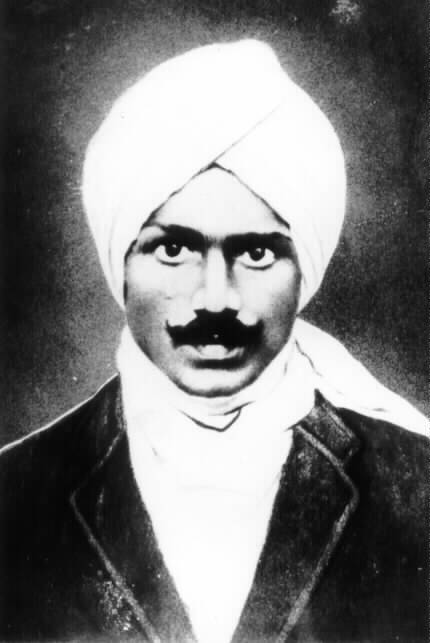
Chinnaswami Subramania Bharati (11 December 1882 – 11 September 1921), known as Bharathiyar and Mahakavi, the great poet, was an Indian poet, journalist and freedom fighter who wrote in Tamil. He is the father of modern Tamil poetry. In simple words and folk rhythms that anyone could sing, he wrote of the country’s freedom, the equality of women, the wickedness of caste and the love of God. He died poor at thirty-eight; his songs are now known to every Tamil.
Quick Facts
| Full name | Chinnaswami Subramania Bharati |
| Born | 11 December 1882, Ettayapuram, Tamil Nadu |
| Died | 11 September 1921, Madras (aged 38) |
| Language | Tamil |
| Occupation | Poet, journalist, freedom fighter |
| Notable works | Panchali Sabatham, Kuyil Pattu, Kannan Pattu, Swadesa Gitangal |
| Titles | Bharati; Mahakavi |
| Spouse | Chellammal |
| Children | 2 daughters |
Early Life
He was born at Ettayapuram, a small principality in the far south, where his father was employed at the court of the local ruler. His mother died when he was five. His father wanted him to learn English and mathematics and become an engineer; the boy made verses. At eleven, after he had impressed an assembly of scholars at the court, he was given the title Bharati, a name of the goddess of learning.
He was married at fourteen to Chellammal, who was seven. His father died soon after, and an aunt took him to Benares, where he spent about four years, learnt Sanskrit, Hindi and English, and saw a wider India.
Journalist
He worked briefly as a court poet and as a Tamil teacher at Madurai. In 1904 he joined the Madras daily Swadesamitran as a sub-editor. In 1905 he attended the Congress session at Benares and, on the way back, met Sister Nivedita, the Irish disciple of Vivekananda. She asked why he had not brought his wife, and told him that a nation could not be free while half of it was enslaved. He regarded her as his guru.
In 1906 he became editor of a new Tamil weekly, India, which supported Bal Gangadhar Tilak and the militant wing of the Congress. It was the first paper in Tamil to carry political cartoons. He attended the Surat Congress of 1907 with the shipping pioneer V. O. Chidambaram Pillai, and published his first book of patriotic songs.
Pondicherry
In 1908 the proprietor of India was jailed and a warrant was out for Bharati. He slipped away to Pondicherry, a French territory, and lived there for ten years. The British stopped his papers from entering their territory and his income dried up. He was often hungry.
These were nevertheless his great years. He had the company of Aurobindo Ghose and other exiles, and wrote his three major works:
- Kannan Pattu, songs in which Krishna is by turns the poet’s friend, mother, father, servant, king, child, beloved and teacher
- Kuyil Pattu, the song of the koel, a fantasy of love
- Panchali Sabatham, “Panchali’s Vow”, the episode of the dice game and the humiliation of Draupadi from the Mahabharata, in which she stands both for the Indian woman and for India in bondage
His Songs
- **Freedom:** “Achamillai, achamillai”, “there is no fear”; and a song that celebrates independence as already won, written decades before it came
- **One India:** “Sindhu nadhiyin misai”, imagining wheat from the Ganga exchanged for betel from the Kaveri
- **Women:** the “new woman” who walks upright and looks the world in the eye; he wrote that the customs that confined women should be burnt
- **Caste:** “there is no caste, little one”, from a song for children, “Odi vilayadu pappa”. He invested a Dalit youth with the sacred thread and ate with people of all communities, to the scandal of his own.
- **Children and nature**, and prose poems that were the first free verse in Tamil
He also wrote stories and essays, and translated from Sanskrit and English.
Return and Death
In November 1918 he crossed into British territory and was arrested at Cuddalore. He was released after some weeks on conditions, and lived in his wife’s village, in poor health. In 1920 he returned to Swadesamitran in Madras.
In mid-1921 he was struck by the elephant of the Parthasarathy temple at Triplicane, which he used to feed. He recovered from the injury but fell ill some weeks later and died in the early hours of 11 September 1921. About a dozen people attended the funeral.
Legacy
In 1949 the government of Madras bought the copyright in his works and gave it to the public, the first time this was done for any Indian writer. His songs are sung in concert halls, schools and films. His houses at Ettayapuram, Pondicherry and Triplicane are memorials, and a university at Coimbatore bears his name. His birthday is observed as a day of the Indian languages.
Among the Tamil reformers who came after him was Periyar.
Featured image: Subramania Bharati. Photo by an unknown photographer, in the public domain, via Wikimedia Commons.



