
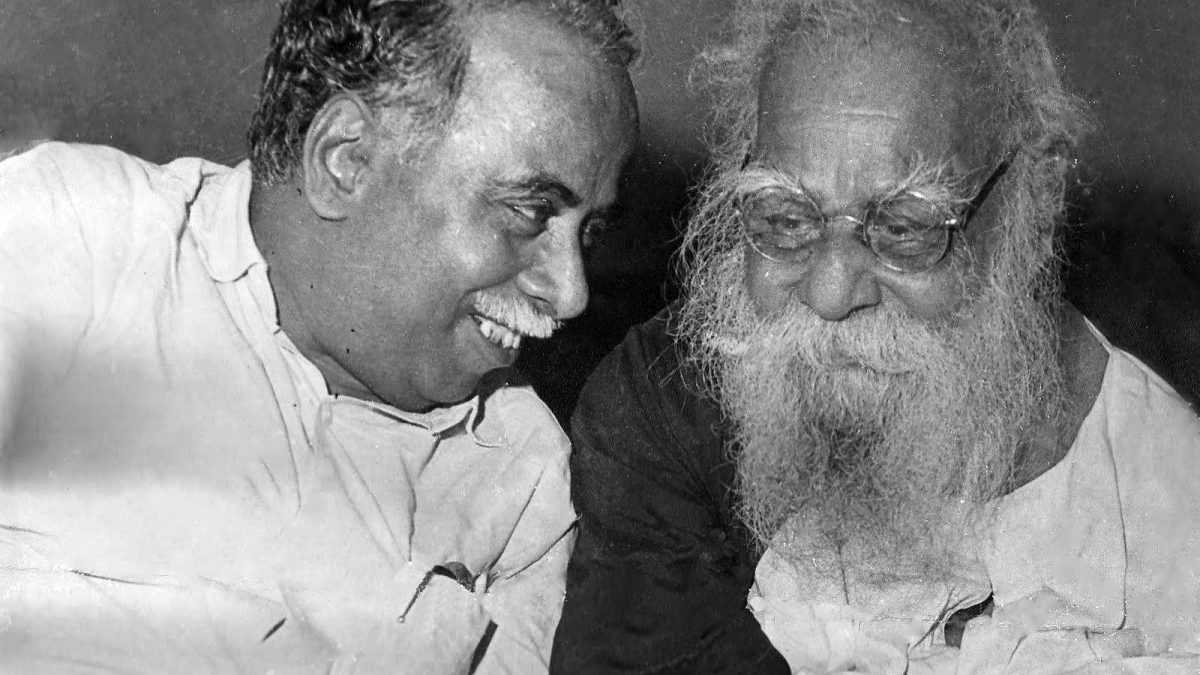
Erode Venkatappa Ramasamy (17 September 1879 – 24 December 1973), known as Periyar, “the great one”, or Thanthai Periyar, was an Indian social reformer and political leader who founded the Self-Respect Movement and the Dravidar Kazhagam. For half a century he campaigned against caste, the authority of Brahmin priests, religious orthodoxy and the subordination of women, and for the dignity of Tamil and other non-Brahmin people. Every major party in Tamil Nadu since 1967 has claimed descent from his movement.
Quick Facts
| Full name | Erode Venkatappa Ramasamy |
| Born | 17 September 1879, Erode, Madras Presidency (now Tamil Nadu) |
| Died | 24 December 1973 (aged 94), Vellore, Tamil Nadu |
| Known as | Periyar; Thanthai Periyar |
| Occupation | Social reformer, politician |
| Known for | Self-Respect Movement (1925); Dravidar Kazhagam (1944) |
| Journals | Kudi Arasu, Viduthalai |
| Spouse | Nagammai (d. 1933); Maniammai (m. 1949) |
Early Life
Ramasamy was born in Erode, the son of Venkatappa Nayakar, a prosperous merchant, into a devout family that often hosted religious teachers. He had only a few years of schooling and joined his father’s business at twelve. He was married at nineteen to Nagammai. Listening to the pandits who visited his home, he began to question the stories they told and the caste rules they upheld.
In 1904 he went on a pilgrimage to Kashi. The story he later told, of being turned away hungry from a free feeding house reserved for Brahmins although it had been endowed by a non-Brahmin merchant, marked for him the end of his faith.
Congress Years
He became a successful businessman and held many civic offices in Erode, including chairman of the municipality. In 1919 he joined the Indian National Congress, gave up his posts, took to khadi and led the picketing of toddy shops; he had the coconut trees in his own grove cut down. He was president of the party in the Tamil region.
In 1924 he went to Vaikom in Travancore, where people of the lowest castes were forbidden to use the roads around a temple, and led the agitation there after its local leaders had been arrested. He was jailed twice and earned the title “Hero of Vaikom”. A dispute over separate dining for Brahmin and other boys at a Congress-supported school, and the party’s refusal to accept reserved representation for non-Brahmins, convinced him that it would not confront caste. He walked out of its Kanchipuram session in 1925.
Self-Respect Movement
That year he founded the Self-Respect Movement and the weekly Kudi Arasu. It taught that people should refuse any practice that marked them as inferior by birth. It promoted marriages conducted without priests or ritual, the remarriage of widows, the right of women to property, divorce and birth control, and the dropping of caste names; he removed “Nayakar” from his own. He visited the Soviet Union and Europe in 1931–32.
In 1937 the Congress government of Madras made Hindi compulsory in schools. Periyar led the protest, in which two young men died in custody, and was sentenced to prison; while there, in 1938, he was elected president of the Justice Party, the old party of the non-Brahmin elite. The slogan “Tamil Nadu for Tamils” dates from these years.
Dravidar Kazhagam
At Salem in 1944 the party was renamed the Dravidar Kazhagam and turned into a social movement that would not contest elections. Its members wore black shirts. He called for a separate Dravidian country and declared 15 August 1947 a day of mourning, arguing that power was passing from the British to north Indian and upper-caste rule.
In 1949, at seventy, he married Maniammai, a party worker about forty years younger, saying that he needed a legal heir for the movement’s property. His chief lieutenant, C. N. Annadurai, left with most of the younger leaders and founded the Dravida Munnetra Kazhagam. Periyar continued with provocative protests: breaking images of Ganesha, burning pictures of Rama and, in 1957, copies of the Constitution, for which thousands of his followers went to jail. He supported the Congress Chief Minister K. Kamaraj, in whose policies of schooling and reservation he saw his own aims. When Annadurai won power in 1967 he dedicated the government to Periyar and legalised self-respect marriages.
Death and Legacy
He went on touring and speaking until days before his death at Vellore on 24 December 1973. Critics have objected to the harshness of his attacks on religion and on Brahmins. His admirers point to what changed: in few parts of India did the old hierarchy lose its hold so thoroughly, and reservation, rationalism and pride in the Tamil language became the common ground of the state’s politics.
Featured image: Periyar E. V. Ramasamy (right) with C. N. Annadurai. Photo by an unknown photographer, in the public domain, via Wikimedia Commons.



