
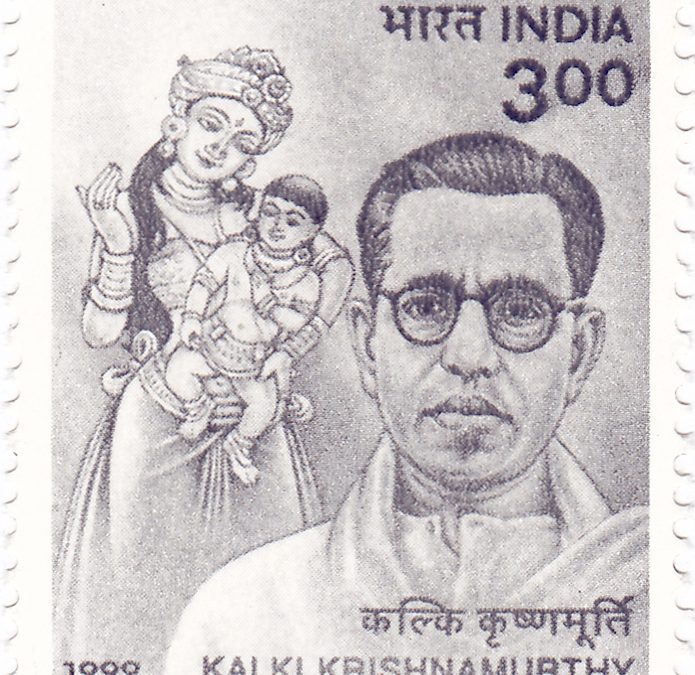
Ramaswamy Krishnamurthy (9 September 1899 – 5 December 1954), known by his pen name Kalki, was an Indian writer, journalist and freedom fighter who wrote in Tamil. He was the most popular Tamil writer of his time, the creator of the Tamil historical novel, and the founder of the magazine that bears his name. Ponniyin Selvan, his five-volume romance of the Chola empire, has been read by generation after generation and was filmed on a grand scale in 2022.
Quick Facts
| Full name | Ramaswamy Krishnamurthy |
| Pen name | Kalki |
| Born | 9 September 1899, Puttamangalam, near Mayiladuthurai, Tamil Nadu |
| Died | 5 December 1954, Madras (aged 55) |
| Language | Tamil |
| Occupation | Novelist, journalist, critic, freedom fighter |
| Founded | Kalki magazine (1941) |
| Notable works | Thyaga Bhoomi, Parthiban Kanavu, Sivagamiyin Sabadham, Alai Osai, Ponniyin Selvan |
| Awards | Sahitya Akademi Award (1956, posthumous) |
| Spouse | Rukmini |
Early Life
He was born in a village in the Kaveri delta, the son of a village accountant of modest means. He went to school at Mayiladuthurai and to the high school at Tiruchirappalli.
In 1921, shortly before his final examinations, he left school in response to Mahatma Gandhi‘s call for non-cooperation and joined the Congress. He was sentenced to a year in prison in 1922. He went to jail twice more, in 1930 and 1941.
Journalist
In 1923 he became a sub-editor on a nationalist Tamil daily. He then worked with C. Rajagopalachari, whom he regarded as his master, at his ashram in the countryside, editing a journal that campaigned for prohibition.
From 1928 he wrote for the humorous weekly Ananda Vikatan, and soon became its editor. Under him it grew into the most widely read magazine in the Tamil country. He wrote almost everything: political comment, satire, short stories, travel pieces, and music and dance reviews under another name. His Tamil was easy, lively and funny, and brought a whole new public to reading.
In 1941, when the magazine’s proprietor would not let him go to prison again, he left and, with his friend T. Sadasivam, the husband of the singer M. S. Subbulakshmi, founded his own weekly, Kalki.
Novels
Social novels
Thyaga Bhoomi (1939), about a Brahmin priest who shelters Dalits and a wife who walks out on her husband, was serialised with stills from the film being made of it at the same time. The film was banned by the British government for its nationalist scenes. Alai Osai (“The Sound of the Waves”, 1948), set against the freedom movement from 1930 to 1947, he thought his best book; it won the Sahitya Akademi Award after his death.
Historical novels
- Parthiban Kanavu (1941–43), on a Chola prince’s dream of independence under the Pallavas
- Sivagamiyin Sabadham (“Sivagami’s Vow”, 1944–46), on the wars of the Pallava and Chalukya kings in the seventh century and the sculptors of Mamallapuram
- Ponniyin Selvan (“The Son of the Kaveri”, 1950–54), on the tenth-century struggle for the Chola throne that ended with the accession of the prince who became Rajaraja the Great. It ran in his magazine for three and a half years, and readers waited at railway stations for each week’s issue.
He researched his periods with care, visiting the sites and reading the inscriptions, and then filled them with spies, conspirators, lovers and boatwomen of his own invention. The books gave Tamils a vivid sense of the greatness of their past. See the Great Living Chola Temples.
Music and Causes
He was the leading music critic in Tamil and a campaigner for the singing of Tamil songs in concerts, then dominated by Telugu and Sanskrit. He wrote lyrics himself; “Kaatrinile varum geetham”, sung by M. S. Subbulakshmi in the film Meera, is the best known. He raised the money for a memorial to the poet Subramania Bharati at Ettayapuram, and supported temple entry for Dalits and the remarriage of widows.
Death
He died in Madras on 5 December 1954 of tuberculosis, days after finishing the last instalment of Ponniyin Selvan. He was fifty-five.
Legacy
His works were made public property by the government of Tamil Nadu. Ponniyin Selvan has been serialised in the magazine again and again, each time lifting its sales, and was filmed in two parts by the director Mani Ratnam in 2022 and 2023.
Featured image: Kalki Krishnamurthy, from a 1999 postage stamp of India. Photo by India Post, Government of India, licensed under Government Open Data License – India, via Wikimedia Commons.



