Gurajada Venkata Apparao (21 September 1862 – 30 November 1915) was an Indian playwright, poet and reformer who wrote in Telugu. His play Kanyasulkam, written in the language people actually spoke, attacked the selling of child brides and is regarded as the greatest play in Telugu. He is considered the founder of modern Telugu literature.
Quick Facts
| Full name | Gurajada Venkata Apparao |
| Born | 21 September 1862, Rayavaram, Visakhapatnam district, Madras Presidency |
| Died | 30 November 1915, Vizianagaram (aged 53) |
| Language | Telugu (also wrote in English) |
| Occupation | Playwright, poet, short-story writer, teacher |
| Notable works | Kanyasulkam, Mutyala Saralu, Desamunu Preminchumanna, Diddubatu, Purnamma |
| Titles | Kavisekhara, Abhyudaya Kavita Pitamahudu |
| Spouse | Appala Narasamma (m. 1885) |
Early Life
He was born at his maternal uncle’s house at Rayavaram, near Yelamanchili. His father worked for the Vizianagaram estate as a revenue official. The father died young, and the boy was educated at Vizianagaram in some hardship, helped by the principal of the Maharaja’s College, C. Chandrasekhara Sastri, who gave him board and lodging.
Education and Service
He took his B.A. from the Maharaja’s College in 1886 with philosophy and Sanskrit, and became a teacher and then a lecturer there. He began by writing verse in English; a poem, “Sarangadhara”, was praised by an editor in Calcutta, who also advised him to write in his own language.
The Maharaja of Vizianagaram, Ananda Gajapati, took him into his circle. Gurajada served the royal house for the rest of his life as lecturer, epigraphist and later private secretary to the Maharaja’s sister, and was closely involved in the family’s long lawsuit over the estate.
Works
Kanyasulkam
The custom of kanyasulkam, bride price, led poor Brahmin families in the region to sell small girls in marriage to old men, who soon left them child widows. The Maharaja had a survey made and tried to have the practice outlawed. Gurajada wrote his play to rouse opinion. It was first performed in 1892 and published in 1897; he revised it thoroughly for the second edition of 1909.
It is a comedy. Its characters, the glib, English-spouting rogue Girisam, the wise courtesan Madhuravani, the miserly priest Agnihotravadhanlu, have become part of the Telugu language. The whole play is in the spoken dialect of the Vizianagaram region, which no serious writer had used before.
Poetry
In 1910 he published Mutyala Saralu (“Strings of Pearls”), poems in a new, simple metre of his own. They include:
- “Desamunu Preminchumanna” (“Love your country”), with its line that the country is not its soil but its people
- “Purnamma”, the ballad of a girl married to an old man
- “Kanyaka” and “Lavanaraju Kala”
Stories
“Diddubatu” (“Correction”), published in 1910, is generally counted as the first modern short story in Telugu.
The Language Question
With his schoolfellow and friend Gidugu Ramamurthy he led the movement to use spoken Telugu in place of the archaic literary dialect in books and in schools. In 1914, as a member of a Madras University committee on the subject, he wrote a long Minute of Dissent defending the living language. The cause won only after his death.
Personal Life
He married Appala Narasamma in 1885. His health was poor for years, and he died at Vizianagaram in 1915. His house there is preserved as a memorial library.
Legacy
The poet Sri Sri said that Telugu literature had three great poets, Tikkana, Vemana and Gurajada. Kanyasulkam has been staged continuously for more than a century and was filmed in 1955 with N. T. Rama Rao as Girisam.
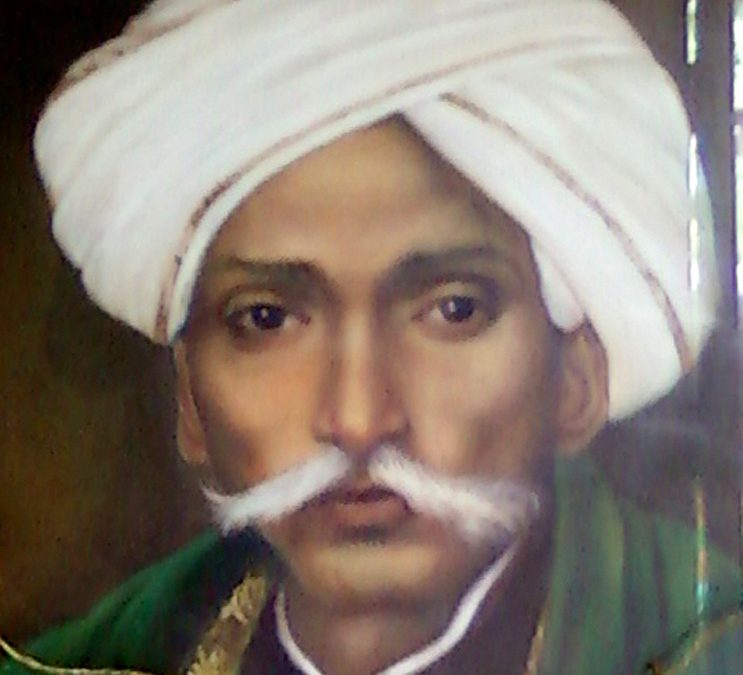
Featured image: A portrait of Gurajada Apparao kept at his house in Vizianagaram. Photo by Adityamadhav83, licensed under CC BY-SA 3.0, via Wikimedia Commons.