
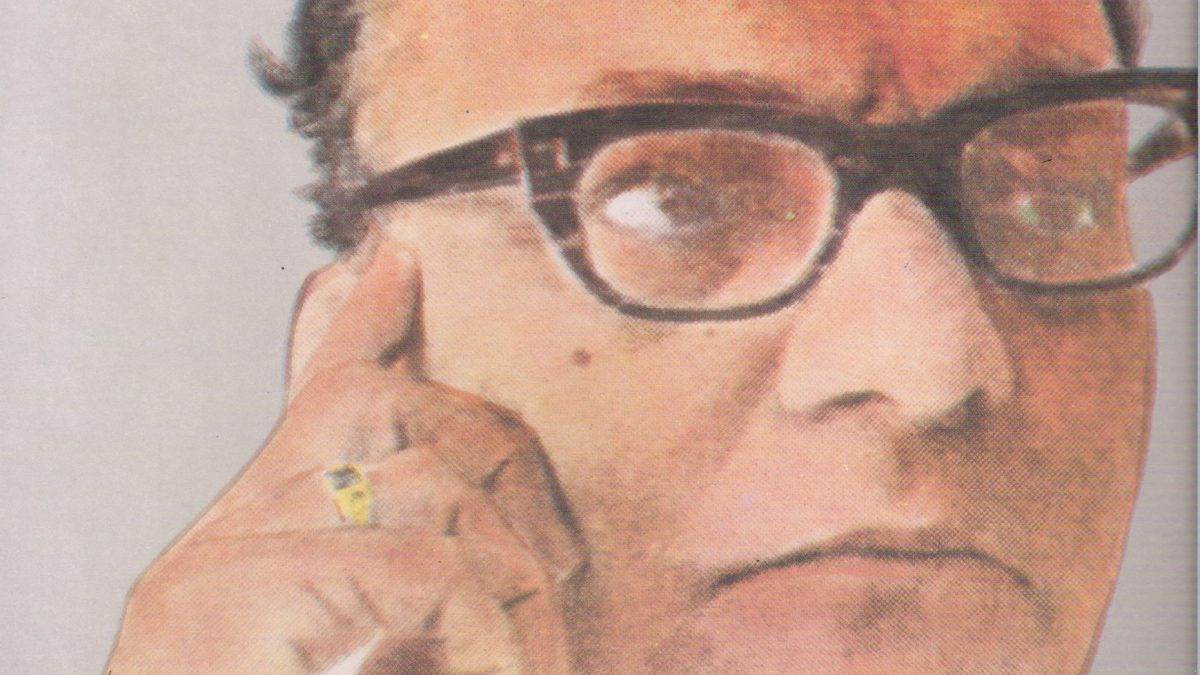
Srirangam Srinivasa Rao (30 April 1910 – 15 June 1983), known as Sri Sri, was an Indian poet and lyricist who wrote in Telugu. His collection Maha Prasthanam, written in the 1930s, turned Telugu poetry away from romance and devotion towards the worker, the hungry and the street. He is called Mahakavi, the great poet, and remains the most quoted Telugu poet of the twentieth century.
Quick Facts
| Full name | Srirangam Srinivasa Rao |
| Pen name | Sri Sri |
| Born | 30 April 1910, Visakhapatnam, Madras Presidency |
| Died | 15 June 1983, Madras (aged 73) |
| Language | Telugu |
| Occupation | Poet, film lyricist, translator |
| Notable works | Maha Prasthanam, Khadga Srishti, Maro Prasthanam, Siprali, Anantam |
| Awards | Sahitya Akademi Award (1972), National Film Award for Best Lyrics (1974), Soviet Land Nehru Award |
| Spouse | Venkata Ramanamma; Sarojini |
Early Life
He was born in Visakhapatnam and was adopted by a relative, Srirangam Suryanarayana, whose family name he took. He began writing verse as a child in the classical style and published his first book, Prabhava, while still in his teens. He took his B.A. from Madras University in 1931.
The Years of Hunger
The Depression years that followed were hard. He was unemployed or in poorly paid jobs, working at different times as a clerk and a newspaper sub-editor, and he knew hunger. Reading the modern poets of Europe and the news of the world’s upheavals, and influenced by the Telugu poets Gurajada Apparao and Kavikondala Venkata Rao, he broke with the romantic school in which he had been formed.
Maha Prasthanam
The poems he wrote between about 1933 and 1940 were collected as Maha Prasthanam (“The Great Journey”) and published as a book in 1950, with a celebrated preface by the writer Chalam. Their rhythms are those of a march or a drum. They announce another world, call on the reader to come forward, and insist that poetry can be made of anything: a matchstick, a piece of soap, a puppy. Lines from them are known to Telugu speakers who have read little else.
“Until 1930, Telugu poetry led me,” he said; “after that, I led it.”
Movements
He was a founder of the progressive writers’ association in Telugu, the Abhyudaya Rachayitala Sangham, in 1943. In 1970, at a meeting held to honour his sixtieth birthday, young poets inspired by the peasant uprisings at Naxalbari and Srikakulam challenged the older writers to take sides. He did, and became the first president of the Revolutionary Writers’ Association, known as Virasam.
Films
To earn a living he moved to Madras and from 1950 wrote for the cinema, beginning with a dubbed film, Ahuti. Over three decades he wrote lyrics, dialogue and dubbing scripts for hundreds of Telugu films. His song “Telugu Veera Levara” in Alluri Seetarama Raju won the National Film Award for Best Lyrics for 1974.
Other Works
- Khadga Srishti (“Creation of the Sword”) and Maro Prasthanam, later collections
- Siprali, light verse and limericks
- Charama Ratri, short stories
- Radio plays and translations of French and other surrealist poets
- Anantam, a frank autobiography
He received the Sahitya Akademi Award in 1972.
Personal Life
He married Venkata Ramanamma, and later Sarojini, who was his secretary and collaborator on film work; he had a son and three daughters with Sarojini. He died of cancer in Madras in 1983.
Legacy
A statue of him stands on the Tank Bund in Hyderabad and on the beach road in Visakhapatnam. For Telugu readers “Sri Sri” is nearly a synonym for modern poetry.
Featured image: A portrait of Sri Sri. Photo by రహ్మానుద్దీన్, licensed under CC BY-SA 3.0, via Wikimedia Commons.



