
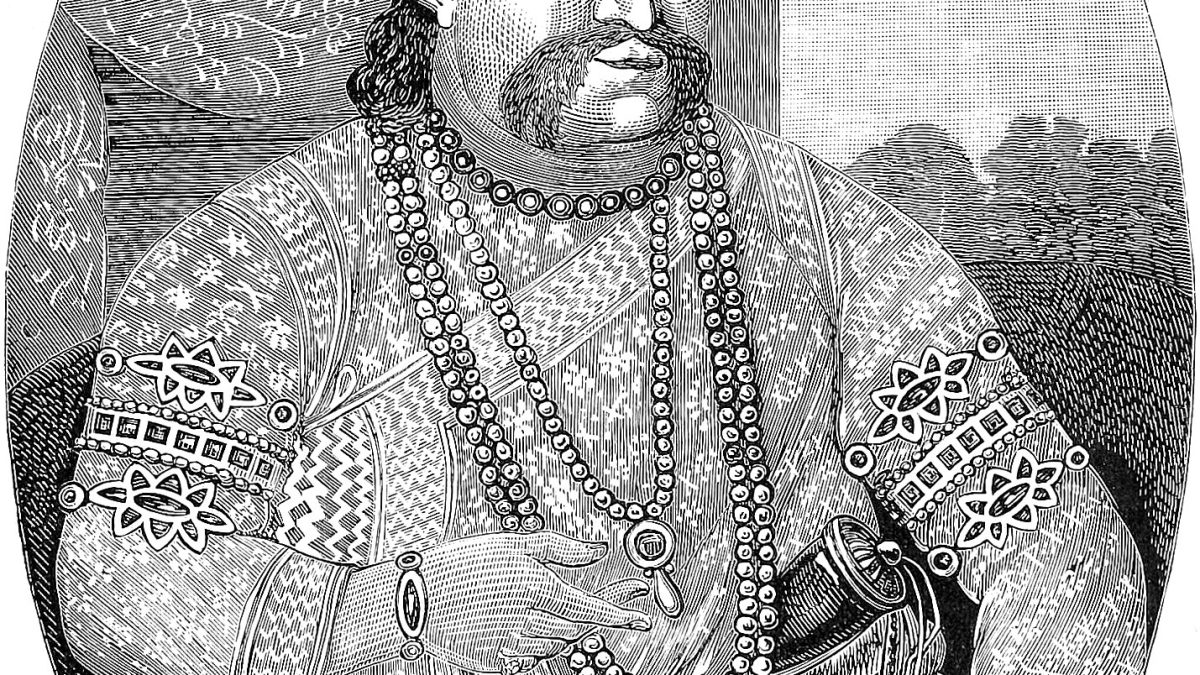
Wajid Ali Shah (30 July 1822 – 1 September 1887) was the last King of Awadh, who reigned from 1847 until the East India Company annexed his kingdom in 1856. A poet, playwright, composer and dancer, he was one of the great patrons of the arts in nineteenth-century India; the Lucknow style of Kathak and the thumri owe much to his court. He spent the last thirty years of his life in exile near Calcutta. British writers of the time portrayed him as a dissolute ruler who lost his throne through neglect, a judgement later historians have questioned.
Quick Facts
| Title | King of Awadh |
| Born | 30 July 1822, Lucknow, Uttar Pradesh, India |
| Died | 1 September 1887 (aged 65), Metiabruz, Calcutta |
| Reign | 13 February 1847 – 11 February 1856 |
| Father | Amjad Ali Shah |
| Known for | Patronage of Kathak, thumri and Urdu theatre; Qaiserbagh |
| Pen name | Akhtar |
| Spouses | Many, including Begum Hazrat Mahal |
Early Life
He was born in Lucknow and came to the throne at twenty-four on the death of his father. He had been educated in Persian and Urdu literature, music and the conduct of government, and he began his reign with energy, reorganising the army, attending parades daily and hearing petitions in person.
Reign
The kings of Awadh had long been reduced to dependence by treaties with the East India Company, whose Resident in Lucknow watched and reported on everything. Ill health and the obstruction he met soon turned the young king away from administration towards the arts. Successive Residents sent the Governor-General accounts of disorder in the countryside and frivolity at court.
He built the Qaiserbagh palace complex between 1848 and 1850 as the setting for his court. He was himself a trained dancer and musician, a pupil of the Kathak masters of Lucknow, and under him the dance acquired the grace and expressiveness that distinguish the Lucknow tradition. He composed and staged dance-dramas on the story of Krishna and Radha, called rahas, in which he sometimes took part; they are counted among the beginnings of modern Urdu theatre. Writing under the name Akhtar, he composed ghazals, long narrative poems and many thumris, and he is the author of dozens of books in Urdu and Persian. The thumri “Babul mora naihar chhooto jaye”, a bride’s lament on leaving her father’s house, is traditionally said to express his grief at leaving Lucknow.
Annexation
On 7 February 1856 the Governor-General, Lord Dalhousie, annexed Awadh on the ground of misgovernment. The king refused to sign the treaty placed before him by the Resident, James Outram, but ordered his troops and people not to resist. He left for Calcutta, intending to go to London to plead his case; his mother went in his place and died in Paris on the journey home.
Resentment at the annexation was a leading cause of the uprising of 1857 in Awadh. One of his wives, Begum Hazrat Mahal, proclaimed their young son king and directed the resistance at Lucknow. The former king, though he took no part, was confined in Fort William for more than two years.
Exile
Released in 1859, he settled on a British pension at Metiabruz on the Hooghly below Calcutta. There he recreated a small Lucknow, with palaces, mosques, imambaras, a private zoo, poets, musicians and kite-fliers. Many customs of the old court survived there, and Kolkata’s style of biryani is popularly traced to his kitchens. He died on 1 September 1887 and is buried in the imambara he built at Metiabruz.
Legacy
His reputation has risen as the charges used to justify the annexation have been re-examined. His last days in Lucknow are the background of a celebrated short story by Premchand, filmed by Satyajit Ray as Shatranj Ke Khilari (1977).
Frequently Asked Questions
When and where was Wajid Ali Shah born?
Wajid Ali Shah was born on 30 July 1822 in Lucknow, Uttar Pradesh, India.
When did Wajid Ali Shah die?
Died: 1 September 1887 (aged 65), Metiabruz, Calcutta.
What is Wajid Ali Shah known for?
Known for: Patronage of Kathak, thumri and Urdu theatre; Qaiserbagh.
Featured image: Wajid Ali Shah, engraving published in 1895. Photo by an unknown artist, in the public domain, via Wikimedia Commons.



