
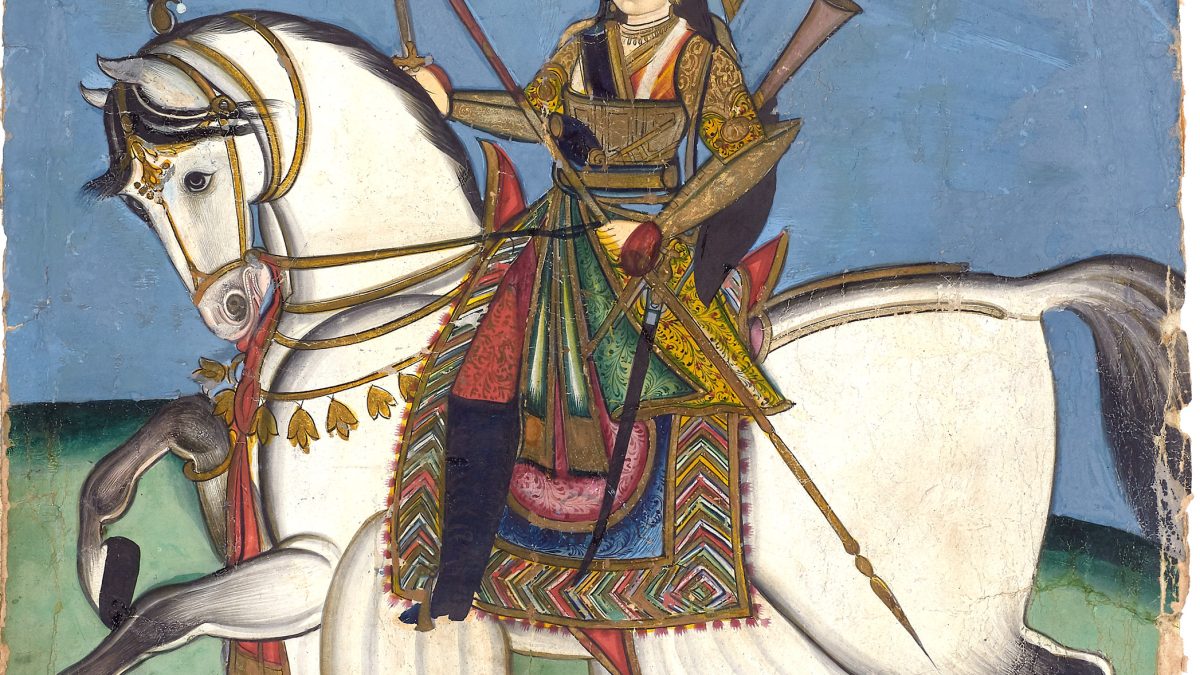
Rani Lakshmibai (19 November 1828 – 18 June 1858), the Rani of Jhansi, was a queen of the Maratha-ruled state of Jhansi. She was one of the leading figures of the Indian Rebellion of 1857. She refused to hand her kingdom to the British East India Company and led her forces in battle on horseback. She died fighting at Gwalior and became an enduring symbol of courage and resistance to colonial rule in India.
Quick Facts
| Birth name | Manikarnika Tambe (“Manu”) |
| Born | 19 November 1828, Varanasi, India |
| Died | 18 June 1858, Kotah-ki-Serai, near Gwalior (aged 29) |
| Title | Rani (Queen) of Jhansi |
| Father | Moropant Tambe |
| Spouse | Maharaja Gangadhar Rao Newalkar of Jhansi (m. 1842; d. 1853) |
| Children | Damodar Rao (died in infancy); adopted son Damodar Rao |
| Known for | Leading resistance in the Indian Rebellion of 1857 |
Early Life
Lakshmibai was born Manikarnika Tambe in Varanasi and was affectionately called Manu. Her mother died when she was about four, and her father, Moropant Tambe, took her to the court of the former Peshwa, Baji Rao II, at Bithoor. There she grew up alongside boys such as Nana Sahib and learned to read, ride horses, and use the sword and other weapons. These were unusual skills for a girl of her time.
Queen of Jhansi
In 1842 Manikarnika married Gangadhar Rao Newalkar, the Maharaja of Jhansi, and took the name Lakshmibai. Their son, born in 1851, died a few months later. Shortly before his own death in November 1853, the Maharaja adopted a young relative, who was renamed Damodar Rao, as his heir.
The Doctrine of Lapse
The Governor-General, Lord Dalhousie, refused to recognise the adopted heir under the Doctrine of Lapse. Under that policy the Company could annex any princely state whose ruler died without a natural heir. Jhansi was annexed in 1854 and the Rani was granted a pension. She appealed the decision without success. Her defiant words, remembered in legend as “Main apni Jhansi nahi doongi” (“I will not give up my Jhansi”), became a rallying cry.
The Rebellion of 1857
When the rebellion broke out in 1857, Company troops at Jhansi mutinied, and the Rani took control of the state. She organised its defences, recruited soldiers and trained women for combat.
In March 1858 British forces under Sir Hugh Rose besieged Jhansi. After a fierce defence the city fell in early April. According to popular accounts, the Rani escaped from the fort at night on horseback with her adopted son tied to her back.
Lakshmibai joined the rebel leader Tatya Tope at Kalpi. After further defeats, the rebels made a daring move and captured the fortress city of Gwalior. British forces soon counterattacked.
Death
On 18 June 1858, dressed as a cavalry leader, Lakshmibai was mortally wounded fighting the British at Kotah-ki-Serai near Gwalior. She was about 29. Sir Hugh Rose later described her as the most dangerous of all the rebel leaders.
Legacy
Frequently Asked Questions
When and where was Rani Lakshmibai born?
Rani Lakshmibai was born on 19 November 1828 in Varanasi, India.
When did Rani Lakshmibai die?
Died: 18 June 1858, Kotah-ki-Serai, near Gwalior (aged 29).
What is Rani Lakshmibai known for?
Known for: Leading resistance in the Indian Rebellion of 1857.
Featured image: Rani Lakshmibai on horseback, a painting from Central India, possibly Jhansi, c. 1860. Image via Wikimedia Commons, in the public domain.



