
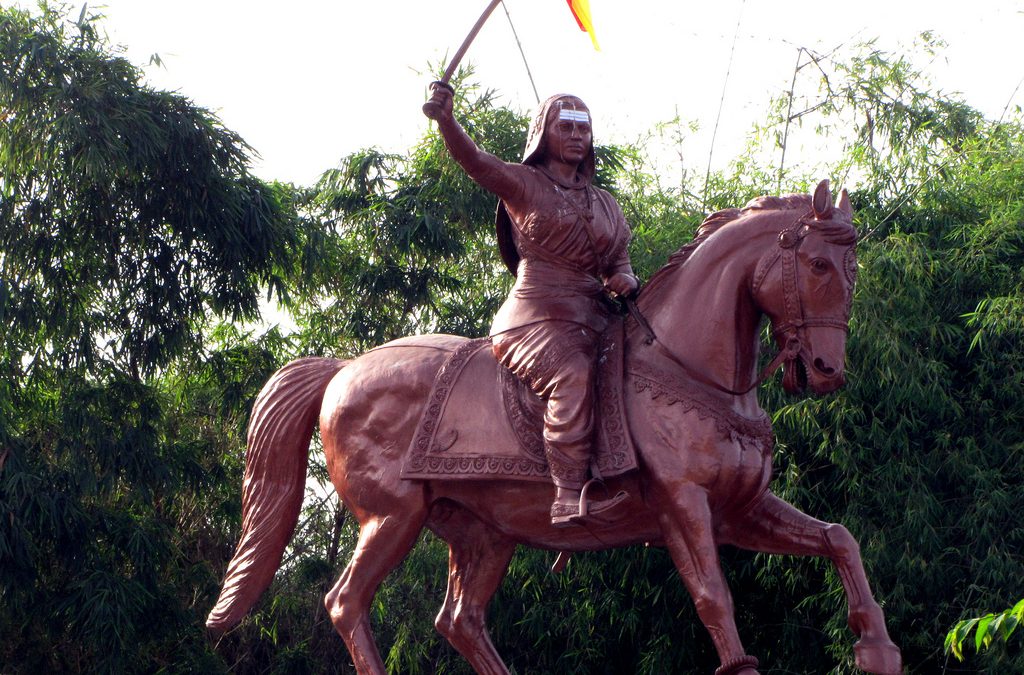
Kittur Rani Chennamma (23 October 1778 – 21 February 1829) was the queen of Kittur, a small princely state in what is now northern Karnataka. In 1824, when the East India Company refused to recognise her adopted heir and moved to take over the state, she led her forces against it and won the first engagement. She was defeated and died in captivity. She is remembered as one of the first Indian rulers to take up arms against British rule, a generation before the Revolt of 1857.
Quick Facts
| Born | 23 October 1778, Kakati, Belgaum district, Karnataka |
| Died | 21 February 1829, Bailhongal (aged 50) |
| Title | Rani of Kittur |
| Known for | Armed resistance to the East India Company, 1824 |
| Spouse | Raja Mallasarja Desai of Kittur |
| Adopted son | Shivalingappa |
Early Life
She was born at Kakati, a village near Belgaum, into a Lingayat family. As a girl she was trained in riding, sword-fighting and archery, and was known in her district for her courage. At about fifteen she was married to Mallasarja, the Desai, or ruler, of Kittur, a prosperous little state on the trade route between the Deccan and the coast.
The Crisis
Her husband died in 1816. Her son succeeded him and died in 1824, leaving no heir. Chennamma adopted a boy of the family, Shivalingappa, and placed him on the throne.
The East India Company, which had become the paramount power in the region after defeating the Marathas, refused to recognise the adoption. The Collector of Dharwad, St John Thackeray, held that the state had lapsed to the Company, took charge of its administration and sealed its treasury, which was said to hold some fifteen lakh rupees in coin and jewels. The principle was the one that Lord Dalhousie would later make notorious as the Doctrine of Lapse.
Chennamma wrote to the Governor of Bombay pleading her case. The plea was rejected.
The Battle of October 1824
On 23 October 1824 Thackeray brought troops and guns up to the fort of Kittur and gave an ultimatum. The gates opened and the Kittur forces, led by the Rani’s commanders, charged out. Thackeray was shot dead, with a number of his men, and two British officers were taken prisoner.
The Rani treated the prisoners well. She released them on a promise from the Company’s commissioner that the fighting would stop and negotiations begin.
Defeat
The promise was not kept. The Company gathered a much larger force from Mysore and Sholapur, with heavy artillery, and attacked again at the beginning of December. The defenders held out for several days; gunpowder in the fort is said to have been tampered with by traitors. A British officer who was a nephew of the Governor of Madras was among those killed. Kittur fell on 5 December 1824.
Captivity
Chennamma was taken prisoner and confined in the fort of Bailhongal, where she spent her days in reading scripture and worship. She died there on 21 February 1829.
Sangolli Rayanna
Her lieutenant Sangolli Rayanna escaped and carried on a guerrilla war in the countryside, aiming to restore the adopted prince. He was captured through treachery and hanged in 1831.
Legacy
Kittur was absorbed into the Company’s territory. But the Rani became a heroine of Kannada folk songs and plays, and later of the freedom movement.
- A statue of her on horseback stands in the grounds of Parliament in New Delhi, unveiled in 2007.
- The Kittur Utsav is held every October to mark her victory.
- A train between Bengaluru and the north of the state, a university at Belagavi and many institutions in Karnataka carry her name.
She is often spoken of with Rani Lakshmibai of Jhansi, who fought the same policy thirty-three years later in the Revolt of 1857.
Featured image: A statue of Kittur Rani Chennamma. Photo by Suma, licensed under CC BY-SA 2.0, via Wikimedia Commons.



