
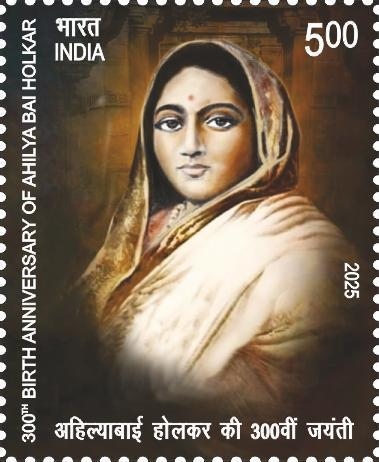
Ahilyabai Holkar (31 May 1725 – 13 August 1795) was the ruler of the Holkar state of Malwa, in central India, from 1767 until her death. A village headman’s daughter who lost her husband, her father-in-law and her son within thirteen years, she took charge of the kingdom and governed it for nearly three decades with a justice and economy that contemporaries, Indian and British, thought remarkable. She is remembered across India for the temples, ghats, wells and rest-houses she built at the country’s holy places.
Quick Facts
| Born | 31 May 1725, Chaundi, Ahmednagar district, Maharashtra |
| Died | 13 August 1795, Maheshwar, Madhya Pradesh (aged 70) |
| Dynasty | Holkar |
| Reign | 1767–1795 |
| Capital | Maheshwar |
| Father | Mankoji Shinde |
| Spouse | Khanderao Holkar (d. 1754) |
| Children | Male Rao and Muktabai |
| Title | Punyashlok, “of sacred fame” |
Early Life
She was born at Chaundi, a village in the Deccan, the daughter of its headman, a man of the shepherd community. Girls were not then taught to read; her father taught her.
The story goes that Malhar Rao Holkar, a general of the Maratha Peshwa who had made himself master of Malwa, stopped at the village on his way to Pune and noticed the eight-year-old girl feeding the poor at the temple. He took her home as a bride for his son, Khanderao. They were married in 1733.
Widowhood
Khanderao was killed by a cannon shot in 1754, at the siege of the fort of Kumher. She prepared to burn herself on his pyre, as custom expected. Malhar Rao begged her not to, saying that he had lost a son and could not lose her too.
He trained her as his deputy. While he was away on campaign she ran the administration, collected revenue and forwarded supplies and guns; his letters to her give detailed military instructions. He died in 1766. Her son, Male Rao, succeeded him and died insane within a year.
Ruler
A minister of the state plotted with the Peshwa’s uncle to seize it. She wrote to the Peshwa asking to be allowed to rule herself, and called out her troops. The Peshwa gave his sanction, and in December 1767 she took charge. She appointed Tukoji Holkar, a trusted officer of the clan, to command the army, and for nearly thirty years the two worked in harmony, he in the field and she at the seat of government.
She moved the capital to Maheshwar, on the north bank of the Narmada.
Government
- **Justice:** she held open court every day, heard any subject who came, and was known for patient and impartial decisions
- **Revenue:** the land tax was moderate and its collection regular; she left the treasury full
- **Property:** she ended the practice by which the state seized the wealth of those who died without sons, and allowed widows to keep it and to adopt heirs
- **Order:** she brought the Bhil and Gond tribes, who raided the roads, to a settlement by granting them land and the right to a small toll in return for protecting travellers
- **Trade:** merchants and bankers were encouraged to settle, and Indore grew from a village into a prosperous town
- **Weaving:** she brought weavers to Maheshwar, where they began making the fine cotton and silk cloth that still carries the town’s name
Sir John Malcolm, the British administrator who collected accounts of her a generation later, wrote that she appeared, within her sphere, one of the purest and most exemplary rulers that ever existed.
Builder
She kept the money of the state separate from her personal estate and spent the latter on works of piety, far beyond her own territory.
- the Kashi Vishwanath temple at Varanasi, rebuilt in 1780 beside the site of the one demolished in the previous century, and ghats there, among them the one that bears her name
- a temple at Somnath in Gujarat
- the Vishnupad temple at Gaya
- temples, ghats and pilgrim houses at Ayodhya, Mathura, Haridwar, Dwarka, Rameswaram, Puri, Nashik, Ujjain, Omkareshwar and many other places
- wells, tanks and roads, and Ganga water sent each year to shrines across the country
Sorrows
Her private life was a succession of losses. Her daughter Muktabai burnt herself on her husband’s pyre in 1791, though her mother pleaded with her. Ahilyabai lived austerely, dressed in plain white, and spent hours each day in worship and in hearing scripture.
Death
She died at Maheshwar on 13 August 1795. Tukoji succeeded her.
Legacy
The airport and the university at Indore are named after her, and in 2023 the district of her birth was renamed Ahilyanagar. Her fort and the ghats at Maheshwar are among the sights of the Narmada. The three-hundredth anniversary of her birth was observed across India in 2025.
Featured image: Ahilyabai Holkar, from a 2025 postage stamp of India. Photo by India Post, Government of India, licensed under Government Open Data License – India, via Wikimedia Commons.



