
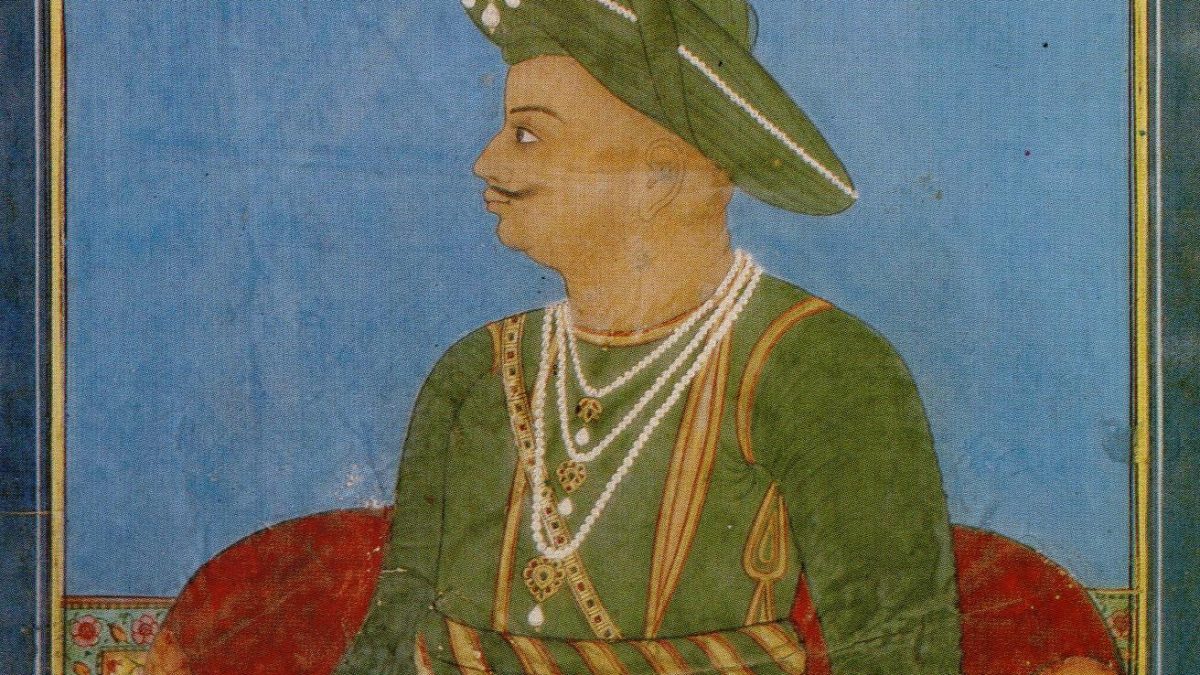
Tipu Sultan (20 November 1750 – 4 May 1799), known as the Tiger of Mysore, was the ruler of the kingdom of Mysore in south India from 1782 until his death. The son of Haidar Ali, he fought the English East India Company in three wars, used rockets in battle, sought alliances with France and the Ottoman empire, and tried to modernise his state’s army and economy. He was killed when the British stormed his capital. He remains a hero to many Indians and a deeply contested figure to others.
Quick Facts
| Full name | Sultan Fateh Ali Sahab Tipu |
| Born | 20 November 1750, Devanahalli, near Bangalore |
| Died | 4 May 1799, Seringapatam (aged 48) |
| Title | Sultan of Mysore |
| Reign | 1782–1799 |
| Father | Haidar Ali |
| Known for | The Anglo-Mysore Wars; Mysorean rockets; resistance to the East India Company |
| Capital | Seringapatam (Srirangapatna) |
Early Life
He was born at Devanahalli, north of Bangalore, and named after a Sufi saint of Arcot, Tipu Mastan Aulia. His father, Haidar Ali, an officer in the army of the Wodeyar rajas of Mysore, rose to become the real ruler of the kingdom by about 1761.
Haidar, who could not read, gave his son a prince’s education: the Quran, Persian, Arabic, Kannada and Urdu, and the arts of riding and war, some of it from French officers in his father’s service. Tipu commanded troops in his teens.
The Wars
- **First Anglo-Mysore War (1767–1769):** he took part as a youth
- **Second (1780–1784):** he destroyed a British column under Colonel Braithwaite in 1782. Haidar died that December, and Tipu succeeded him. He ended the war by the Treaty of Mangalore, on equal terms, the last time an Indian ruler dictated peace to the Company.
- **Third (1790–1792):** his attack on Travancore brought the British, the Marathas and the Nizam against him together. Besieged in his capital, he had to give up half his kingdom and hand over two of his sons as hostages.
- **Fourth (1799):** he died in the storming of Seringapatam
The Ruler
He was an energetic and inventive administrator, interested in everything.
- **Rockets:** his army used iron-cased rockets with a range of up to two kilometres. The British studied captured examples and developed the Congreve rocket from them.
- **Economy:** he introduced silk cultivation to Mysore, set up state factories and trading houses, planned a dam on the Kaveri, and laid out the Lal Bagh garden at Bangalore begun by his father
- **Reforms:** a new calendar, new coins, new weights and measures, and a revenue system that dealt directly with the cultivators
- **Diplomacy:** he sent embassies to the Ottoman Sultan and to Louis XVI of France, and later corresponded with Napoleon. French republicans at his capital founded a Jacobin club and addressed him as “Citizen Tipu”.
The tiger was his emblem: on his throne, his banners, his soldiers’ uniforms and a mechanical toy showing a tiger mauling a European.
The Debate
His record in religious matters is fiercely argued over.
- **The charge:** in campaigns in Malabar, Coorg and Mangalore he deported large numbers of people, among them Nairs, Kodavas and Catholics, and many were forcibly converted to Islam. His own letters boast of it.
- **The defence:** these were punishments of rebellious regions, not a general policy. In Mysore itself he gave grants to Hindu temples, including the Ranganatha temple beside his palace, and corresponded respectfully with the head of the Sringeri monastery, whom he helped after a Maratha raid. His chief ministers were Hindus.
Both sets of facts are documented. Arguments over how to remember him continue in Karnataka to this day.
Death
He was killed at the gate of his fort on 4 May 1799 and buried beside his father. A saying attributed to him is that it is better to live a day as a tiger than a hundred years as a sheep. The Wodeyar dynasty was restored under British protection.
Featured image: Tipu Sultan, portrait by an unknown Mysore artist, about 1790. Photo by an unknown Mysore artist, in the public domain, via Wikimedia Commons.



