
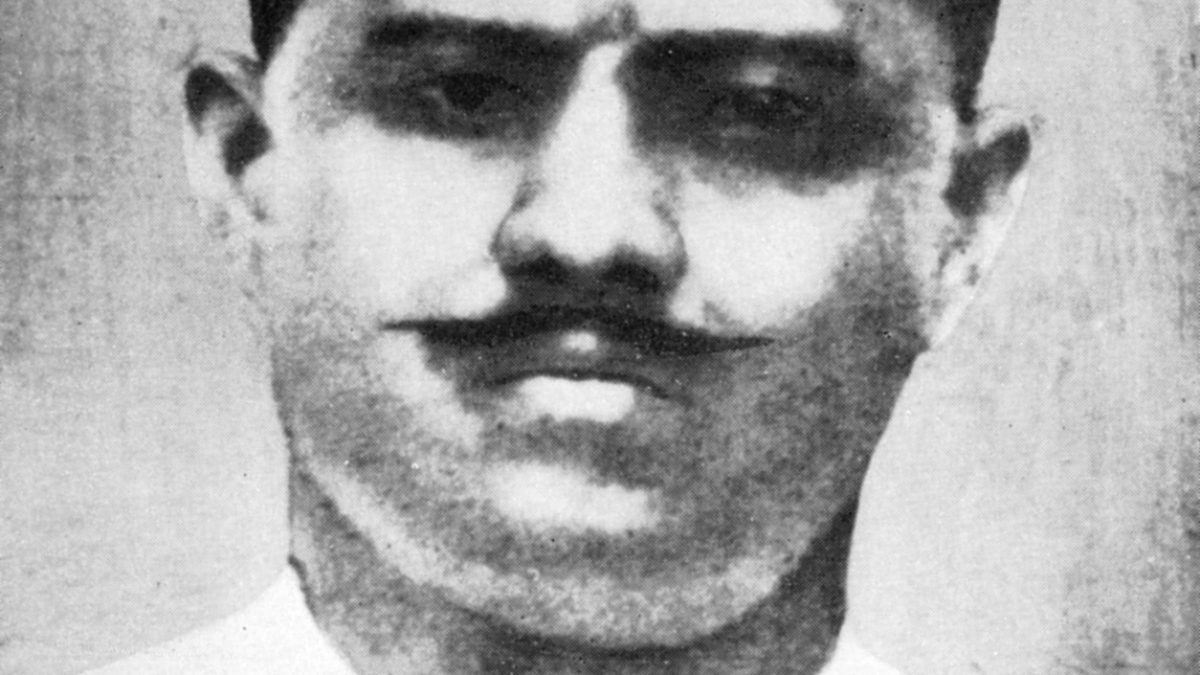
Ram Prasad Bismil (11 June 1897 – 19 December 1927) was an Indian revolutionary, poet and writer. He was a founder of the Hindustan Republican Association and the leader of the Kakori train action of August 1925, for which he was hanged at Gorakhpur. He wrote in Hindi and Urdu under several pen names, and the patriotic verse associated with him, above all “Sarfaroshi ki tamanna”, was sung by generations of freedom fighters.
Quick Facts
| Full name | Ram Prasad Bismil |
| Born | 11 June 1897, Shahjahanpur, United Provinces (now Uttar Pradesh) |
| Died | 19 December 1927 (aged 30), Gorakhpur Jail |
| Organisation | Hindustan Republican Association |
| Known for | Mainpuri conspiracy (1918); Kakori train action (1925) |
| Pen names | Bismil, Ram, Agyat |
Early Life
Bismil was born in Shahjahanpur to Murlidhar, a minor employee of the municipality, and Moolmati. He learned Hindi from his father and Urdu from a maulvi, and later English. As a teenager he joined the Arya Samaj, whose discipline of celibacy, exercise and study he followed strictly, and a preacher of the movement, Swami Somdev, turned his thoughts to politics. The death sentence passed on the revolutionary Bhai Parmanand in 1915 moved him to vow to fight British rule.
Revolutionary Career
He formed a secret society and, with the schoolteacher Genda Lal Dixit, organised young men in the districts of Mainpuri, Etawah and Agra. They raised money by robbery and circulated a pamphlet and poem that the government banned. When the group was betrayed in 1918 he went underground for two years, during which he translated and wrote several books, publishing them himself. A general amnesty in 1920 allowed him to return home.
He attended the Ahmedabad Congress of 1921 and supported the demand for complete independence, then lost faith in non-violent methods after the Non-Cooperation Movement was withdrawn. In October 1924, with Sachindranath Sanyal and Jogesh Chandra Chatterjee, he founded the Hindustan Republican Association at Kanpur. Its manifesto called for a federal republic of the united states of India, universal suffrage and an end to systems that allowed the exploitation of one person by another. Bismil commanded its organisation in the United Provinces.
To fund the purchase of arms he planned the stopping of a train carrying railway takings. On the evening of 9 August 1925 he and nine others, including Ashfaqulla Khan and Chandrashekhar Azad, halted the train near Kakori, outside Lucknow, and took a few thousand rupees from the guard’s safe. He was arrested in his home town on 26 September. The trial at Lucknow lasted about eighteen months and became a national event, with leading lawyers defending the accused. Four were sentenced to death and others to long terms of transportation.
Writing
Bismil wrote poems, translated works from Bengali and English, and in the condemned cell at Gorakhpur wrote an autobiography, completed three days before his death and smuggled out in parts. It is one of the finest documents of the revolutionary movement, candid about its failures and urging young people to work among peasants and labourers instead of relying on pistols. The ghazal “Sarfaroshi ki tamanna”, written by the Patna poet Bismil Azimabadi, became famous through his recitation of it in court and in jail.
Execution and Legacy
He was hanged on 19 December 1927. A large crowd followed his body to the cremation ground on the Rapti. The association he founded was reorganised the following year by Azad and Bhagat Singh, who added the word “Socialist” to its name. Parks, a railway station near Shahjahanpur and memorials at Gorakhpur preserve his name.
Frequently Asked Questions
When and where was Ram Prasad Bismil born?
Ram Prasad Bismil was born on 11 June 1897 in Shahjahanpur, United Provinces (now Uttar Pradesh).
When did Ram Prasad Bismil die?
Died: 19 December 1927 (aged 30), Gorakhpur Jail.
What is Ram Prasad Bismil known for?
Known for: Mainpuri conspiracy (1918); Kakori train action (1925).
Featured image: Ram Prasad Bismil, undated photograph. Photo by an unknown photographer, licensed under CC BY-SA 4.0, via Wikimedia Commons.



