
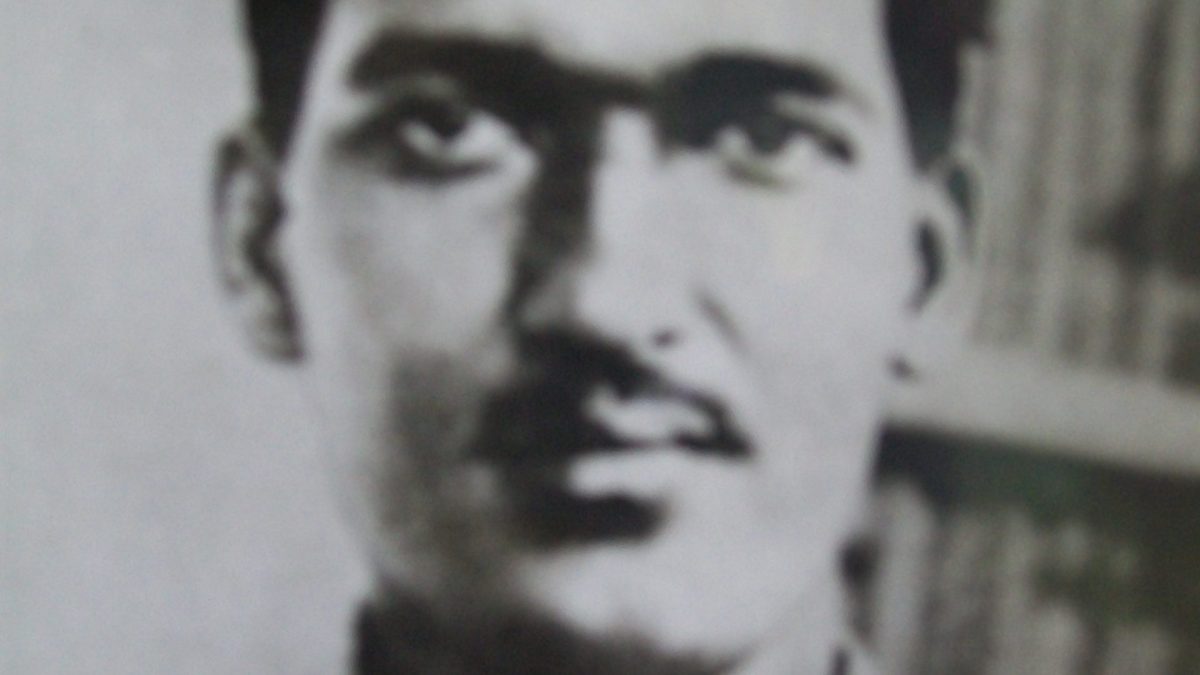
Ashfaqulla Khan (22 October 1900 – 19 December 1927) was an Indian revolutionary and Urdu poet, a member of the Hindustan Republican Association and one of the four men hanged for the Kakori train action of 1925. His close friendship with Ram Prasad Bismil, a devout Arya Samaj Hindu, and their deaths on the same day have made the pair a lasting symbol of Hindu–Muslim unity in the freedom struggle.
Quick Facts
| Full name | Ashfaqulla Khan |
| Born | 22 October 1900, Shahjahanpur, United Provinces (now Uttar Pradesh) |
| Died | 19 December 1927 (aged 27), Faizabad Jail |
| Organisation | Hindustan Republican Association |
| Known for | Kakori train action (1925) |
| Pen name | Hasrat |
Early Life
He was born into a Pathan family of landowners in Shahjahanpur, the youngest of six children of Shafiqullah Khan and Mazharunnisa. An elder brother who had studied with Ram Prasad Bismil often spoke of his classmate’s courage and his verse. Ashfaqulla, still at school, sought Bismil out. Bismil was at first reluctant to trust a Muslim boy with revolutionary work, but the two became inseparable. Ashfaqulla wrote poetry in Urdu and Hindi under the pen names Hasrat and Warsi.
Revolutionary Career
Like many young men he joined the Non-Cooperation Movement and felt betrayed when Mahatma Gandhi called it off in 1922 after the violence at Chauri Chaura. In 1924 he joined the newly formed Hindustan Republican Association, which aimed to overthrow British rule by armed revolution and establish a federal republic.
The party needed money for arms. Ashfaqulla argued against robbing a train carrying government funds, warning that it would bring the full force of the state down on a young organisation. He was outvoted and then took a leading part. On 9 August 1925 ten men stopped the 8 Down train from Shahjahanpur to Lucknow near Kakori by pulling the chain. The guard’s van carried an iron safe; when others failed to break it open, Ashfaqulla, the strongest of the group, smashed it with repeated blows. A passenger was killed by a stray shot during the raid.
The government arrested more than forty people within weeks. Ashfaqulla escaped. He walked to Nepal, then lived for about ten months in Bihar, working under an assumed name as a clerk for an engineering firm. He went to Delhi hoping to go abroad to study engineering and seek help for the movement. A friend from his home town with whom he stayed informed the police, and he was arrested.
A police officer of his own faith urged him to turn approver, arguing that Bismil was fighting for a Hindu India. He replied that he knew his friend better, and that even a Hindu India would be better than British India. He was tried in a supplementary case and sentenced to death. Appeals and petitions for mercy, signed by members of the legislatures, were rejected.
Execution
He was hanged in Faizabad Jail on the morning of 19 December 1927, the same day as Bismil at Gorakhpur and Roshan Singh at Allahabad; Rajendra Lahiri had been hanged two days earlier. Witnesses recorded that he walked to the gallows reciting the Quran and kissed the rope.
Legacy
His letters and poems from the condemned cell call on Indians of all faiths to stand together. He is commemorated in Shahjahanpur and Faizabad, and the Kakori case, in which Chandrashekhar Azad alone evaded capture, inspired the next wave of revolutionaries led by Bhagat Singh.
Frequently Asked Questions
When and where was Ashfaqulla Khan born?
Ashfaqulla Khan was born on 22 October 1900 in Shahjahanpur, United Provinces (now Uttar Pradesh).
When did Ashfaqulla Khan die?
Died: 19 December 1927 (aged 27), Faizabad Jail.
What is Ashfaqulla Khan known for?
Known for: Kakori train action (1925).
Featured image: Ashfaqulla Khan, about 1920. Photo by an unknown photographer, in the public domain, via Wikimedia Commons.



