
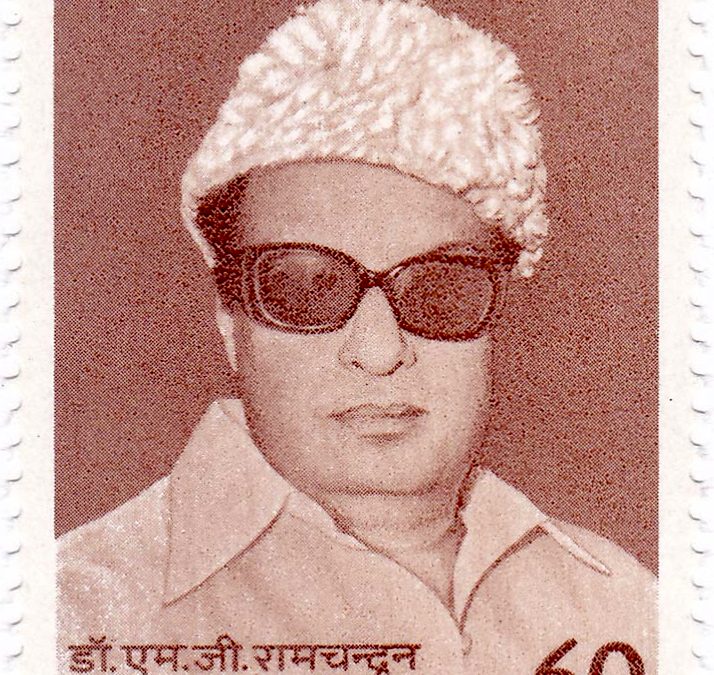
Marudur Gopalan Ramachandran (17 January 1917 – 24 December 1987), known as MGR, was an Indian actor, film-maker and politician who was Chief Minister of Tamil Nadu from 1977 until his death. For thirty years he was the biggest star of Tamil cinema, playing the champion of the poor. He carried that image into politics, founded the All India Anna Dravida Munnetra Kazhagam in 1972, and won three elections in a row. He was awarded the Bharat Ratna in 1988.
Quick Facts
| Full name | Marudur Gopalan Ramachandran |
| Born | 17 January 1917, near Kandy, Ceylon (now Sri Lanka) |
| Died | 24 December 1987, Madras (aged 70) |
| Occupation | Actor, film producer and director, politician |
| Party | Dravida Munnetra Kazhagam (1953–1972); AIADMK (founder, 1972) |
| Office | Chief Minister of Tamil Nadu (1977–1987) |
| Notable films | Malaikkallan, Nadodi Mannan, Enga Veettu Pillai, Adimai Penn, Rickshawkaran, Ulagam Sutrum Valiban |
| Awards | National Film Award for Best Actor (1971), Bharat Ratna (1988, posthumous) |
| Spouse | Thangamani; Sathanandavathi; V. N. Janaki |
Early Life
He was born in the hill country of Ceylon to a Malayali family from Kerala; his father worked there. The father died when the boy was about two, and his mother brought her children to Kumbakonam in the Tamil country, where the family knew real hunger. He left school after the third class and, at about seven, joined a boys’ drama company with his elder brother, Chakrapani.
Actor
He made his film debut in a small part in Sathi Leelavathi (1936) and waited more than ten years for a leading role, in Rajakumari (1947). Malaikkallan (1954), in which he played an outlaw who robs the rich, made him the foremost star of Tamil cinema. He produced and directed Nadodi Mannan (1958), an enormous success.
In well over a hundred films he was the same man: the rickshaw puller, fisherman, farmer or factory hand who fights the landlord and the smuggler, protects women, honours his mother, and never drinks or smokes. The songs carried a message. He won the National Film Award for Rickshawkaran. Off the screen he gave generously, and publicly, to the poor and to victims of floods and fires.
The DMK
He joined the Dravida Munnetra Kazhagam in 1953, drawn by its leader, C. N. Annadurai. His films were the party’s most effective propaganda; its colours and symbols appeared in them.
On 12 January 1967 the actor M. R. Radha shot him in the neck at his home. He survived, with his voice permanently altered. Posters of him bandaged in a hospital bed helped the DMK to its victory in the election weeks later, in which he won a seat himself.
The AIADMK
After Annadurai’s death in 1969 he supported M. Karunanidhi for Chief Minister and became party treasurer. The two fell out. In October 1972, after he publicly demanded that party leaders declare their assets, he was expelled. On 17 October he founded his own party, named for Anna.
Chief Minister
The AIADMK won the election of 1977, and he was sworn in on 30 June. He was re-elected in 1980 and 1984.
- **The noon meal scheme (1982):** a free cooked meal every day for children in schools and nurseries, a great expansion of the programme begun by K. Kamaraj. Economists called it wasteful; it raised attendance, improved nutrition and gave work to thousands of women, and was later adopted across India.
- **Welfare:** free clothing, footwear and books for schoolchildren, and pensions
- **Education:** new universities, among them one for women and one for Tamil, and the opening of professional colleges to private bodies
His government was also criticised for corruption, for dependence on revenue from liquor, and for harsh police action. He gave support to the Tamil militants of Sri Lanka.
Illness and Death
In October 1984 he suffered a stroke and kidney failure and was flown to a hospital in New York. He won that year’s election from his hospital bed. He returned, able to speak only with difficulty, and governed for three more years. He died in Madras on 24 December 1987. Some two million people came to his funeral; there was rioting, and a number of his followers took their own lives.
Succession
His widow, V. N. Janaki, was Chief Minister for twenty-four days. The party then united behind his former co-star and protégée, J. Jayalalithaa.
Featured image: M. G. Ramachandran, from a 1990 postage stamp of India. Photo by India Post, Government of India, licensed under Government Open Data License – India, via Wikimedia Commons.



