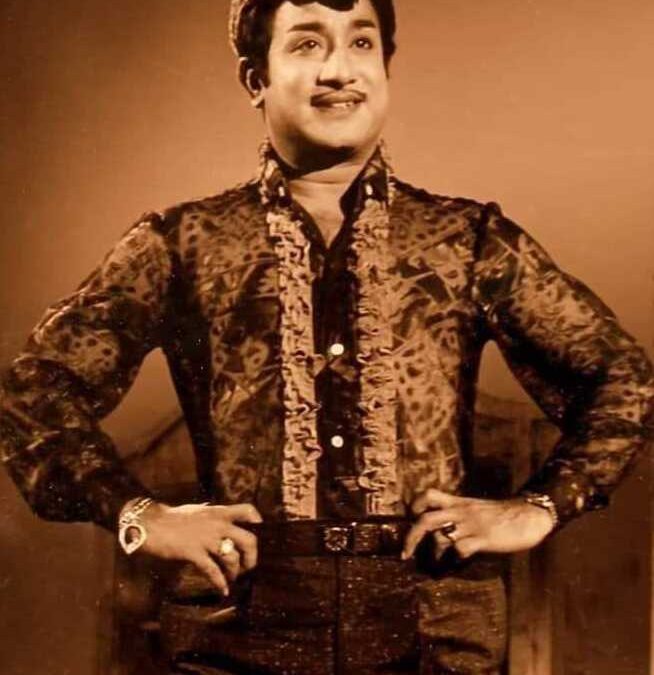
Villupuram Chinnaiah Ganesan (1 October 1928 – 21 July 2001), known as Sivaji Ganesan, was an Indian actor who was the leading dramatic star of Tamil cinema from the 1950s to the 1980s. Trained on the stage from childhood, he had a resonant voice, flawless diction and an astonishing range, and played kings, gods, saints, freedom fighters, drunkards, old men and lovers in close to three hundred films. Tamils called him Nadigar Thilagam, the pride of actors. He received the Dadasaheb Phalke Award in 1996.
Quick Facts
| Full name | Villupuram Chinnaiah Ganesan |
| Born | 1 October 1928, Villupuram, Tamil Nadu |
| Died | 21 July 2001, Chennai (aged 72) |
| Occupation | Actor, producer, politician |
| Years active | 1952–1999 |
| Notable films | Parasakthi, Veerapandiya Kattabomman, Pasamalar, Karnan, Navarathri, Thiruvilayadal, Thillana Mohanambal, Vietnam Veedu, Muthal Mariyathai, Thevar Magan |
| Awards | Padma Shri (1966), Padma Bhushan (1984), Chevalier of the Order of Arts and Letters (1995), Dadasaheb Phalke Award (1996) |
| Spouse | Kamala |
| Children | Ramkumar, Prabhu and two daughters |
Early Life
He was born at Villupuram, the fourth son of a railway worker who took part in the freedom movement and, by the family’s account, was arrested on the day of the boy’s birth. The family was poor.
At about seven, entranced by a street play, he ran away to join a touring boys’ drama company. He stayed in the theatre for nearly twenty years, playing first girls’ parts and then everything else, and learnt dance, singing and the delivery of long speeches in classical Tamil.
The Name
In 1946 he played the Maratha king Shivaji in a play written by C. N. Annadurai, the future Chief Minister. The social reformer Periyar, who presided, was so struck that he declared the young man should be called Sivaji from then on.
Parasakthi
His first film was Parasakthi (1952), written by M. Karunanidhi, a fierce attack on social injustice and religious hypocrisy. The young actor’s long speech in a courtroom, delivered in a torrent of alliterative Tamil, was learnt by heart across the state. He was a star from his first film.
Career
- Veerapandiya Kattabomman (1959), as the chieftain who defied the East India Company and was hanged; he was named best actor at the Afro-Asian film festival in Cairo in 1960, the first Indian actor so honoured abroad
- Pasamalar (1961), as a brother whose love for his sister destroys him, with Savitri
- Kappalottiya Thamizhan (1961), as the freedom fighter V. O. Chidambaram Pillai
- Karnan (1964) and Thiruvilayadal (1965), from the epics and legends
- Navarathri (1964), in which he played nine different men
- Thillana Mohanambal (1968), as a proud player of the nadaswaram
- Deiva Magan, Vietnam Veedu, Gauravam and Thanga Pathakkam
- Muthal Mariyathai (1985), as an ageing village headman, in a quieter, realistic style
- Thevar Magan (1992), with Kamal Haasan
His style was grand and theatrical: every emotion was shown in full, in face, voice and walk. A later generation found it too large for the screen; he showed in his late films that he could act small when he chose.
Rivalry
For thirty years Tamil cinema had two poles. M. G. Ramachandran was the hero of the masses, who always won; Sivaji was the actor, who was allowed to suffer, fail and die. Their admirers formed rival camps in every town.
Politics
He began in the Dravidian movement, left it in the 1950s, and for most of his life supported the Congress, which sent him to the Rajya Sabha in 1982. A party of his own, formed in 1988, lost every seat it contested, including his. He had none of his rival’s success in politics.
Honours
- Padma Shri (1966) and Padma Bhushan (1984)
- France’s Chevalier of the Order of Arts and Letters (1995)
- Dadasaheb Phalke Award (1996)
It is often remarked that he never won the National Film Award for Best Actor.
Personal Life
He married Kamala in 1952. His younger son, Prabhu, is a leading Tamil actor, as is his grandson Vikram Prabhu; the elder son, Ramkumar, is a producer. He maintained a large household in Chennai, open to anyone from the film world.
Death
He died in Chennai on 21 July 2001 of respiratory and heart disease. A statue and a memorial stand in the city, and the government gives an annual award in his name.
Featured image: Sivaji Ganesan. Photo by Manirvp666, licensed under CC BY-SA 4.0, via Wikimedia Commons.