
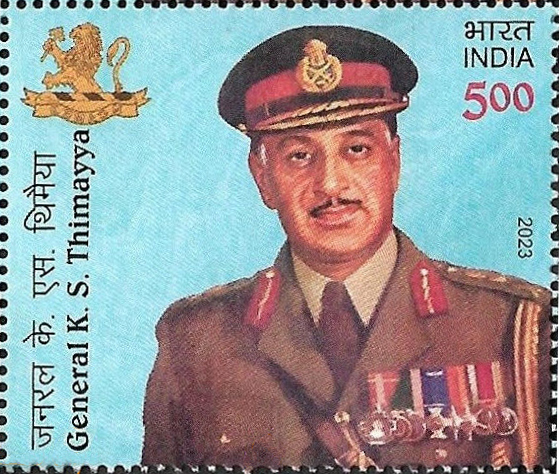
General Kodandera Subayya Thimayya (31 March 1906 – 18 December 1965) was an Indian Army officer who was Chief of the Army Staff from 1957 to 1961. He was the only Indian to command an infantry brigade in battle during the Second World War, led the division that saved Ladakh in 1948, and won international respect as head of the commission that dealt with prisoners after the Korean War. Many regard him as the finest field commander India has produced.
Quick Facts
| Full name | Kodandera Subayya Thimayya |
| Nickname | Timmy |
| Born | 31 March 1906, Madikeri, Coorg (now Kodagu, Karnataka) |
| Died | 18 December 1965, Nicosia, Cyprus (aged 59) |
| Education | Bishop Cotton Boys’ School, Bangalore; Prince of Wales Royal Indian Military College, Dehradun; Royal Military College, Sandhurst |
| Service | British Indian Army and Indian Army (1926–1961) |
| Regiment | 19th Hyderabad Regiment (now the Kumaon Regiment) |
| Offices | Chief of the Army Staff (1957–1961); Commander, United Nations Force in Cyprus (1964–1965) |
| Awards | Distinguished Service Order (1945), Padma Bhushan (1954) |
| Spouse | Nina Thimayya |
Early Life
He was born at Madikeri into a family of coffee planters of the Kodava community. He went to school at Coonoor and Bangalore and to the military college at Dehradun, and was one of six Indian cadets admitted to Sandhurst in his year. He was commissioned in 1926 and joined the Hyderabad Regiment.
As a young officer in the 1930s he sympathised openly with the national movement. He asked Motilal Nehru whether he should resign, and was told that a free India would need trained officers.
His wife, Nina, was decorated for her rescue work during the Quetta earthquake of 1935.
Burma
He commanded a battalion of his regiment in the Arakan and in January 1945 fought the battle of Kangaw, among the hardest of the campaign, for which he received the Distinguished Service Order. He was then given command of a brigade in action, the only Indian so trusted in the war. He represented India at the Japanese surrender at Singapore and commanded the Indian brigade in the occupation of Japan.
1947–48
During Partition he served with the force that tried to keep order in the Punjab. In 1948 he took command of the division in the Kashmir valley.
The enemy held the Zoji La, the pass of 11,500 feet that is the only road from the valley to Ladakh, and Leh was cut off. Infantry attacks had failed. Thimayya had light tanks dismantled, carried up in secret and reassembled, and on 1 November 1948 led the assault himself in the leading tank. The defenders, who had not imagined that armour could operate at such a height, broke. Dras and Kargil were retaken and the link with Leh restored.
Korea
In 1953 the United Nations chose India to chair the Neutral Nations Repatriation Commission, which had custody of the prisoners of the Korean War who refused to go home. Thimayya was its chairman. For months he stood between the two sides, each of which wished to coerce the prisoners, and held to the principle that none should be forced. He was awarded the Padma Bhushan.
Chief of the Army Staff
He became chief on 8 May 1957. He was concerned about the Chinese build-up on the northern border and pressed for the reorganisation and re-equipment of the army.
He found himself at odds with the Defence Minister, V. K. Krishna Menon, who interfered in promotions and dismissed his warnings. On 31 August 1959 he sent his resignation to Jawaharlal Nehru. The Prime Minister persuaded him to withdraw it, and then, in Parliament, belittled the matter. Thimayya served out his term and retired in May 1961. The defeat of 1962 came the following year.
Cyprus
In July 1964 the United Nations appointed him commander of its peacekeeping force in Cyprus, where fighting had broken out between the Greek and Turkish communities. He died there of a heart attack on 18 December 1965. Cyprus issued a postage stamp in his honour, and a road in Nicosia carries his name.
Legacy
His family home at Madikeri, Sunny Side, is a museum. Soldiers remembered him as a commander who was always forward, who laughed easily and who spoke his mind to his superiors. The first Indian chief of the army, K. M. Cariappa, came from the same small district.
Featured image: General K. S. Thimayya, from a 2023 postage stamp of India. Photo by India Post, Government of India, licensed under Government Open Data License – India, via Wikimedia Commons.



