
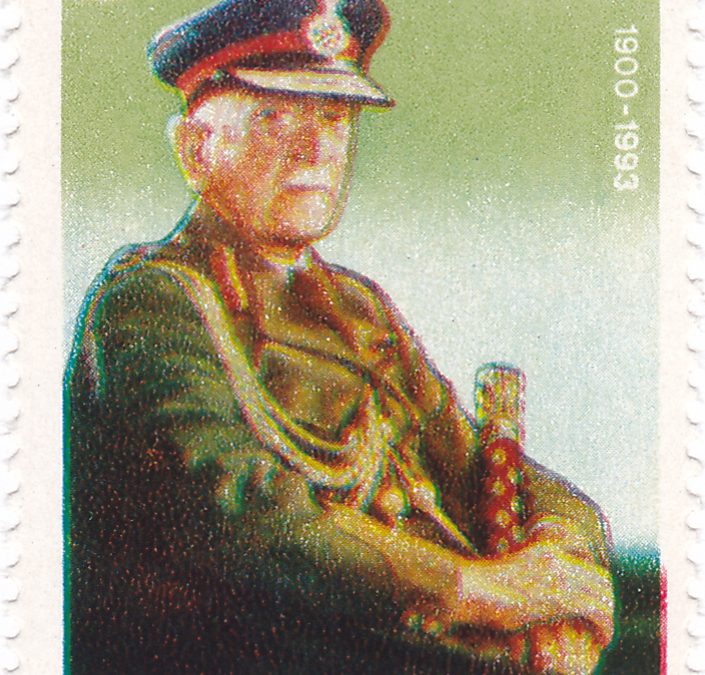
Field Marshal Kodandera Madappa Cariappa (28 January 1899 – 15 May 1993) was the first Indian Commander-in-Chief of the Indian Army. He took over from the last British chief on 15 January 1949, a date observed each year as Army Day. He led the army’s western command in the Kashmir war of 1947–48, and set the tradition of a professional force that keeps out of politics. He is one of only two Indian Army officers to have held the rank of Field Marshal.
Quick Facts
| Full name | Kodandera Madappa Cariappa |
| Nickname | Kipper |
| Born | 28 January 1899, Shanivarsanthe, Coorg (now Kodagu, Karnataka) |
| Died | 15 May 1993, Bangalore (aged 94) |
| Education | Presidency College, Madras; Daly Cadet College, Indore |
| Service | British Indian Army and Indian Army (1919–1953) |
| Regiment | Rajput Regiment |
| Offices | Commander-in-Chief, Indian Army (1949–1953); High Commissioner to Australia and New Zealand (1953–1956) |
| Rank | Field Marshal (1986) |
| Children | K. C. Cariappa and a daughter |
Early Life
He was born in Coorg, the small hill province in the south known for its soldiers, the son of an official of the revenue department. He was at Presidency College in Madras when, at the end of the First World War, the government decided to admit Indians to the commissioned ranks of the army. He was selected for the first batch trained at Indore and was commissioned in December 1919.
A Career of Firsts
He served in Mesopotamia and on the North-West Frontier. In 1933 he became the first Indian officer to attend the Staff College at Quetta, and in 1942 the first to command a battalion. In the Second World War he served in Iraq, Syria and Iran and then in Burma, and was made an Officer of the Order of the British Empire. He was among the first two Indians chosen for the Imperial Defence College in London.
In 1947 he was on the committee that divided the army between India and Pakistan, a task he found painful.
The Kashmir War
In January 1948 he took over the army’s command responsible for operations in Jammu and Kashmir. Under him the army recaptured Naushera and Jhangar, relieved Poonch, and in November 1948 forced the Zoji La pass with tanks, opening the road to Leh and saving Ladakh.
Commander-in-Chief
On 15 January 1949 he succeeded General Sir Roy Bucher. He was forty-nine.
- he made the army Indian in spirit as well as in command, and gave it the greeting “Jai Hind”
- he insisted that soldiers stay out of politics and that politicians stay out of promotions
- he opposed the reservation of posts in the army by caste or community
- he raised the Brigade of the Guards, the first regiment recruited from all classes and regions, and the Territorial Army
He retired in January 1953 and served for three years as High Commissioner to Australia and New Zealand.
1965
His son, Flight Lieutenant K. C. Cariappa, was shot down over Pakistan in the war of 1965 and taken prisoner. The President of Pakistan, Ayub Khan, who had served under the elder Cariappa before Partition, sent word that the young man would be well looked after and offered to release him. Cariappa is said to have replied that all the prisoners were his sons and that he asked no favour for one. His son, later an Air Marshal, was repatriated with the others.
Later Life
He lived at Madikeri in Coorg, in a house he called Roshanara, and spoke and wrote on national discipline and the welfare of ex-servicemen. He visited troops at the front in both the 1965 and 1971 wars. He stood once for Parliament, in 1971, as an independent, and lost.
On 28 April 1986 the President conferred on him the rank of Field Marshal.
Death
He died in Bangalore on 15 May 1993, aged ninety-four, and was cremated at Madikeri.
Legacy
He is remembered for correctness carried almost to eccentricity, and for having handed on, at the birth of the republic, an army that takes its orders from the elected government. The only other Field Marshal of the Indian Army is Sam Manekshaw; another great soldier of Coorg was General K. S. Thimayya.
Featured image: Field Marshal K. M. Cariappa, from a 1995 postage stamp of India. Photo by India Post, Government of India, licensed under Government Open Data License – India, via Wikimedia Commons.



