
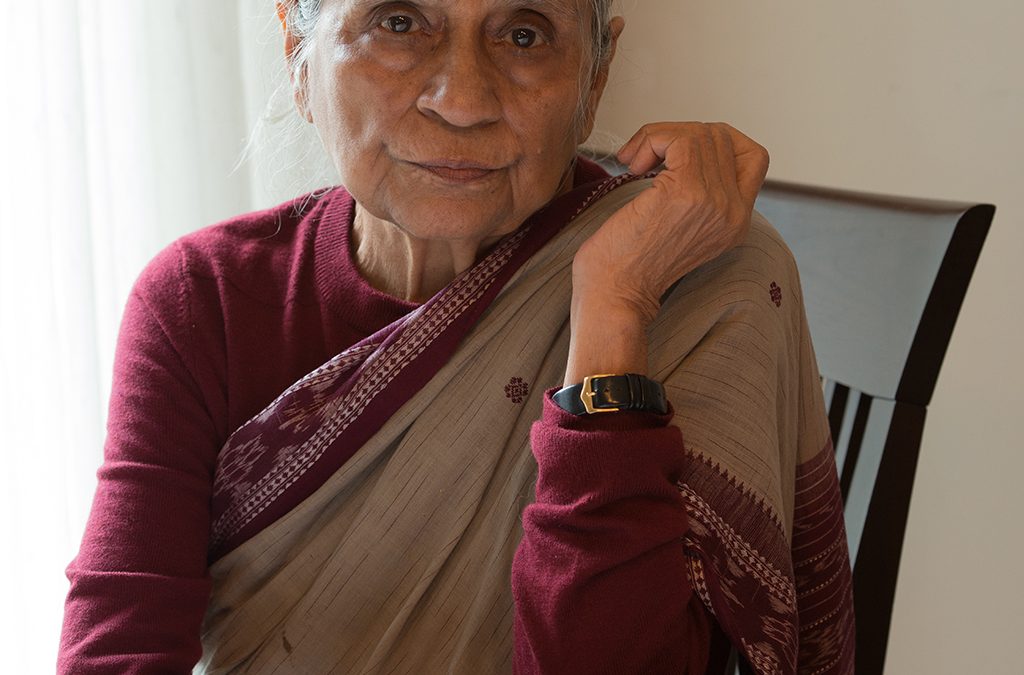
Ela Ramesh Bhatt (7 September 1933 – 2 November 2022) was an Indian lawyer, labour organiser and Gandhian who founded the Self Employed Women’s Association, known as SEWA, in 1972. SEWA brought together street vendors, home-based workers, rag pickers and labourers, women who had been invisible to both trade unions and the law, into a union that now has well over two million members, and it created a bank owned by its members. Her work shaped thinking on informal labour and microfinance around the world.
Quick Facts
| Full name | Ela Ramesh Bhatt |
| Born | 7 September 1933, Ahmedabad, Gujarat, India |
| Died | 2 November 2022 (aged 89), Ahmedabad, Gujarat |
| Occupation | Lawyer, trade union organiser |
| Known for | Founder of SEWA and SEWA Cooperative Bank |
| Education | M.T.B. College, Surat (B.A.); Sir L. A. Shah Law College, Ahmedabad (LL.B.) |
| Spouse | Ramesh Bhatt |
| Children | 2 |
| Awards | Ramon Magsaysay Award (1977); Right Livelihood Award (1984); Padma Shri (1985); Padma Bhushan (1986) |
Early Life
Bhatt was born in Ahmedabad and grew up in Surat. Her father was a lawyer and her mother was active in the women’s movement. She took a degree in English at Surat and a law degree at Ahmedabad in 1954, winning a gold medal for her work on Hindu law. At college she met Ramesh Bhatt, a student leader with whom she surveyed slum families for the 1951 census, and she married him in 1956.
Career
In 1955 she joined the legal department of the Textile Labour Association, the Ahmedabad mill workers’ union founded with the guidance of Mahatma Gandhi. From 1968 she headed its women’s wing. When mills closed, she saw that families survived on what the women earned by sewing, vending and carrying loads, work that had no legal recognition or protection.
A group of women who carried cloth on their heads in the wholesale market came to her to complain that merchants cheated them. She wrote about it in a newspaper, the merchants replied, and the women had the exchange printed and distributed. From that beginning SEWA was registered as a trade union in April 1972, after she persuaded officials that workers without an employer could still form a union. Vegetable sellers, cart pullers, bidi rollers, garment stitchers and waste pickers joined. The union fought for vendors’ right to space in the city, for fair piece rates and for identity cards.
Its members were in permanent debt to moneylenders, and banks would not deal with women who could not sign their names. In 1974 about four thousand of them contributed ten rupees each to start a cooperative bank, which identified account holders by photograph. It became a model for lending to poor women. SEWA went on to set up cooperatives for dairying, crafts, child care, health care and insurance.
In 1981, after SEWA publicly supported Dalits during riots over reservations, the parent union expelled it, and it grew faster on its own.
She was a nominated member of the Rajya Sabha from 1986 to 1989 and chaired a national commission on self-employed women whose report, Shramshakti, documented the conditions of informal workers. She served on the Planning Commission, was a founder and chair of Women’s World Banking, helped secure the International Labour Organization’s convention on home work, and in 2007 was a founding member of The Elders, the group convened by Nelson Mandela. She was chancellor of Gujarat Vidyapith from 2015 to 2022.
Writing and Legacy
Her book We Are Poor but So Many (2006) tells SEWA’s story. She described her philosophy as a hundred-mile principle: that food, clothing and shelter should as far as possible come from within a hundred miles. She died in Ahmedabad on 2 November 2022.
Frequently Asked Questions
When and where was Ela Bhatt born?
Ela Bhatt was born on 7 September 1933 in Ahmedabad, Gujarat, India.
When did Ela Bhatt die?
Died: 2 November 2022 (aged 89), Ahmedabad, Gujarat.
What is Ela Bhatt known for?
Known for: Founder of SEWA and SEWA Cooperative Bank.
What honours has Ela Bhatt received?
Ramon Magsaysay Award (1977); Right Livelihood Award (1984); Padma Shri (1985); Padma Bhushan (1986).
Featured image: Ela Bhatt at McMaster University, Hamilton, Canada, October 2013. Photo by Mohan Juneja, licensed under CC BY-SA 3.0, via Wikimedia Commons.



