
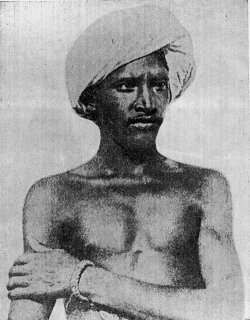
Birsa Munda (15 November 1875 – 9 June 1900) was a tribal leader, religious reformer and freedom fighter of the Munda people of Chotanagpur, in what is now Jharkhand. In a life of less than twenty-five years he founded a new faith, united his people against the landlords, moneylenders and missionaries who had taken their land, and led an armed rising against British rule known as the Ulgulan, the Great Tumult. He is revered as Bhagwan Birsa and Dharti Aba, father of the earth.
Quick Facts
| Born | 15 November 1875, Ulihatu, Ranchi district, Bengal Presidency (now in Khunti district, Jharkhand) |
| Died | 9 June 1900, Ranchi Jail (aged 24) |
| State | Jharkhand |
| Community | Munda |
| Known for | The Ulgulan (Munda rebellion) of 1899–1900; the Birsait faith |
| Titles | Dharti Aba; Bhagwan |
| Legacy | Chotanagpur Tenancy Act, 1908 |
Early Life
He was born on a Thursday, from which he took his name, in the village of Ulihatu, to a family of poor sharecroppers who moved from village to village in search of work. He herded sheep, played the flute and was noticed by a teacher as a bright boy.
To attend the German mission school at Chaibasa he had to become a Christian, and was baptised as Birsa David. He studied there for some years. He left, by the usual account, after a missionary spoke with contempt of the Mundas. He then came under the influence of a Vaishnava holy man and for a time wore the sacred thread and gave up meat.
The Mundas’ Grievance
The Mundas had cleared the forests of Chotanagpur and held the land in common under a system called khuntkatti. Under British rule their chiefs’ estates passed to outsiders, landlords, contractors and moneylenders, whom the tribes called dikus. The Mundas were reduced to tenants and forced labourers on their ancestors’ land. Lawful agitation led by their chiefs had achieved nothing.
The Prophet
In 1895, aged about twenty, Birsa declared that God had appointed him to save his people. Thousands came to hear him and to be healed. He taught the worship of one God, cleanliness and the giving up of drink, sacrifice and belief in spirits, and told the Mundas to pay no rent, since the land was theirs. He prophesied that the rule of the Queen would end and the Munda kingdom begin.
The government arrested him in August 1895 and jailed him for two years.
The Ulgulan
Released in 1897, he went from village to village organising. On Christmas Eve 1899 his followers, armed with bows, axes and spears, attacked churches and police stations across the Ranchi and Singhbhum districts. Several policemen were killed.
The authorities sent troops. On 9 January 1900 soldiers surrounded the rebels on Dombari hill and fired on them; a large number of men, women and children were killed. Birsa escaped. He was captured in the Chakradharpur forest on 3 February 1900, betrayed for a reward.
Death
He died in Ranchi Jail on 9 June 1900, before his trial was complete. The jail authorities gave the cause as cholera. Many of his people have never believed it. Of his followers, three were hanged and dozens transported or imprisoned.
What the Rising Achieved
The government ordered a survey of land rights, and in 1908 passed the Chotanagpur Tenancy Act, which recognised the Mundas’ customary tenures and barred the transfer of tribal land to outsiders. It remains in force.
Legacy
- Jharkhand was created on his birthday, 15 November 2000.
- Since 2021 the day has been observed across India as Janjatiya Gaurav Divas, a day honouring tribal heritage.
- His portrait hangs in the Parliament of India.
- The airport, the central jail, now a museum, and an agricultural university at Ranchi bear his name, as does the hockey stadium at Rourkela.
Later tribal leaders of the state, among them Shibu Soren, claimed his inheritance.
Featured image: Birsa Munda, from a photograph published in 1912. Photo by an unknown photographer, in the public domain, via Wikimedia Commons.



