
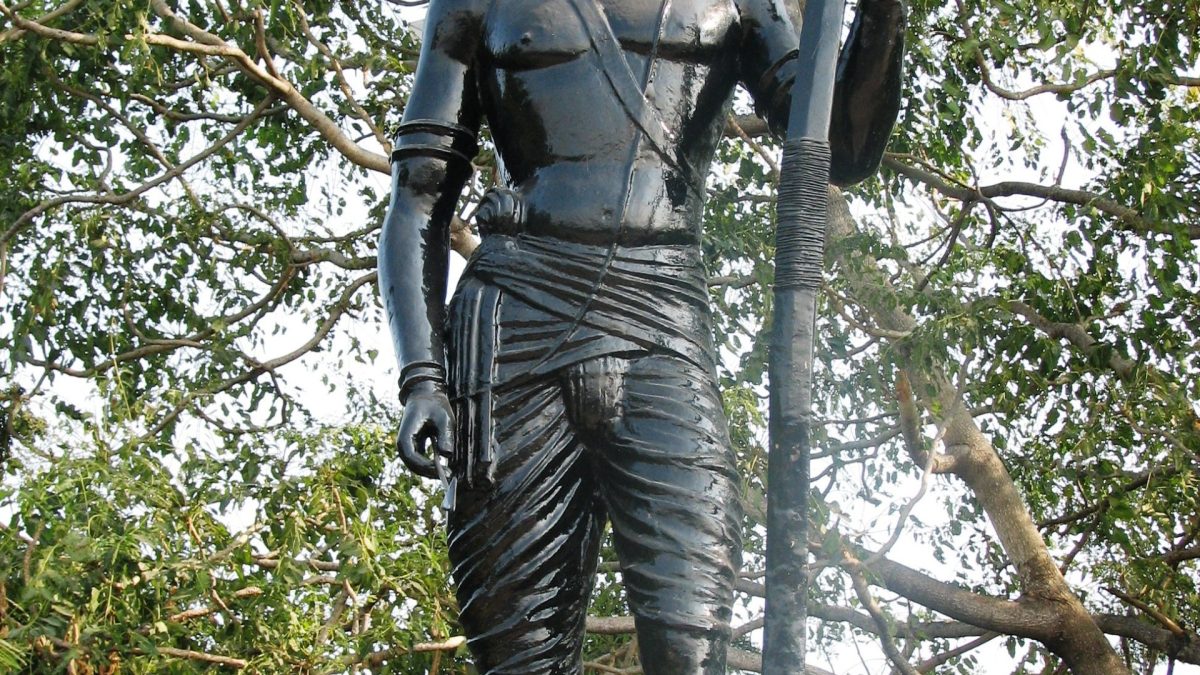
Alluri Sitarama Raju (4 July 1897 – 7 May 1924) was an Indian revolutionary who led an armed rising of the hill tribes of the Godavari Agency, in what is now Andhra Pradesh, against British rule. For nearly two years, from August 1922, his small band raided police stations for weapons and held off a large force sent to hunt it down. He was captured and shot on 7 May 1924, at twenty-six. In the Telugu country he is honoured as Manyam Veerudu, the hero of the forest.
Quick Facts
| Full name | Alluri Sitarama Raju |
| Born | 4 July 1897, Pandrangi, Visakhapatnam district, Andhra Pradesh |
| Died | 7 May 1924, Koyyuru, Visakhapatnam Agency (aged 26) |
| Known for | Leading the Rampa Rebellion (1922–1924) |
| Title | Manyam Veerudu |
| Area of activity | The hill tracts of the Godavari and Visakhapatnam Agency |
Early Life
He was born into a family of the Kshatriya community of coastal Andhra; the family home was at Mogallu in the West Godavari district. His father, a photographer at Rajahmundry, died when the boy was eight, and he was brought up in the houses of an uncle and other relatives, moving from school to school in Rajahmundry, Kakinada, Visakhapatnam and Narsapur. He was an indifferent student and left without a qualification.
He was drawn to the religious life. In his late teens he set out as a wandering ascetic and travelled, mostly on foot, to the holy places of northern India. He learnt something of astrology, herbal medicine and the handling of animals.
Among the Hill People
About 1917 he settled in the hills of the Agency, the forested tract behind the coastal plain, inhabited by the Koya and other tribes. They came to regard the young holy man who healed the sick and lived on fruit and milk as possessed of special powers. He settled their disputes and persuaded many to give up drink.
Grievances
The hill people lived by shifting cultivation and by what the forest gave. The forest laws had closed large areas to them and made their way of farming an offence. Officials also forced them to work on road building for a pittance or nothing, and a local official in charge of the works was notorious for flogging those who refused.
Raju was aware of the non-cooperation movement and respected Gandhi, but he held that only force would move the British.
The Rebellion
In August 1922 he and some three hundred followers, armed with bows and a few guns, attacked the police stations at Chintapalli, Krishnadevipeta and Rajavommangi on successive days and carried off their rifles and ammunition. He is said to have signed the station registers with a list of what he had taken.
- **September 1922:** his men ambushed a police column in a hill pass and killed two British officers
- **The following months:** further raids for arms and supplies, and a running fight through forest that the rebels knew and their pursuers did not
- **The government’s response:** it brought in the Malabar Special Police, trained in jungle fighting, and later a battalion of the Assam Rifles, and offered rewards. Villages suspected of feeding the rebels were punished.
His lieutenants were hill men, chief among them the brothers Gantam Dora and Mallu Dora. He kept a strict discipline: Indians in government service who fell into his hands were released, and he sent word ahead of some of his attacks.
The rebellion never spread beyond the hills, and by early 1924 the band had been worn down by losses and hunger.
Death
On 7 May 1924 he was captured in the forest near the village of Koyyuru, by most accounts while bathing at a stream. He was tied to a tree and shot without trial on the orders of the officer commanding the detachment. His body was cremated nearby. The campaign had lasted nearly two years and cost the government a very large sum.
Legacy
- His tomb at Krishnadevipeta is a place of pilgrimage, and his birthday is a state festival in Andhra Pradesh.
- A postage stamp was issued in 1986. A bronze statue thirty feet high was unveiled at Bhimavaram in 2022, his hundred and twenty-fifth anniversary year, and a district of Andhra Pradesh was named after him the same year.
- A celebrated Telugu film of 1974 told his story, and a character loosely based on him is one of the two heroes of the film RRR (2022), directed by S. S. Rajamouli.
He stands with Birsa Munda and Rani Gaidinliu among the leaders of the tribal risings against colonial rule.
Featured image: A statue of Alluri Sitarama Raju. Photo by The original uploader was Chavakiran at Telugu Wikipedia., in the public domain, via Wikimedia Commons.



