
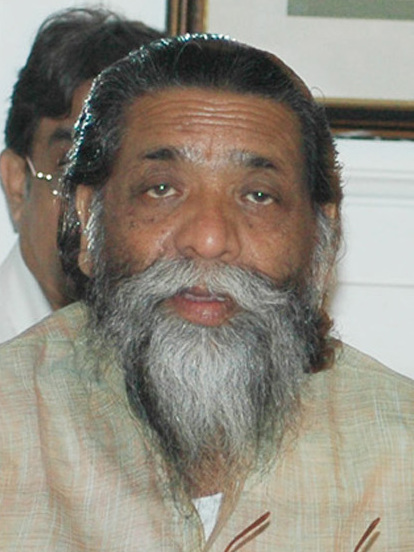
Shibu Soren (11 January 1944 – 4 August 2025) was an Indian politician and tribal leader who founded the Jharkhand Mukti Morcha and led the movement for a separate state of Jharkhand for nearly three decades. Known to his people as Dishom Guru, the teacher of the land, he was a member of the Lok Sabha eight times, a Union minister and three times, briefly, Chief Minister of the state he had fought for. His career was shadowed by criminal cases, in all of which he was eventually cleared.
Quick Facts
| Full name | Shibu Soren |
| Born | 11 January 1944, Nemra, Hazaribagh district, Bihar (now in Ramgarh district, Jharkhand) |
| Died | 4 August 2025, New Delhi (aged 81) |
| State | Jharkhand |
| Community | Santhal |
| Party | Jharkhand Mukti Morcha (co-founder; president for 38 years) |
| Offices | Chief Minister of Jharkhand (2005, 2008–2009, 2009–2010); Union Minister of Coal; Member of the Lok Sabha for Dumka (eight terms) |
| Title | Dishom Guru |
| Spouse | Rupi Soren |
| Children | Durga, Hemant, Basant and Anjali |
Early Life
He was born in the village of Nemra into a Santhal family. His father, Sobaran Soren, a schoolteacher, spoke out against the moneylenders who had taken the tribal people’s land in return for small debts. In 1957, when Shibu was thirteen, his father was murdered by their men.
He left school and swore to end the moneylenders’ power.
The Campaign Against Moneylenders
In the late 1960s and early 1970s he organised the Santhals of the Dhanbad and Giridih region. His followers took back land, harvested by force the crops standing on fields the moneylenders had seized, a practice called “dhan kato”, and held village courts. He also campaigned against liquor and for schooling. There were violent clashes, and he lived for years in the forest, wanted by the police.
The Jharkhand Mukti Morcha
In the early 1970s, with the Kurmi leader Binod Bihari Mahato and the trade unionist A. K. Roy, he founded the Jharkhand Mukti Morcha. Its demand was a separate state for the tribal belt of south Bihar and the adjoining districts, a cause first raised decades earlier. The party joined tribals with the miners and industrial workers of the coalfields.
Career
He was elected to the Lok Sabha from Dumka in 1980 and won the seat eight times. Through the 1980s and 1990s he bargained with governments in Patna and Delhi, alternating agitation with alliance. The state of Jharkhand was created on 15 November 2000.
Chief Minister
- **March 2005:** sworn in without a majority, he resigned after ten days
- **August 2008 – January 2009:** he had to resign when he lost a by-election to enter the assembly
- **December 2009 – May 2010:** his government fell when an ally withdrew
Union minister
He was Coal Minister in the government of Manmohan Singh in 2004 and again later, resigning each time because of court proceedings.
The Cases
- **The bribery case:** members of his party were accused of taking money to vote for the government of P. V. Narasimha Rao in a confidence vote in 1993
- **The Chirudih case:** he was charged over a clash in 1975 in which eleven people were killed, and was acquitted in 2008
- **The murder case:** in 2006 a Delhi court convicted him of the murder of his former private secretary in 1994 and sentenced him to life imprisonment, the first conviction of a serving Union minister for murder. The Delhi High Court acquitted him in 2007, finding the evidence inadequate, and the Supreme Court upheld the acquittal.
Last Years
He was a member of the Rajya Sabha in his final years, while his son led the party and the state. He died in a Delhi hospital on 4 August 2025 after a long kidney illness and was cremated with state honours at Nemra.
Family
His eldest son, Durga, died in 2009. His second son, Hemant Soren, is the Chief Minister of Jharkhand, and his youngest, Basant, a legislator.
To his followers he was the heir of Birsa Munda, and the man without whom there would be no Jharkhand.
Featured image: Shibu Soren as Union Minister of Coal. Photo by the Ministry of Coal, licensed under Government Open Data License – India, via Wikimedia Commons.



