
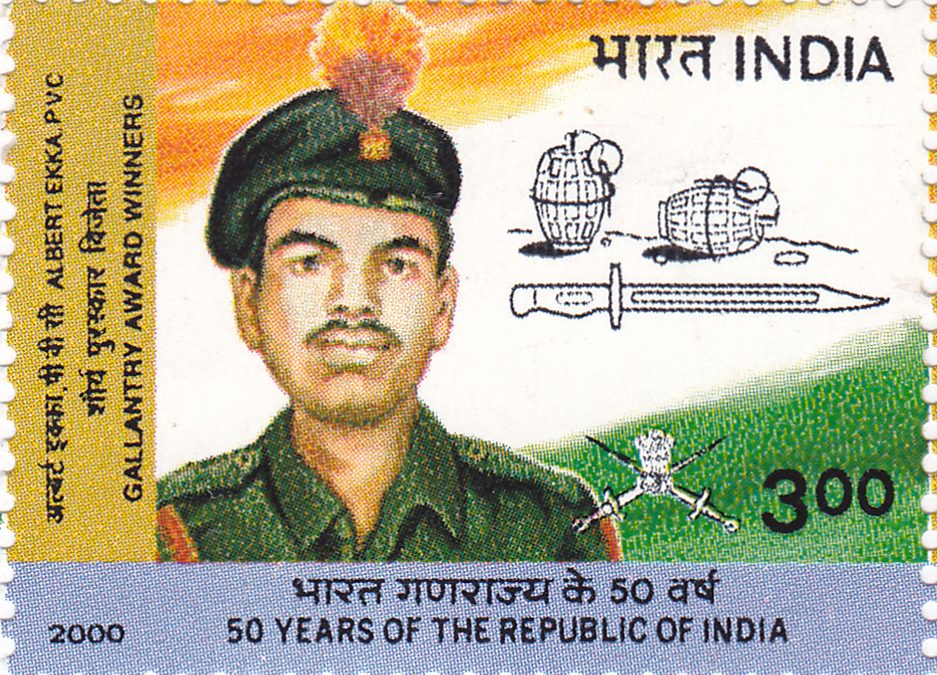
Lance Naik Albert Ekka (27 December 1942 – 3 December 1971) was a soldier of the Indian Army who was posthumously awarded the Param Vir Chakra, India’s highest decoration for gallantry in war, for his actions in the Battle of Gangasagar on the first night of the war of 1971. He was the only recipient of the award on the eastern front of that war, and the first from the region that is now Jharkhand.
Quick Facts
| Full name | Albert Ekka |
| Born | 27 December 1942, Zari, Gumla district, Bihar (now Jharkhand) |
| Died | 3 December 1971, Gangasagar, East Pakistan (aged 28) |
| State | Jharkhand |
| Community | Oraon |
| Service | Indian Army (1962–1971) |
| Rank | Lance Naik |
| Unit | 14th Battalion, Brigade of the Guards |
| Award | Param Vir Chakra (posthumous) |
| Spouse | Balamdina Ekka |
| Children | 1 |
Early Life
He was born in the village of Zari in the Gumla district of the Chotanagpur plateau, to Julius and Mariam Ekka, a family of the Oraon tribe who were Christians. Like most boys of his village he grew up hunting in the forest with a bow, and was a good hockey player. He wanted to be a soldier.
Army Career
He enlisted in the Bihar Regiment in December 1962. When the 14th Battalion of the Brigade of the Guards was raised in 1968 he was transferred to it. He served in counter-insurgency operations in the North-East and was promoted to Lance Naik.
The Battle of Gangasagar
When war with Pakistan began on 3 December 1971, his battalion was on the eastern front, near Agartala in Tripura. Its task was to capture a Pakistani position at Gangasagar, a few kilometres inside East Pakistan on the railway line towards Akhaura, the capture of which would open the road to Dhaka for the Indian advance.
The position was strongly held, with bunkers, minefields and machine guns, on high ground beside a marsh. The battalion attacked on the night of 3–4 December, advancing along the railway embankment.
The first action
As his company approached, a light machine gun in a bunker opened fire and began to cause casualties. Ekka charged the bunker, bayoneted the two soldiers in it and silenced the gun. He was wounded.
The second action
He fought on with his company through bunker after bunker, for about a kilometre and a half. Near the northern end of the position a medium machine gun on the upper floor of a fortified building opened fire and stopped the advance. Though already seriously hurt, Ekka crawled forward and threw a grenade into the building, killing one of the gunners. The gun kept firing. He climbed the side wall, got inside and bayoneted the man at the gun.
The position fell. Ekka collapsed from his wounds and died.
The Citation
The citation for the Param Vir Chakra states that he displayed the most conspicuous valour and determination and made the supreme sacrifice in the best traditions of the Army. The capture of Gangasagar forced the enemy to abandon Akhaura and helped clear the way for the campaign described in the 1971 India–Pakistan War.
Family
His wife, Balamdina, received the medal from the President. Their son, Vincent, was an infant at the time. For many years the family did not know exactly where he had been buried; in 2015 soil from the site at Gangasagar was brought back to his village. Balamdina Ekka died in 2021.
Remembrance
- The main square of Ranchi is named Albert Ekka Chowk and has his statue.
- The block in Gumla district that contains his village has been named after him.
- India issued a postage stamp in his honour in 2000.
- Bangladesh has honoured him among the friends of its liberation war.
He stands with Birsa Munda among the heroes of the tribal people of Jharkhand.
Featured image: Albert Ekka, from a 2000 postage stamp of India. Photo by India Post, Government of India, licensed under Government Open Data License – India, via Wikimedia Commons.



