
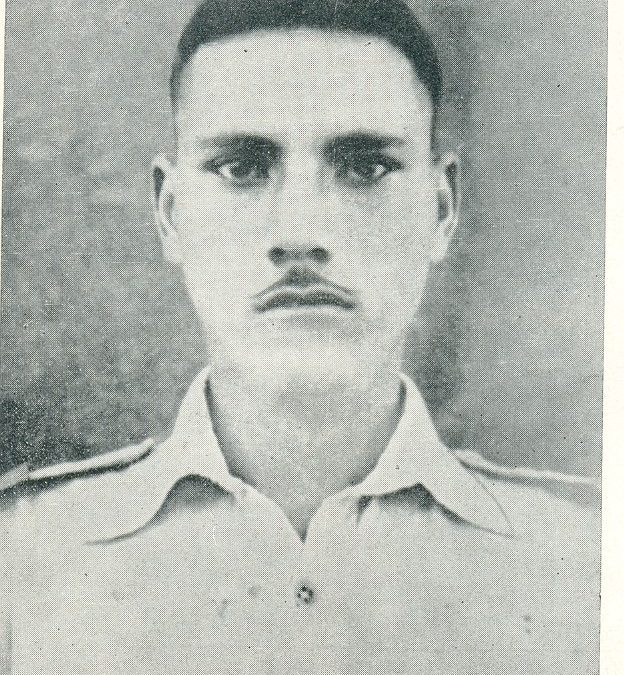
Company Quartermaster Havildar Abdul Hamid (1 July 1933 – 10 September 1965) was a soldier of the Indian Army who was posthumously awarded the Param Vir Chakra, India’s highest decoration for gallantry in war, for his actions at the Battle of Asal Uttar in the war of 1965. Firing an anti-tank gun mounted on an open jeep, he destroyed several Pakistani Patton tanks over three days before he was killed.
Quick Facts
| Full name | Abdul Hamid |
| Born | 1 July 1933, Dhamupur, Ghazipur district, Uttar Pradesh |
| Died | 10 September 1965, near Chima, Khem Karan sector, Punjab (aged 32) |
| Service | Indian Army (1954–1965) |
| Rank | Company Quartermaster Havildar |
| Unit | 4th Battalion, The Grenadiers |
| Award | Param Vir Chakra (posthumous) |
| Spouse | Rasoolan Bibi |
| Children | 5 |
Early Life
He was born in the village of Dhamupur in eastern Uttar Pradesh. His father, Mohammad Usman, was a tailor, and the boy helped at the sewing machine. His interests were elsewhere: he wrestled, swam the swollen river in the rains, and was a good shot with a catapult and later a gun. He had little schooling.
Army Career
He enlisted in December 1954 and was posted to the 4th Battalion of the Grenadiers. He served at Agra, Amritsar, Jammu and Kashmir, Delhi and in the North-East. In the war with China in 1962 his battalion fought in the battle on the Namka Chu river, was surrounded, and made its way out on foot through Bhutan.
He was trained on the 106-millimetre recoilless gun, a light anti-tank weapon carried on a jeep, and was known as the best shot with it in the battalion. By 1965 he had been promoted to quartermaster of his company, a post behind the line. When the war began he was put back in charge of a gun detachment.
The Battle of Asal Uttar
In September 1965 Pakistan launched its 1st Armoured Division, equipped with American M48 Patton tanks, then considered among the best in the world, across the border in the Khem Karan sector of Punjab. The aim was to break through to the bridge over the Beas and cut off Amritsar.
The Indian division fell back to prepared positions around the village of Asal Uttar. The fields of sugar cane and cotton stood tall, and the ground had been flooded by breaching canals. The 4th Grenadiers held a stretch of the road to the village of Chima.
8 and 9 September
On the morning of 8 September a column of Pattons approached the battalion’s position. Hamid, hidden in the sugar cane with his jeep, waited until the leading tank was a few dozen metres away and fired. It burst into flames, and the crews of the tanks behind abandoned them. The attacks were renewed that day and the next, and he destroyed more tanks, moving his jeep after each shot.
10 September
On the third morning the Pattons came on again under heavy artillery fire. He knocked out another. As he and the crew of a second tank sighted on each other, both fired. The tank was hit, and its shell destroyed the jeep. He was killed.
The Citation
The citation for the Param Vir Chakra, written from the first reports before the battle ended, credits him with three tanks. Accounts from his battalion put the number at seven or eight. The award was announced on 16 September 1965, within a week of his death.
The Battle’s Result
Pakistan’s armoured division lost about a hundred tanks at Asal Uttar, many of them captured intact, bogged in the flooded fields. The place where they were collected was nicknamed Patton Nagar. The offensive, Pakistan’s main effort of the war, had failed.
Family
His wife, Rasoolan Bibi, received the medal from the President on Republic Day 1966. She lived at Dhamupur, where she campaigned for a memorial and for facilities for the village, and died in 2019.
Remembrance
- A memorial stands at his grave near Asal Uttar, and another in his village, where a fair is held each September.
- India issued a postage stamp in his honour in 2000.
- His story appears in school textbooks, and has been told on television and film.
He is among the best known of the twenty-one recipients of the Param Vir Chakra, with Albert Ekka, who won it in 1971.
Featured image: Company Quartermaster Havildar Abdul Hamid. Photo by Auwm grenadiers, licensed under CC0, via Wikimedia Commons.



