
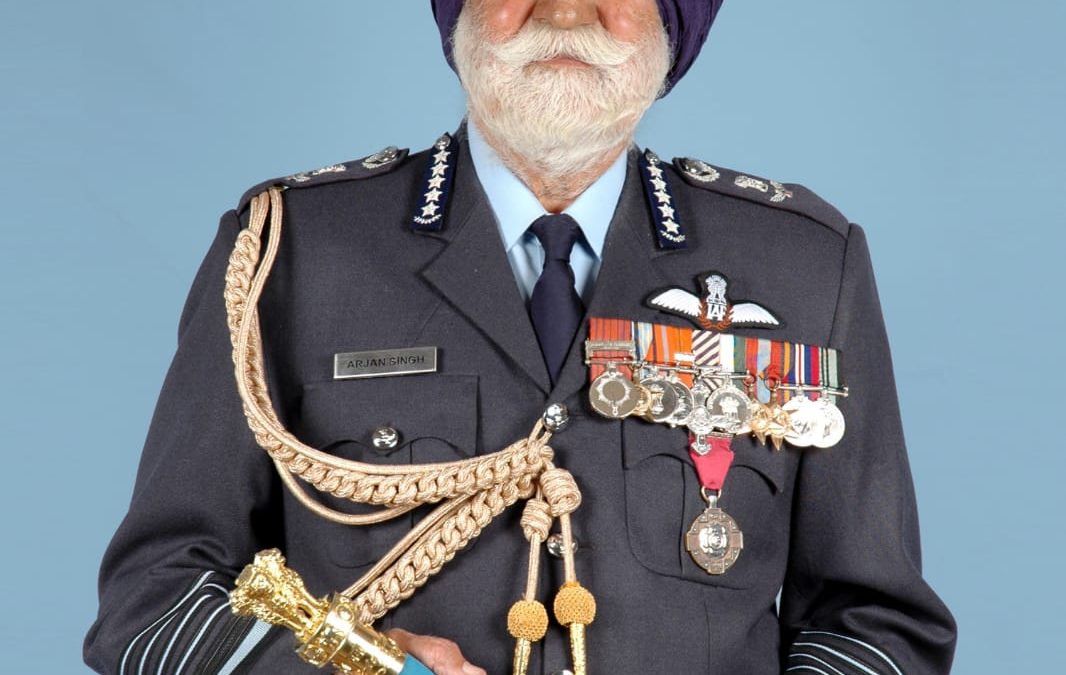
Marshal of the Indian Air Force Arjan Singh (15 April 1919 – 16 September 2017) was an Indian air force officer who was Chief of the Air Staff from 1964 to 1969 and led the service in the war of 1965 against Pakistan. A decorated fighter pilot of the Burma campaign, he became chief at forty-five. In 2002 he was given the five-star rank of Marshal of the Indian Air Force, the only officer ever to hold it.
Quick Facts
| Full name | Arjan Singh Aulakh |
| Born | 15 April 1919, Lyallpur, Punjab (now Faisalabad, Pakistan) |
| Died | 16 September 2017, New Delhi (aged 98) |
| Education | Government College, Lahore; Royal Air Force College, Cranwell |
| Service | Indian Air Force (1939–1969) |
| Offices | Chief of the Air Staff (1964–1969); Ambassador to Switzerland; High Commissioner to Kenya; Lieutenant Governor of Delhi (1989–1990) |
| Awards | Distinguished Flying Cross (1944), Padma Vibhushan (1965) |
| Rank | Marshal of the Indian Air Force (2002) |
| Spouse | Teji Arjan Singh (d. 2011) |
Early Life
He was born at Lyallpur into a Sikh family with a tradition of soldiering; his father, grandfather and great-grandfather had all served in the cavalry. He was a student at Government College in Lahore, and a champion swimmer, when at nineteen he was selected for the Royal Air Force College at Cranwell in England. He was commissioned as a pilot officer in December 1939.
Burma
He flew on the North-West Frontier and then, in 1944, commanded No. 1 Squadron of the Indian Air Force in the Arakan and at Imphal, flying Hurricanes in close support of the army during the Japanese siege. His squadron flew continuously through the battle. The supreme commander, Lord Mountbatten, pinned the Distinguished Flying Cross on him on the airfield.
15 August 1947
On the day of independence he led the flypast of more than a hundred aircraft over the Red Fort in Delhi as the national flag was raised.
Rise
He commanded the air base at Ambala, trained at staff colleges in Britain, and held the operational command of the air force twice. During the war with China in 1962, in which the air force was not used in combat, he was deputy chief. He became Chief of the Air Staff on 1 August 1964, at forty-five. He remained a flying chief; over his career he flew more than sixty types of aircraft.
The War of 1965
On 1 September 1965 Pakistani armour attacked in the Chhamb sector of Jammu, threatening the road to Kashmir. The Defence Minister called him in and asked how soon the air force could act. He is said to have answered, “In an hour.” The first aircraft took off within that time and struck the advancing tanks at dusk.
In the three weeks that followed the air force attacked bases deep in Pakistan and fought for control of the air against a smaller force equipped with more modern American aircraft. The small Gnat fighter proved a match for the Sabre. Both sides claimed success in the air war; what is agreed is that the Indian Air Force, under his calm direction, gave the army the support it needed and ended the war confident.
He was awarded the Padma Vibhushan, and the rank of the chief was raised: he became the first Air Chief Marshal of the service. He retired in July 1969, aged fifty.
Diplomat and Administrator
He was Ambassador to Switzerland and the Vatican, High Commissioner to Kenya, a member of the Minorities Commission, and Lieutenant Governor of Delhi in 1989–90.
Marshal
In January 2002 the Government of India conferred on him the rank of Marshal of the Indian Air Force, equivalent to Field Marshal. Officers of that rank never retire.
In July 2015, aged ninety-six, he went to the airport in Delhi to receive the body of the former President, A. P. J. Abdul Kalam. He rose from his wheelchair, stood to attention with the help of a stick, and saluted.
Generosity
He sold his farm near Delhi and gave the proceeds, some two crore rupees, to a trust for the welfare of retired airmen.
Death
He died in New Delhi on 16 September 2017, aged ninety-eight, and was given a state funeral with a flypast and a gun salute. The air base at Panagarh in West Bengal had been named after him the year before, the first to be named for a living officer.
Among the soldiers of the same generation were Sam Manekshaw and K. M. Cariappa.
Featured image: Marshal of the Indian Air Force Arjan Singh. Photo by the Indian Air Force, licensed under Government Open Data License – India, via Wikimedia Commons.



