
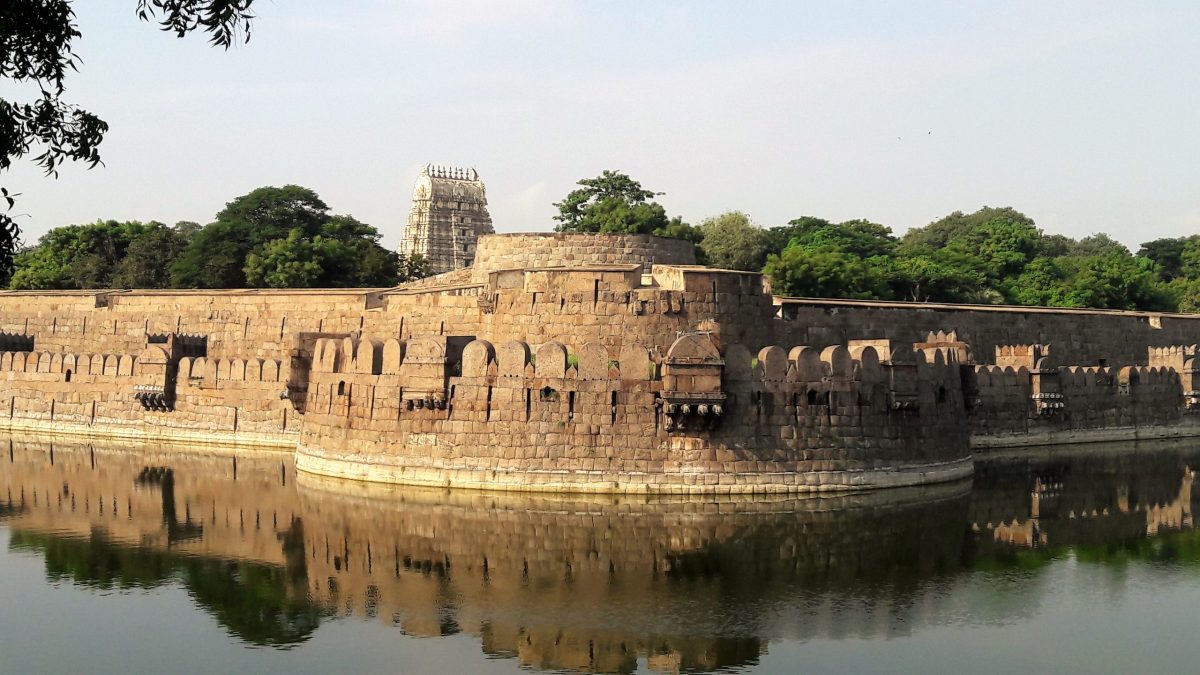
Long before the Revolt of 1857, Indian soldiers of the East India Company had already risen once. On 10 July 1806 sepoys at Vellore, in present-day Tamil Nadu, killed their British officers and seized the fort. The revolt lasted a single day, but it was the first large-scale and violent mutiny against the Company, and the grievances behind it were the same as those that would explode half a century later.
Quick Facts
| Date | 10 July 1806 |
| Place | Vellore Fort, Madras Presidency (now Tamil Nadu) |
| Cause | Dress and appearance regulations; Mysore royal family confined at the fort |
| British losses | About 200 killed or wounded |
| Mutineers killed | About 350 |
| Outcome | Revolt crushed; regulations withdrawn; senior officials recalled |
The Causes
In November 1805 new rules for the Madras Army ordered Hindu soldiers not to wear caste marks on their foreheads while on duty, and Muslims to shave their beards and trim their moustaches. A round hat with a leather cockade replaced the turban, and to the sepoys it resembled the headgear of Europeans and of Indian converts to Christianity. A military board had earlier warned that changes to uniform needed the greatest care. In May 1806 sepoys who protested at Vellore were sent to Madras and given 90 lashes each, a Hindu and a Muslim, and were dismissed.
There was also a political motive. After the fall of Seringapatam, the family of Tipu Sultan had been settled as pensioners in a palace inside Vellore Fort, with their retainers. Tipu’s sons took part in the plot, and the wedding of one of his daughters on 9 July 1806 gave conspirators a reason to gather at the fort.
The Night of 10 July
Before dawn the sepoys killed British officers and soldiers in their quarters, including the fort’s commander, Colonel Fancourt, and attacked the European barracks. The mutineers raised a flag of the Mysore kingdom, and one of Tipu’s sons was proclaimed ruler. But they had no plan for what would follow, and they did not close the gates or secure the road to Arcot.
- **Relief force:** Colonel Rollo Gillespie rode from Arcot with cavalry and guns and blew open the gate
- **Reprisals:** about 100 of the mutineers were shot without trial in the fort; formal court-martials followed
- **Total deaths:** about 350 mutineers died, according to the generally accepted account
Aftermath
The Company’s response was to withdraw the offending regulations. The Commander-in-Chief of the Madras Army, Sir John Cradock, and the Governor of Madras, Lord William Bentinck, were both recalled. The sons and family of Tipu Sultan were moved to Calcutta. The Company drew its own conclusions, which it later forgot: that interference with religious custom in the army was dangerous.
Why It Matters
The mutiny is one of the earliest armed protests against the Company, and in Tamil Nadu it is remembered as a precursor of the freedom struggle. The parallels with 1857, when the issue of greased cartridges set off a far wider revolt, are plain. The earlier story of the fall of Mysore is told in the Siege of Seringapatam and in Tipu Sultan’s biography; the later revolt in the Revolt of 1857.
Featured image: Vellore Fort, scene of the 1806 mutiny, with the Jalakandeswarar temple inside, Tamil Nadu. Photo by Ssriram mt, licensed under CC BY-SA 4.0, via Wikimedia Commons.

Leave a Reply