
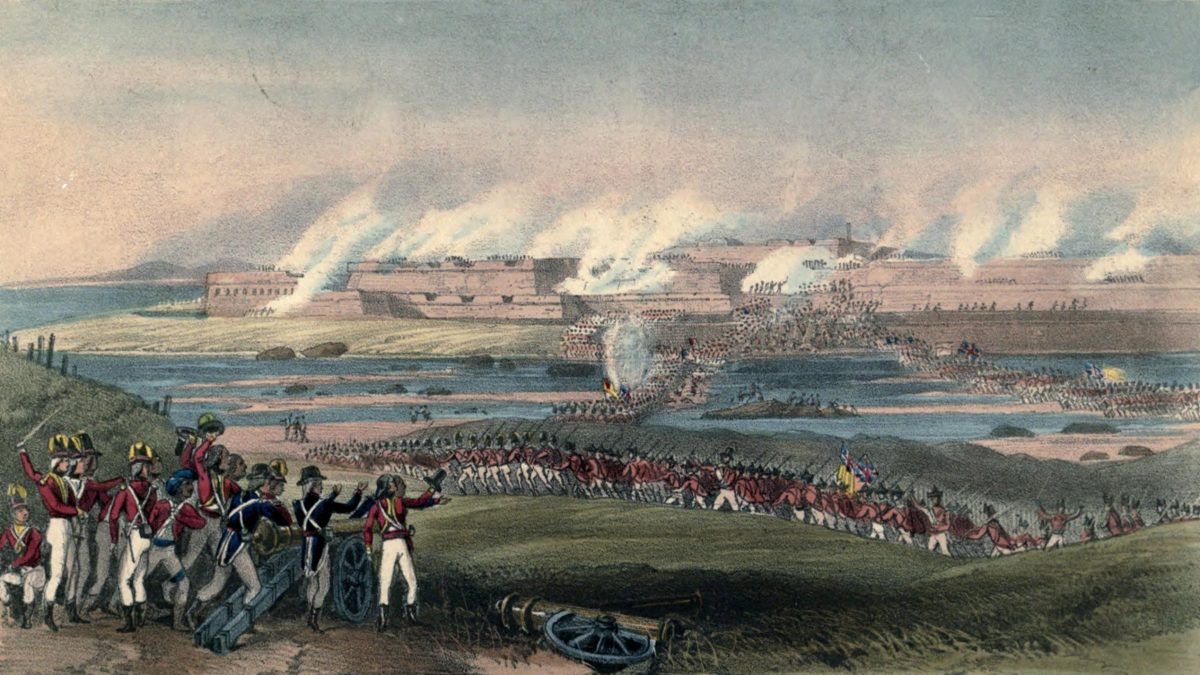
On the afternoon of 4 May 1799, troops of the English East India Company stormed the island fortress of Seringapatam, capital of Mysore. Its ruler, Tipu Sultan, died fighting at one of the gates. His death removed the most determined enemy the British had faced in India.
Mysore under Haidar and Tipu
Haidar Ali, a soldier of fortune, took control of the Hindu kingdom of Mysore around 1761, keeping its Wodeyar rajas as figureheads. He and his son Tipu, who succeeded him in 1782, built a centralised state with a disciplined army, French-trained infantry and artillery, and iron-cased rockets that were more advanced than anything in Europe.
Four wars
- First war, 1767–1769: Haidar appeared before Madras and dictated peace.
- Second war, 1780–1784: Haidar destroyed a British force at Pollilur in 1780, one of the Company’s worst defeats in India. Tipu concluded the war by the Treaty of Mangalore on equal terms.
- Third war, 1790–1792: After Tipu attacked Travancore, a British ally, Lord Cornwallis, with the Marathas and the Nizam of Hyderabad, besieged Seringapatam. Tipu had to cede half his kingdom, pay a large indemnity and give two young sons as hostages.
- Fourth war, 1799: the last.
The road to the last war
Tipu spent the years after 1792 rebuilding his strength and looking for allies. He wrote to the Ottoman sultan, to the ruler of Afghanistan and above all to revolutionary France. In 1798 a small party of French volunteers arrived from Mauritius, and Napoleon Bonaparte landed in Egypt, writing of his wish to free Tipu from “the iron yoke of England”.
The new Governor-General, Richard Wellesley, Lord Mornington, treated this as justification for war. He first forced the Nizam to disband his French-officered corps, and then, when Tipu delayed negotiations, ordered an invasion.
The siege
Two armies entered Mysore in February 1799: the main force under General George Harris from the east, with a contingent of the Nizam’s troops accompanied by the Governor-General’s younger brother, Colonel Arthur Wellesley, the future Duke of Wellington; and a smaller force from the west coast. Together they numbered about 50,000. Tipu, defeated in two field actions, fell back on his capital.
Seringapatam stands on an island in the Kaveri river. The besiegers arrived on 5 April and opened batteries against the north-western corner of the walls. Time was short: their food was running low, and the monsoon would soon flood the river. By 3 May the guns had made a practicable breach.
The storm
The assault was set for one o’clock on 4 May, the hottest hour, when the defenders would be resting. It was led by Major-General David Baird, who had spent nearly four years as a prisoner in the dungeons of the same fortress.
The storming columns, about 4,000 men, waded the shallow river under fire, climbed the breach within minutes and split left and right along the ramparts. Tipu, who had been at his midday meal, hurried to the northern wall and fought among his soldiers, firing at the attackers with guns handed up by his servants. Wounded, he was carried back in the press to the Water Gate. There he was killed by a soldier who wanted his jewelled sword-belt and did not know who he was. His body was found that evening under a heap of the dead, still warm.
A tradition in Mysore holds that his minister Mir Sadiq betrayed him by withdrawing troops from the breach at the vital moment.
The aftermath
- The plunder: The city was looted through the night. The prize officially distributed was the largest the British army had known. Tipu’s throne was broken up; his mechanical tiger, shown devouring a European, is in the Victoria and Albert Museum in London.
- The kingdom: The British and the Nizam took large shares of territory. The rest was restored to the Wodeyar family in the person of a five-year-old boy, Krishnaraja III, under British protection, with the able minister Purnaiah as regent.
- Tipu’s family was pensioned off and removed to Vellore and later Calcutta.
Tipu was buried beside his father in the Gumbaz at Seringapatam. He is remembered by many as a ruler who chose to die rather than become a dependant, and criticised by others for his harsh treatment of some communities he conquered; the argument over his legacy continues. A saying attributed to him is that it is better to live one day as a tiger than a hundred years as a sheep.
Image: The storming of Seringapatam on 4 May 1799, in a British print published in 1851. Photo by Madeley, in the public domain, via Wikimedia Commons.




Leave a Reply