Goswami Tulsidas (c. 1511 – 1623) was an Indian poet-saint and the author of the Ramcharitmanas, a retelling of the story of Rama in Awadhi, the spoken language of eastern Uttar Pradesh. By putting the epic into the people’s tongue he made it the common possession of north India, recited in homes and villages for more than four centuries. He spent most of his life in Varanasi and Ayodhya. The dates and many details of his life rest on tradition more than record.
Quick Facts
| Name | Goswami Tulsidas (childhood name Rambola) |
| Born | c. 1511 (traditional dates vary), Rajapur or Soron, Uttar Pradesh |
| Died | 1623, Assi Ghat, Varanasi |
| Occupation | Poet, saint |
| Languages | Awadhi, Braj |
| Tradition | Ramanandi Vaishnavism |
| Notable works | Ramcharitmanas, Vinaya Patrika, Kavitavali, Gitavali, Dohavali, Hanuman Chalisa |
Early Life
Two places in Uttar Pradesh claim his birth: Rajapur on the Yamuna in the Chitrakoot region and Soron in Kasganj district. According to tradition he was born to a Brahmin couple under an unlucky conjunction of stars and was abandoned, brought up first by a servant woman and then, after her death, as a begging orphan. He himself wrote of a childhood in which he went from door to door for a handful of grain. A Vaishnava ascetic, Narharidas, took him in, named him and first told him the story of Rama. He then studied Sanskrit, the Vedas and philosophy in Varanasi for many years.
A famous story says that he was devoted to his wife, Ratnavali, and once crossed a river in flood at night to reach her at her parents’ house; she told him that if he had half as much love for Rama as for her body of flesh and bone, he would be free of fear. He left to become a wandering ascetic.
Works
He began the poem at Ayodhya on the festival of Rama’s birth in 1574 and completed it, by his own account, after more than two years, much of it in Varanasi. The “Lake of the Deeds of Rama” has seven books and is composed mainly in the chaupai and doha metres. It follows Valmiki’s story but is suffused with devotion, presenting Rama as the supreme God who is also the ideal son, brother, husband and king. Scholars of Varanasi are said to have resented a scripture in the vernacular, and legends tell of the manuscript being tested in the temple of Vishwanath.
The Vinaya Patrika, a “letter of petition” to Rama in the form of hymns, is considered his most personal work. Kavitavali and Gitavali retell episodes of the story in other metres and in Braj, and Dohavali collects his couplets. The Hanuman Chalisa, forty verses in praise of Hanuman, probably the most recited poem in Hindi, is attributed to him.
Varanasi
He lived for decades at Assi Ghat. Tradition credits him with founding the Sankat Mochan temple of Hanuman and with beginning the Ramlila, the annual enactment of the story of Rama that is still performed across north India. He was a contemporary of the emperor Akbar, and is said to have been friendly with the poet-courtier Rahim. He died at Assi Ghat in 1623.
Legacy
The Ramcharitmanas shaped the religion, ethics and language of the Hindi-speaking world more than any other book. Mahatma Gandhi called it the greatest work of devotional literature. Its verses are quoted as proverbs, and sessions of continuous recitation remain part of village and city life in Uttar Pradesh and wherever people from the region have settled.
Frequently Asked Questions
When and where was Tulsidas born?
Birth details: c. 1511 (traditional dates vary), Rajapur or Soron, Uttar Pradesh.
When did Tulsidas die?
Died: 1623, Assi Ghat, Varanasi.
What is Tulsidas’s occupation?
Occupation: Poet, saint.
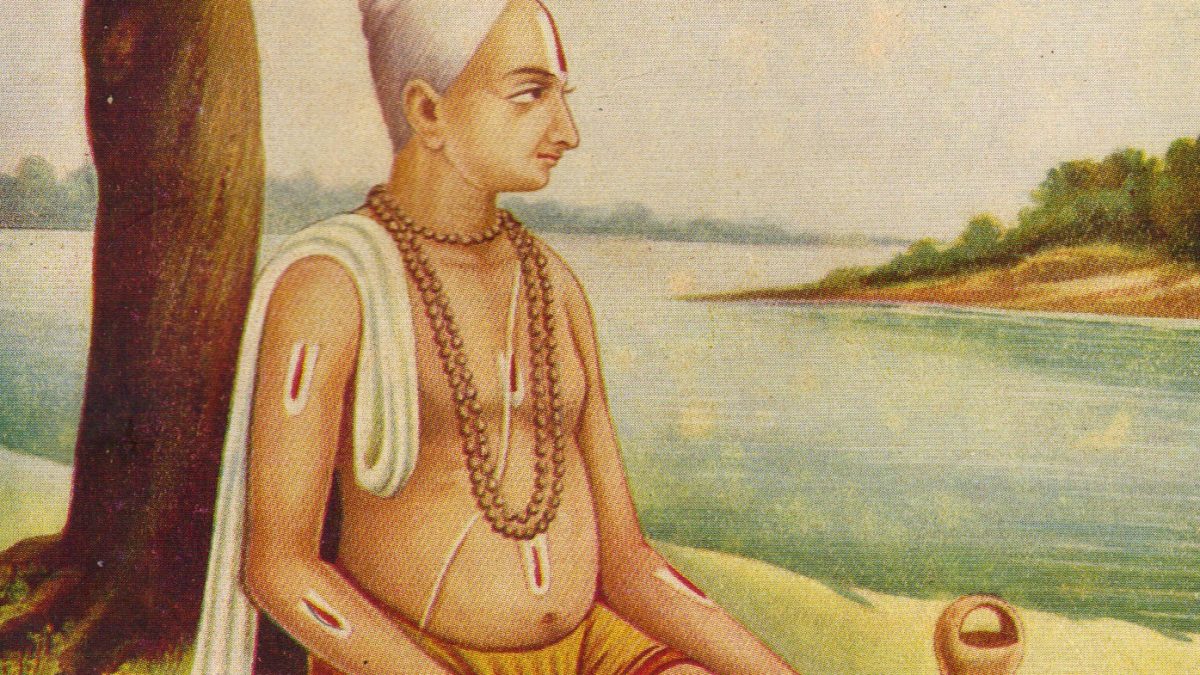
Featured image: Tulsidas composing by the river, a twentieth-century painting. Photo by Mohan, in the public domain, via Wikimedia Commons.