
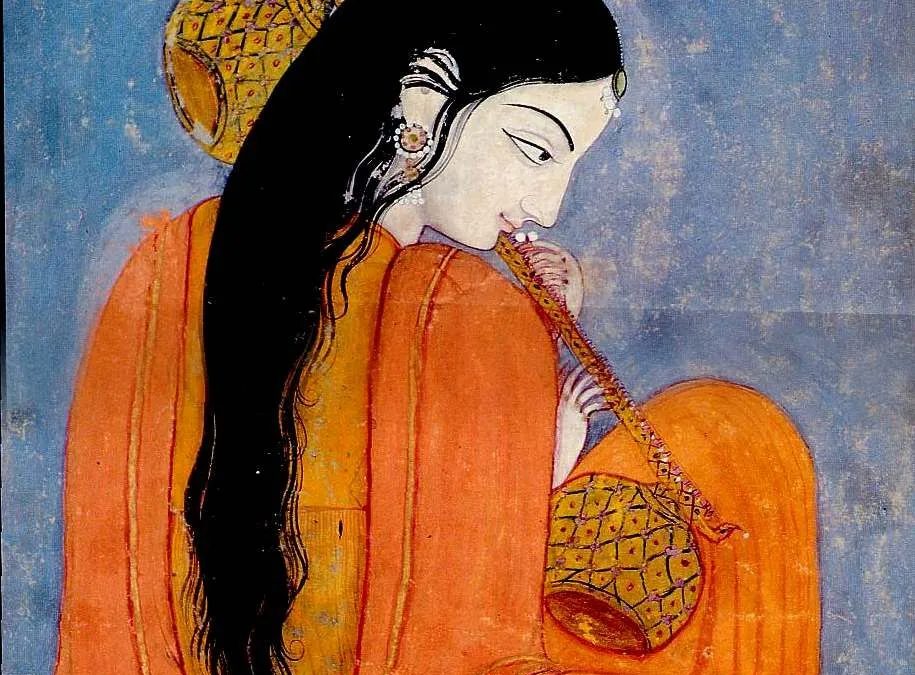
Mirabai (about 1498 – about 1547), also called Meera, was a Rajput princess and a mystic poet of the Bhakti movement, the best-loved woman saint of north India. Married into the royal house of Mewar, she regarded the god Krishna as her true husband, defied the conventions of her rank to sing and dance before his image among ordinary worshippers, and left behind songs that are still sung in every part of the country.
Quick Facts
| Born | about 1498, Kudki, near Merta, Rajasthan |
| Died | about 1547, by tradition at Dwarka, Gujarat |
| Family | Rathore house of Merta |
| Spouse | Bhoj Raj, prince of Mewar |
| Known for | Devotional songs (bhajans) to Krishna |
| Tradition | Bhakti movement |
| Language | Rajasthani and Braj Bhasha |
The Sources
Almost nothing about her is recorded in documents of her own time. Her life is known from accounts written by devotees a century or more later and from her songs, and legend and fact cannot be fully separated. What follows is the story as tradition tells it.
Early Life
She was born into the Rathore family that ruled Merta, a branch of the house of Jodhpur. Her mother died when she was small, and she was brought up by her grandfather, Rao Dudaji, a devout worshipper of Vishnu.
As a child she watched a wedding procession and asked her mother who her own bridegroom would be. Her mother pointed in jest to an image of Krishna. Another story says that a wandering holy man gave her a small figure of Krishna as Giridhar, the lifter of the mountain. She kept it with her for life.
Marriage
In about 1516 she was married to Bhoj Raj, the eldest son of Rana Sanga, the ruler of Mewar and the most powerful Rajput king of the time, and went to live at Chittor. She fulfilled her duties but declared that she was already wedded to Krishna, and refused to worship the goddess of her husband’s family.
Bhoj Raj died a few years later, perhaps of wounds received in battle. Her father was killed fighting beside Rana Sanga against Babur at Khanwa in 1527, and Rana Sanga himself died the next year.
Persecution
A widow of a royal house was expected to live in seclusion. Mira spent her days in the temple, singing and dancing before Krishna in the company of holy men and of anyone who came. Her husband’s relatives, and above all the new ruler, saw it as a disgrace to the family.
The best-known legends belong to this time. A cup of poison was sent to her as holy water; she drank it and came to no harm. A basket said to hold flowers contained a snake; when she opened it she found a garland, or an image of Krishna. A bed of nails became a bed of petals.
The Wanderer
She left Chittor, went back for a time to Merta, and then took to the road as a pilgrim. She lived in Vrindavan, the land of Krishna’s childhood, and finally at Dwarka on the coast of Gujarat. One tradition names the saint Ravidas, a cobbler by caste, as her teacher.
The story of her end is that messengers came from Mewar to bring her home. She asked leave to spend the night in the temple. In the morning she was gone; only her sari was found, wrapped round the image of Krishna, into which she had vanished.
The Songs
More than a thousand songs bear her name; scholars think a few hundred, perhaps fewer, are hers. They are short, in the simple speech of Rajasthan and Braj, and each ends with her signature and the name of her lord, Giridhar Nagar.
- “Mere to Giridhar Gopal, doosro na koi”: “Mine is Giridhar Gopal, and no other”
- “Payoji maine Ram ratan dhan payo”: “I have found the jewel of the Name”
- “Pag ghungroo bandh Mira nachi re”: “Mira danced with bells on her ankles”
Their subject is love: the longing of the soul for God, spoken as a woman’s longing for an absent lover, and her indifference to what the world says.
Legacy
Mahatma Gandhi admired her as an example of non-violent resistance to unjust authority. The singer M. S. Subbulakshmi played her in a celebrated film of 1945. A temple at Chittorgarh fort is associated with her, and her songs remain part of daily worship and of the classical and popular music of India.
Featured image: Mirabai, in a painting of the Kangra school. Photo by an unknown artist, in the public domain, via Wikimedia Commons.



