
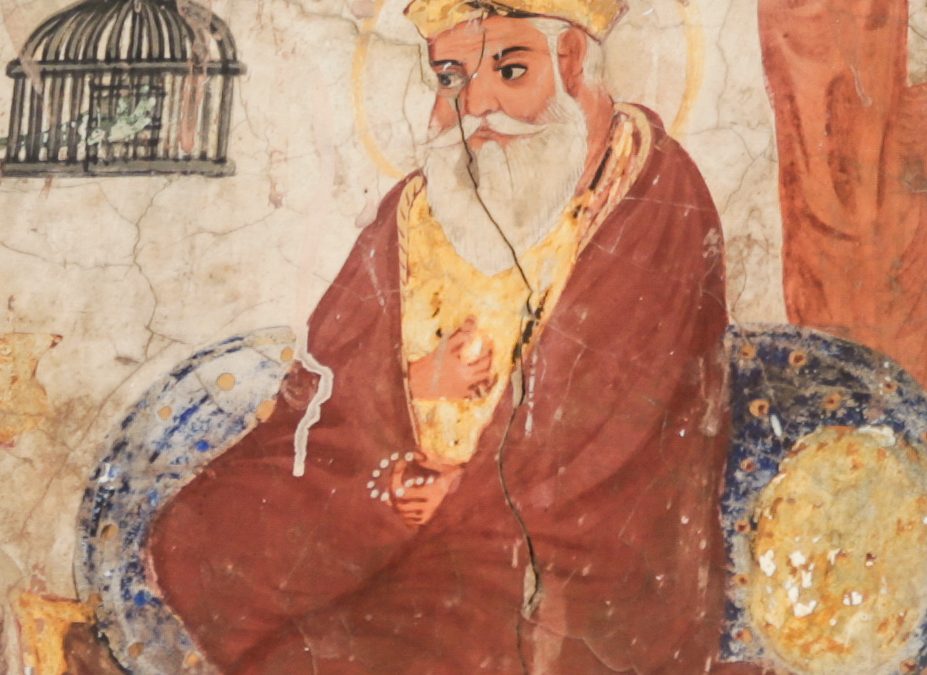
Guru Nanak (1469 – 22 September 1539) was the founder of Sikhism and the first of its ten Gurus. Born in Punjab at a time of religious division and political upheaval, he taught that there is one God, formless and present in all, to be reached not by ritual or renunciation but by remembrance, honest work and sharing with others, and that caste and creed count for nothing. His hymns form the core of the Sikh scripture.
Quick Facts
| Born | 1469, Rai Bhoi di Talwandi (now Nankana Sahib, Pakistan) |
| Died | 22 September 1539, Kartarpur (now in Pakistan) |
| Known for | Founder of Sikhism; first Sikh Guru |
| Parents | Mehta Kalu and Mata Tripta |
| Spouse | Mata Sulakhni |
| Children | Sri Chand and Lakhmi Das |
| Successor | Guru Angad |
| Chief composition | Japji Sahib |
Early Life
He was born in the village of Talwandi, south-west of Lahore, into a Hindu family of the Khatri caste. His father was the village accountant. His birthday is celebrated in the autumn, on the full moon of the month of Kartik, though many scholars place the birth in April.
The traditional accounts of his life, the Janamsakhis, describe a thoughtful child who puzzled his teachers and disappointed his father. Given money to trade with, he spent it on feeding hungry holy men and called it a true bargain. At the ceremony at which a Hindu boy puts on the sacred thread, he is said to have refused it and asked for a thread of compassion and contentment that would not break.
He was married and had two sons. His sister’s husband found him a post as storekeeper to the governor of Sultanpur.
The Vision
At Sultanpur, about the age of thirty, he went one morning to bathe in the river and did not come back. He returned after three days, silent, and then said: “There is no Hindu, there is no Muslim.” He gave away his possessions and set out to teach.
The Journeys
For some twenty years he travelled, on foot, with a Muslim musician named Mardana, who played the rabab while Nanak sang his hymns. Tradition counts four great journeys: east as far as Assam, south to Sri Lanka, north into the Himalayas and Tibet, and west to Mecca and Baghdad. He visited the holy places of Hindus and Muslims alike and debated with pandits, yogis and Sufis.
Many stories are told of these travels. At Haridwar, seeing pilgrims throw water towards the rising sun for their ancestors, he threw it the other way, saying he was watering his fields in Punjab. At Mecca, rebuked for sleeping with his feet towards the Kaaba, he asked that his feet be turned to where God was not.
The Teaching
- **One God:** Ik Onkar, the opening words of his chief hymn, without form, beyond birth and death, the same for all
- **Naam Japna:** constant remembrance of God
- **Kirat Karni:** earning one’s living by honest work
- **Vand Chakna:** sharing what one has with others
- **Equality:** he rejected caste, the claims of priests, idol worship, pilgrimage and fasting as ways to salvation, and insisted on the dignity of women: “Why call her inferior, from whom kings are born?”
- **Life in the world:** the householder, not the hermit, was his ideal
He witnessed the invasion of Babur and wrote verses lamenting the suffering it caused, reproaching rulers who failed to protect their people.
Kartarpur
Around 1520 he settled at Kartarpur on the Ravi, put on a householder’s clothes and worked his fields. A community gathered round him. They met morning and evening to sing; all ate together in a common kitchen, the langar, sitting in rows regardless of caste. These became the central institutions of the Sikh faith.
Succession and Death
He passed over his sons and named a devoted disciple, Lehna, as his successor, calling him Angad, “part of my own body”. He died in 1539. The story goes that Hindus wished to cremate him and Muslims to bury him; in the morning they found only flowers under the sheet, which they divided.
Legacy
His 974 hymns are preserved in the Guru Granth Sahib. The line of Gurus he began ended with Guru Gobind Singh, who gave the community its present form. A visa-free corridor allowing Indian pilgrims to visit Kartarpur was opened in 2019, the 550th anniversary of his birth.
Featured image: Guru Nanak, in a nineteenth-century mural at Gurdwara Baba Atal, Amritsar. Photo by Amritpal Singh Mann. Painted by Jaimal Singh Naqqash (1860–1916), Mehtab Singh Naqqash (1871–1940), and Hukum Singh., licensed under CC BY-SA 4.0, via Wikimedia Commons.



