
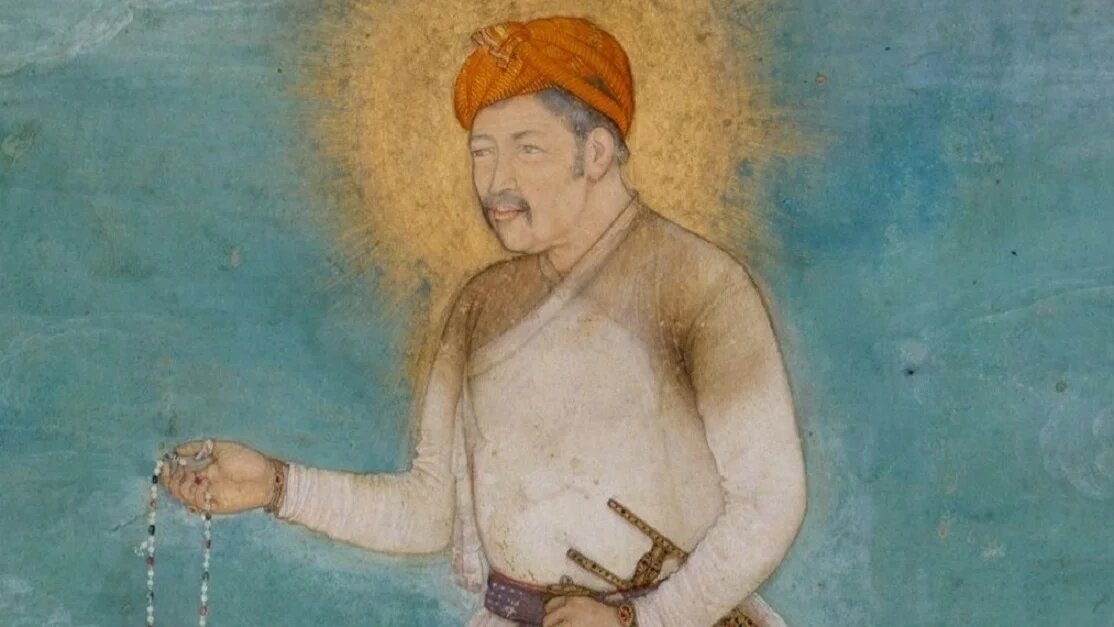
Akbar (15 October 1542 – 27 October 1605), also known as Akbar the Great, was the third Mughal emperor of India. He came to the throne at 13 and ruled from 1556 to 1605. Through conquest and diplomacy he extended Mughal rule over most of the Indian subcontinent, and he created a system of administration that lasted for generations. He is remembered above all for his policy of religious tolerance, his alliances with Rajput rulers and his patronage of art, architecture and learning.
Quick Facts
| Full name | Abu’l-Fath Jalal-ud-din Muhammad Akbar |
| Born | 15 October 1542, Umarkot, Sindh (now in Pakistan) |
| Died | 27 October 1605, Agra (aged 63) |
| Reign | 1556–1605 |
| Dynasty | Mughal |
| Father | Humayun |
| Mother | Hamida Banu Begum |
| Successor | Jahangir (Salim) |
| Capitals | Agra, Fatehpur Sikri, Lahore |
| Resting place | Akbar’s Tomb, Sikandra, Agra |
Early Life
Akbar was born at Umarkot in Sindh while his father, Humayun, was a fugitive who had lost his throne to the Afghan ruler Sher Shah Suri. He spent his childhood in Afghanistan, where he learned to hunt and fight but never learned to read or write. Humayun won back Delhi in 1555 but died a few months later after a fall. Akbar was crowned emperor at Kalanaur in Punjab on 14 February 1556, aged 13.
Reign
Akbar’s guardian, Bairam Khan, ruled as regent in his early years. In November 1556 the Mughal army defeated the Hindu general Hemu at the Second Battle of Panipat, saving the young emperor’s throne. In 1560 Akbar dismissed Bairam Khan and took power into his own hands.
Over the next four decades Akbar conquered Malwa, Gujarat, Bengal, Kashmir, Sindh and parts of the Deccan, creating an empire that stretched from Afghanistan to the Bay of Bengal. He captured the great Rajput forts of Chittor (1568) and Ranthambore (1569). The ruler of Mewar, Maharana Pratap, refused to submit and fought the Mughals at the Battle of Haldighati in 1576.
Instead of only fighting the Rajputs, Akbar made them partners. In 1562 he married a princess of Amber (Jaipur), and Rajput chiefs such as Raja Man Singh became some of his highest generals. He abolished the pilgrim tax and, in 1564, the jizya, the tax on non-Muslims.
Akbar organised his nobles and officers into ranks under the mansabdari system. His finance minister, Raja Todar Mal, measured the land and fixed taxes according to its produce. The empire was divided into provinces, each with its own governor and officials, a structure later rulers kept.
Religion and Culture
Akbar was curious about all faiths. At his new capital, Fatehpur Sikri, he built the Ibadat Khana (House of Worship) in 1575, where Muslim, Hindu, Jain, Zoroastrian and Christian scholars debated before him. He promoted the principle of sulh-i kul, “peace with all”, and in 1582 introduced a small spiritual order known as the Din-i Ilahi. His court was famous for its “nine jewels” (Navratnas), including the singer Tansen, the witty adviser Birbal and the historian Abul Fazl, who wrote the Akbarnama. Mughal painting and architecture flourished under him.
Death
Akbar’s last years were troubled by the rebellion of his son Salim. He fell ill in 1605 and died at Agra on 27 October. Salim succeeded him as the emperor Jahangir. Akbar is buried in a grand tomb at Sikandra, near Agra.
Legacy
Frequently Asked Questions
When and where was Akbar born?
Akbar was born on 15 October 1542 in Umarkot, Sindh (now in Pakistan).
When did Akbar die?
Died: 27 October 1605, Agra (aged 63).
Featured image: Emperor Akbar, a detail from Akbar With Lion and Calf by the Mughal painter Govardhan, about 1630, Metropolitan Museum of Art, New York. Painting by Govardhan, Metropolitan Museum of Art, in the public domain, via Wikimedia Commons.



