
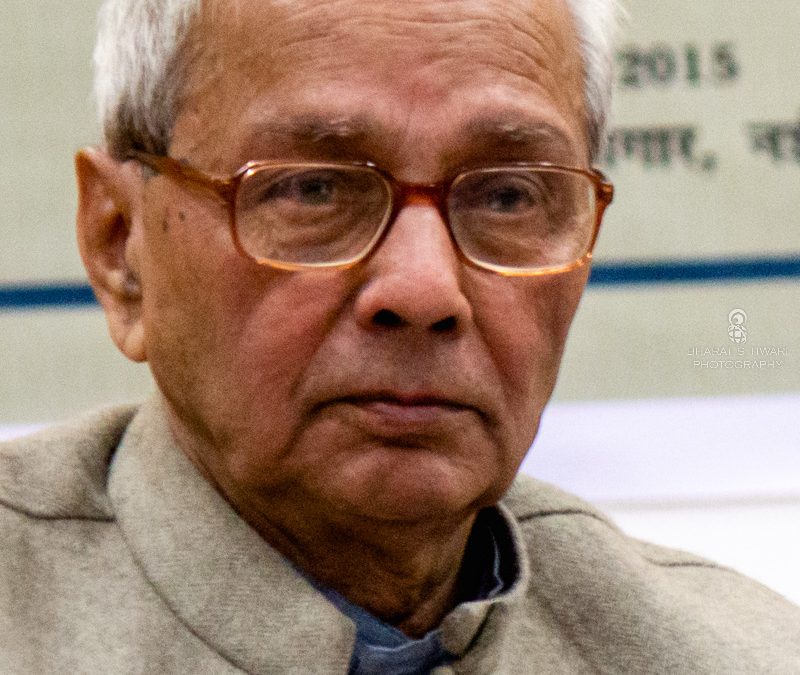
Kedarnath Singh (7 July 1934 – 19 March 2018) was an Indian poet, critic and teacher, one of the most admired voices in Hindi poetry after independence. Born in a village in Ballia in eastern Uttar Pradesh, he wrote in a plain, conversational language about bread, rivers, salt, roads and the speech of villagers, finding in them questions about history and survival. He received the Sahitya Akademi Award in 1989 and the Jnanpith Award for 2013.
Quick Facts
| Full name | Kedarnath Singh |
| Born | 7 July 1934, Chakia, Ballia district, Uttar Pradesh, India |
| Died | 19 March 2018 (aged 83), New Delhi |
| Occupation | Poet, critic, professor |
| Language | Hindi |
| Education | Banaras Hindu University (M.A., Ph.D.) |
| Notable works | Abhi Bilkul Abhi, Zameen Pak Rahi Hai, Akaal Mein Saras, Bagh, Uttar Kabir |
| Awards | Sahitya Akademi Award (1989); Jnanpith Award (2013) |
Early Life
Singh was born in Chakia, a village on the plain between the Ganga and the Ghaghara, into a farming family. He went to the village school and then to Varanasi, where he studied at Udai Pratap College and Banaras Hindu University, taking his master’s degree in Hindi in 1956 and a doctorate in 1964 for a study of imagery in modern Hindi poetry. Varanasi and the Bhojpuri-speaking countryside of his childhood remained the two poles of his imagination.
Career
He taught at colleges in Varanasi, Gorakhpur and Padrauna for some years. In 1976 he joined Jawaharlal Nehru University in Delhi, where he was professor and head of the Hindi department at its Centre of Indian Languages until his retirement in 1999. Generations of Hindi scholars and writers were his students.
He was noticed early: the poet Agyeya included him in Teesra Saptak (1959), an anthology of seven new poets that helped define a generation. His first collection, Abhi Bilkul Abhi, appeared in 1960. Then came a silence of nearly twenty years, broken by Zameen Pak Rahi Hai (1980) and Yahan Se Dekho. Akaal Mein Saras (“Cranes in the Drought”, 1988) won the Sahitya Akademi Award.
His long poem Bagh (“The Tiger”) is a sequence in which a tiger wanders in and out of a town, a presence that is by turns fear, freedom and time itself. Later books include Uttar Kabir Aur Anya Kavitayen (1995), Tolstoy Aur Cycle (2005) and Srishti Par Pahra (2014). Among his best-known shorter poems are “Banaras”, a portrait of the city standing on one leg in the water like a sage, “Roti”, “Nadi” and “Haath”. He also wrote essays and criticism.
Style
Singh joined the craft of modernist poetry to the rhythms of folk speech. His poems begin with an ordinary object or meeting and open outward quietly, without rhetoric. He once wrote that going to the village from the city was like walking from one language into another, and much of his work is about carrying something across that gap: the dignity of labour, the fear of loss of land and tongue, the stubbornness of hope.
Recognition
In addition to the Sahitya Akademi Award he received the Maithili Sharan Gupt Samman, the Kumaran Asan Award, the Vyas Samman and a fellowship of the Sahitya Akademi. The Jnanpith Award for 2013, India’s highest literary honour, was presented to him in 2014. His poems have been translated into English, Spanish, Russian, German and many Indian languages.
Personal Life and Death
His wife died young, and he brought up their children. He divided his later years between Delhi and his village. He died in New Delhi on 19 March 2018.
Frequently Asked Questions
When and where was Kedarnath Singh born?
Kedarnath Singh was born on 7 July 1934 in Chakia, Ballia district, Uttar Pradesh, India.
When did Kedarnath Singh die?
Died: 19 March 2018 (aged 83), New Delhi.
What is Kedarnath Singh’s occupation?
Occupation: Poet, critic, professor.
What honours has Kedarnath Singh received?
Sahitya Akademi Award (1989); Jnanpith Award (2013).
Featured image: Kedarnath Singh in November 2015. Photo by Bharat S. Tiwari, licensed under CC BY-SA 4.0, via Wikimedia Commons.



