Vinod Kumar Shukla (1 January 1937 – 23 December 2025) was an Indian poet and novelist who wrote in Hindi. In a style unlike anyone else’s, plain in vocabulary and strange in its turns of thought, he wrote about the small lives of clerks, teachers and their families in the towns of Chhattisgarh. He received the Sahitya Akademi Award, the PEN/Nabokov Award and, in 2025, the Jnanpith Award, the first writer from Chhattisgarh to be so honoured.
Quick Facts
| Full name | Vinod Kumar Shukla |
| Born | 1 January 1937, Rajnandgaon, Chhattisgarh |
| Died | 23 December 2025, Raipur (aged 88) |
| State | Chhattisgarh |
| Language | Hindi |
| Occupation | Poet, novelist, teacher |
| Education | Jawaharlal Nehru Krishi Vishwavidyalaya, Jabalpur (M.Sc. in agriculture) |
| Notable works | Naukar ki Kameez, Khilega To Dekhenge, Deewar Mein Ek Khidki Rehti Thi, Lagbhag Jai Hind, Sab Kuch Hona Bacha Rahega |
| Awards | Sahitya Akademi Award (1999), PEN/Nabokov Award (2023), Jnanpith Award (59th, for 2024) |
| Spouse | Sudha Shukla |
Early Life
He was born in Rajnandgaon, a small town in what is now Chhattisgarh. His father died when he was a child, and he grew up in a large joint family in which his mother, who read Bengali literature, was the chief influence.
Rajnandgaon was the home, in his last years, of the great Hindi poet Gajanan Madhav Muktibodh, who taught at the local college. The young Shukla showed him his poems, and Muktibodh sent some of them to a magazine. It was his start as a writer.
Teacher
He took a master’s degree in agriculture at Jabalpur and spent his working life teaching agricultural extension at the agricultural college in Raipur, later a university, from which he retired in 1996. He never moved to a metropolis and seldom travelled. He lived in a modest house in Raipur, wrote in the mornings and was little seen at literary gatherings.
Poetry
His first collection, a slim booklet titled Lagbhag Jai Hind (“Almost Jai Hind”), appeared in 1971. It was followed by a volume whose title is itself a poem, translated as “That man put on a new woollen coat and went away like a thought” (1981), and by Sab Kuch Hona Bacha Rahega, Atirikt Nahin and others.
His poems look at ordinary things, a tree, a neighbour, a man walking, as if no one had looked at them before. One of the best known says that he did not know the despairing man, but knew despair, and so went and held out his hand.
Novels
- Naukar ki Kameez (“The Servant’s Shirt”, 1979): a young clerk and his wife in a rented room, and the office hierarchy in which a shirt kept for the boss’s servant becomes a sign of servitude. The film-maker Mani Kaul adapted it in 1999.
- Khilega To Dekhenge (1996): a schoolmaster’s family living in an abandoned police station
- Deewar Mein Ek Khidki Rehti Thi (“A Window Lived in the Wall”, 1997): a newly married mathematics lecturer and his wife, whose one-room home has a window that opens on to a world of rivers and forests. It won the Sahitya Akademi Award in 1999.
- Hari Ghas ki Chhappar Wali Jhopdi aur Bauna Pahad and other books for young readers
His prose has been called magic realism, a label he did not care for. The marvels in his books come from the way poor people use imagination to enlarge cramped lives.
Recognition
- Sahitya Akademi Award (1999)
- PEN/Nabokov Award for Achievement in International Literature (2023), the first for an Indian writer
- Jnanpith Award, the fifty-ninth, announced in March 2025
His books have been translated into English, among them The Servant’s Shirt, A Window Lived in a Wall and the story collection Blue Is Like Blue.
Death
He was admitted to hospital in Raipur with breathing trouble at the beginning of December 2025 and died there on 23 December, a few days before his eighty-ninth birthday. He was cremated with state honours.
Personal Life
He and his wife, Sudha, had a son and a daughter. He continued to write almost to the end, and said that he wrote because there was still so much left to see.
He is the most celebrated writer to have come from the state, whose stage was made known by Habib Tanvir.
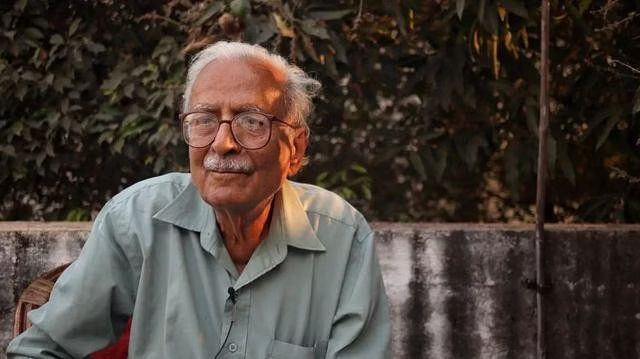
Featured image: Vinod Kumar Shukla at his home in Raipur. Photo by Bolta Kagaz, licensed under CC BY-SA 4.0, via Wikimedia Commons.