
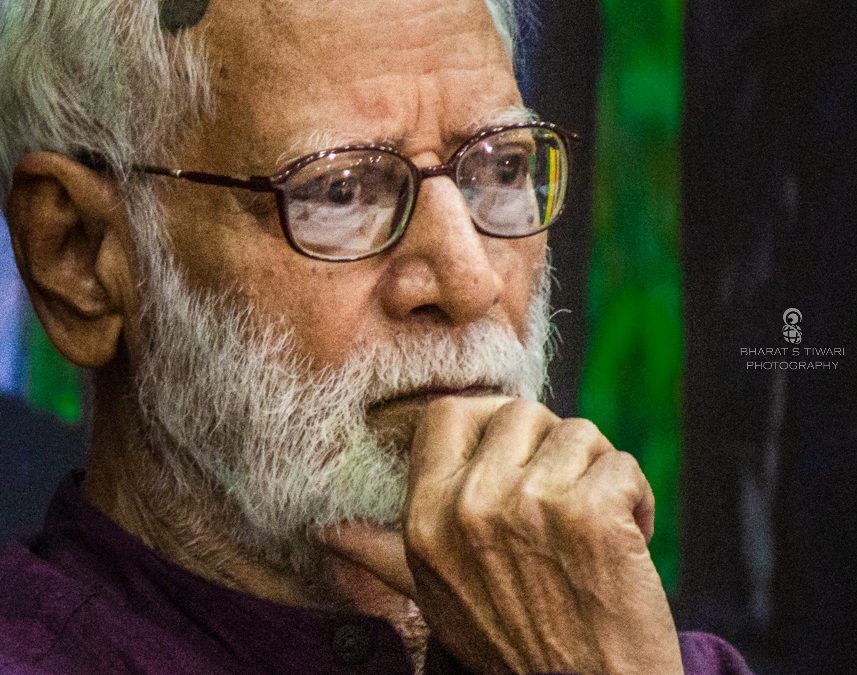
Kashinath Singh (born 1 January 1937) is an Indian writer in Hindi, known for his short stories, novels and memoirs. A lifelong resident of Varanasi and for three decades a teacher at Banaras Hindu University, he is the chronicler of the city’s street life and talk, above all in Kashi Ka Assi, a portrait of the Assi neighbourhood that has been adapted for stage and film. He won the Sahitya Akademi Award in 2011 for the novel Rehan Par Ragghu.
Quick Facts
| Full name | Kashinath Singh |
| Born | 1 January 1937, Jiyanpur, Chandauli district (then Varanasi district), Uttar Pradesh, India |
| Age | 89 |
| Occupation | Novelist, short-story writer, professor |
| Language | Hindi |
| Education | Banaras Hindu University (M.A., Ph.D.) |
| Notable works | Apna Morcha, Kashi Ka Assi, Rehan Par Ragghu, Upsanhar |
| Relatives | Namvar Singh (brother) |
| Awards | Sahitya Akademi Award (2011) |
Early Life
Singh was born in the village of Jiyanpur, east of Varanasi, into a farming family. His father was a schoolteacher. He was the youngest of three brothers; the eldest, Namvar Singh, became the most influential Hindi literary critic of his time. Kashinath followed him to Varanasi, studied Hindi at Banaras Hindu University and took a doctorate there.
Career
He joined the university’s Hindi department as a lecturer in 1965 and retired in 1996 as professor and head of department. He was a popular teacher and remained closely involved with students and with the political arguments of the campus.
He began publishing short stories in the 1960s and was associated with the writers who brought a new directness to Hindi fiction after independence. His collections include Log Bistaron Par, Subah Ka Dar and Aadmi Nama. His first novel, Apna Morcha (1972), grew out of the student agitations of the late 1960s.
Over the 1990s he wrote a series of long sketches set at Assi, the southernmost ghat of Varanasi, and especially at a tea shop where teachers, priests, students, small politicians and idlers argued every day. Published together as Kashi Ka Assi in 2002, the book records, in the neighbourhood’s own unsparing and often bawdy speech, how the caste reservation agitation, the Ayodhya movement, satellite television, foreign tourists and the market economy arrived in an old quarter that believed it could laugh at anything. It is among the most widely read Hindi books of recent decades. The stage version, Kashinama, has been performed many times, and it was filmed as Mohalla Assi with Sunny Deol, released in 2018 after a long dispute with the censors.
Rehan Par Ragghu (2008) follows a retired teacher whose children have moved to cities and abroad and whose village land is being grabbed, a study of old age and the break-up of the family in a globalising India. It won the Sahitya Akademi Award in 2011. Mahua Charit deals with a woman’s desire, and Upsanhar (2014) imagines the last days of Krishna after the Mahabharata war.
His books of reminiscence, among them Yaad Ho Ki Na Yaad Ho, Aachhe Din Pachhe Gaye and Ghar Ka Jogi Jogda, the last about his brother Namvar Singh, are valued as much as his fiction for their portraits of Hindi writers and of Varanasi.
Public Stands
In October 2015 he was one of the writers who returned their Sahitya Akademi awards in protest after the murder of the scholar M. M. Kalburgi and other incidents.
Personal Life
He lives in Varanasi, where he continues to write and to be a familiar figure at literary gatherings.
Frequently Asked Questions
When and where was Kashinath Singh born?
Kashinath Singh was born on 1 January 1937 in Jiyanpur, Chandauli district (then Varanasi district), Uttar Pradesh, India and is 89 years old.
What is Kashinath Singh’s occupation?
Occupation: Novelist, short-story writer, professor.
What honours has Kashinath Singh received?
Sahitya Akademi Award (2011).
Featured image: Kashinath Singh in July 2018. Photo by Bharat S. Tiwari, licensed under CC BY-SA 4.0, via Wikimedia Commons.



