Kalidasa (probably fourth to fifth century CE) was a poet and dramatist in classical Sanskrit, by general consent the greatest writer of ancient India. He wrote three plays, of which Shakuntala is the most famous, two long epic poems and the lyric Meghaduta, “The Cloud Messenger”. His gift for description, especially of nature and of love, and above all his similes, have been proverbial in India for fifteen centuries.
Quick Facts
| Lived | probably 4th–5th century CE |
| Language | Sanskrit |
| Occupation | Poet, dramatist |
| Associated with | Ujjain; the Gupta court |
| Plays | Malavikagnimitram, Vikramorvashiyam, Abhijnanashakuntalam |
| Poems | Raghuvamsha, Kumarasambhava, Meghaduta, Ritusamhara |
| Known for | Mastery of the simile; Shakuntala |
What Is Known
Kalidasa says nothing about himself. No contemporary mentions him, and his date has to be worked out from his works. An inscription of 634 CE at Aihole names him as a famous poet, so he lived before that. His evident love for the city of Ujjain and the picture of a prosperous, well-ordered kingdom in his poems lead most scholars to place him at the court of the Gupta emperors, probably Chandragupta II, called Vikramaditya, who ruled about 380 to 415 CE. Tradition makes him one of the “nine jewels” of a King Vikramaditya’s court.
His name means “servant of Kali”, and his works open with praise of Shiva.
The Legend
The stories told of him are charming and without authority. He was, it is said, a handsome simpleton, so foolish that he was found sawing off the branch on which he sat. Pandits who had been humiliated in debate by a learned princess tricked her into marrying him. When she discovered the truth she turned him out. He prayed to the goddess Kali, who wrote on his tongue, and he returned a poet. Another tale has him murdered in Sri Lanka for the sake of a prize offered for completing a verse.
The Plays
- Malavikagnimitram: probably his first, a comedy of a king’s love for a maid in his queen’s service, who turns out to be a princess
- Vikramorvashiyam: the love of King Pururavas and the heavenly nymph Urvashi; its fourth act, in which the king, mad with grief, questions the birds and beasts of the forest, is famous
- Abhijnanashakuntalam, “The Recognition of Shakuntala”: King Dushyanta, hunting, comes to a hermitage, falls in love with the sage’s foster-daughter Shakuntala and marries her in secret, leaving a ring as a token. A curse makes him forget her. She loses the ring, and when she comes to court, carrying his child, he does not know her. A fisherman finds the ring in a fish; memory returns, and after long sorrow the two are reunited with their son, Bharata.
Kalidasa took the story from the Mahabharata and, by adding the curse and the ring, turned a tale of a faithless king into one of love tested and restored.
The Poems
- Raghuvamsha: the dynasty of Raghu, the ancestors and descendants of Rama, in nineteen cantos
- Kumarasambhava: the birth of the war god, telling of Parvati’s winning of Shiva by her austerities
- Meghaduta: a demigod, exiled for a year in central India, begs a passing monsoon cloud to carry a message to his wife in the Himalayas, and describes the route, the rivers, hills and cities over which it will pass. In about 115 stanzas it is perhaps the most perfect poem in Sanskrit.
- Ritusamhara: a description of the six seasons, generally thought an early work
His Art
Sanskrit critics summed up his excellence in a phrase: “upama Kalidasasya”, the simile belongs to Kalidasa. He is restrained where later poets are elaborate, and he joins the human world to the natural one: his heroines are at home among creepers and deer, and the mountain and the cloud have feelings.
Discovery by the West
Sir William Jones translated Shakuntala into English in 1789. It was retranslated across Europe and astonished readers who had not known that such literature existed. The German poet Goethe wrote a verse in its praise and borrowed the idea of its prologue for his Faust.
Legacy
His works have been translated into every major language and are still performed. The Madhya Pradesh government gives the Kalidas Samman, one of India’s chief awards in the arts, and a festival in his honour is held each year at Ujjain.
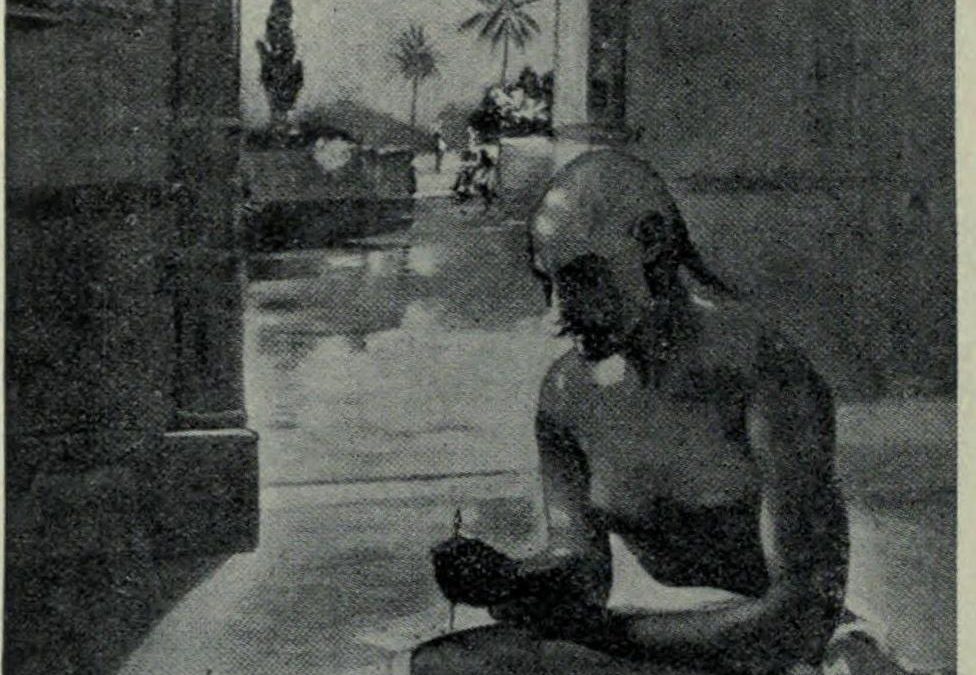
Featured image: Kalidasa composing the Meghaduta, an illustration of the 1920s by William Douglas Almond. Photo by William Douglas Almond, in the public domain, via Wikimedia Commons.